
What Is a Foundry? Metal Casting Operations Explained
A foundry turns solid metal into liquid, then back into a finished part. Here is what actually happens on the floor, and how it differs from fabrication and forging.
In This Guide
What Is a Foundry? A Plain Answer to a Common Question
If you have ever searched “what is a foundry” and come away with a textbook definition that raised more questions than it answered, you are not alone. The short version: a foundry is a workshop where metal is melted into a liquid, poured into a shaped cavity called a mold, and allowed to cool back into a solid part. That finished part is called a casting. Everything a foundry does, from the furnace to the grinding booth, exists to make that one transformation come out clean, dimensionally correct, and strong enough for the job.
That sounds simple, and the basic idea has not changed in thousands of years. Our own operation has been pouring metal since 1888, and the fundamentals a worker followed back then would still be recognizable on the floor today. What has changed is the control. Modern foundry work is far less about brute heat and far more about managing the dozens of small variables that decide whether a casting passes inspection or goes back into the melt as scrap.
The reason the question keeps getting asked is that “foundry” gets used loosely. People apply it to any shop that works with metal, when it really describes a specific process: casting. A machine shop removes metal. A weld shop joins it. A forge hammers it into shape while it is solid. A foundry is the only one of the four that takes metal all the way to liquid and shapes it from there. To learn more about our own foundry services, it helps to first understand the steps every casting moves through.
How a Foundry Works, Step by Step
Start With a Clean Melt
Solid metal is charged into a furnace and brought to a liquid. Before anything is poured, the melt is checked and treated so its chemistry sits inside the target range. A casting can only ever be as good as the metal it started from, so a near defect-free melt is the foundation everything else rests on.
Build the Mold and Cores
A mold holds the negative shape of the part. Most heavy industrial castings are formed in bonded sand, packed around a pattern, with separate sand cores set inside to create internal passages and hollow sections. The mold and cores have to vent gas and hold their shape under the weight and heat of the incoming metal.
Pour Without Turbulence
The liquid metal is poured through a runner system into the cavity. The goal is a smooth, rising fill, never a splashing fall. When the metal surface tumbles, it folds its own oxide skin into the body of the part, seeding hidden defects. A well-designed gating system fills from the bottom and keeps the metal front moving steadily upward.
Solidify and Feed
As the casting cools it shrinks, and that shrinkage has to be fed with extra liquid metal from reservoirs called risers, or the part forms internal voids. Controlling how heat leaves the mold, and in what order each section freezes, is one of the most technical parts of the whole operation.
Shake Out, Finish, and Inspect
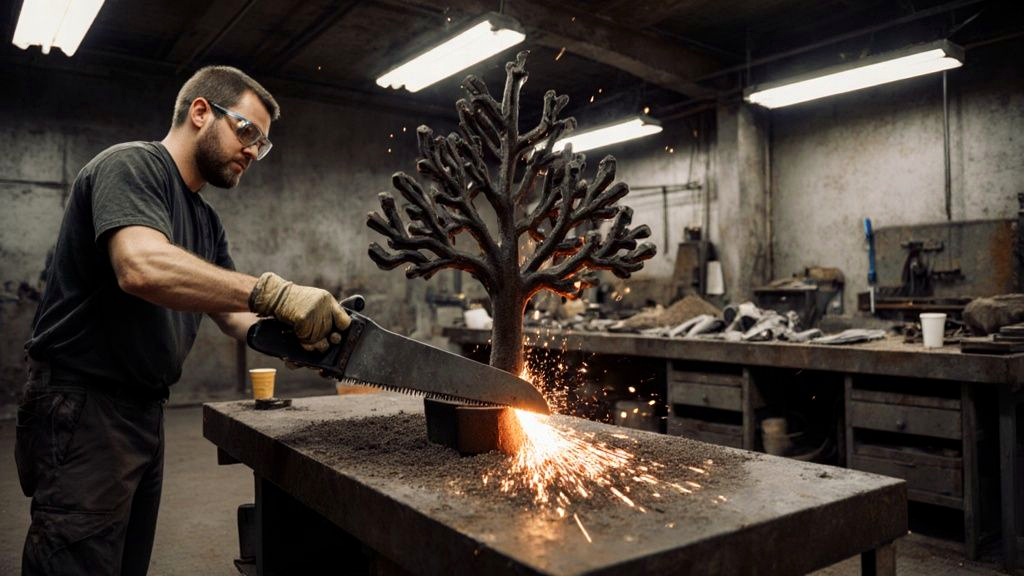
Once solid, the casting is broken free of the sand, the runners and risers are cut off, and the surface is cleaned by grinding or blasting. Finished parts are checked for dimensions and internal soundness before they ship, and many move on to machining for their critical surfaces.
Foundry vs. Fabrication vs. Forging: Why the Difference Matters
The most common reason people look up what a foundry does is to figure out whether they actually need one, or whether a fabrication shop or a forge would serve them better. The three are not interchangeable, and choosing wrong adds cost and delay.
Liquid Metal Into a Mold
- Melts metal fully, then shapes it as a liquid
- Excels at complex shapes, internal passages, and hollow sections
- Cost-effective at volume once the pattern exists
- Handles cast iron and alloys that are hard to work any other way
Solid Metal, Joined or Worked
- Fabrication cuts, bends, and welds solid stock together
- Forging hammers or presses solid metal into shape
- Best for simpler geometries and high-stress directional grain
- No melting, so no mold or pattern is needed
A practical example: if you need a pump housing with curved internal channels, a fabrication shop would have to cut and weld many pieces together, with every joint a potential leak. A foundry pours that channel as one continuous form. On the other hand, a simple steel bracket made in low quantities is often cheaper to cut and weld than to tool up a mold for. The choice comes down to geometry, volume, and the properties the finished part has to deliver. We cover this trade-off in more depth in our breakdown of foundry vs. forging, which walks through where each process wins.
A foundry is the only metalworking path that takes a material all the way to liquid. That single fact is what gives casting its freedom of shape, and also what makes melt quality and pouring discipline non-negotiable.
The Metals a Foundry Pours
Each of these families has its own quirks. Some metals readily absorb gas from a humid environment and release it as porosity when they freeze. Others grow a tough oxide film the instant the surface meets air. A foundry that understands these behaviors melts, treats, and pours each alloy in the way that keeps those defects out of the finished part, rather than treating every metal the same.
What Separates a Good Foundry From a Cheap One
Once you understand what a foundry is, the next useful question is what makes one foundry better than another when the castings look identical on the outside. The answer lives in the variables you cannot see in a finished part, and it is the reason two shops can quote the same job at very different prices and deliver very different results.
Discipline at Every Stage
Good castings come from following a chain of rules where any single broken link can ruin the whole part. Start with a clean, properly treated melt. Keep the metal from tumbling and folding oxide into itself during the pour. Vent the cores so gas escapes instead of bubbling up through the metal. Feed the shrinkage so the inside does not pull apart as it cools. None of these steps is glamorous, and skipping any one of them is invisible until the casting fails in service.
Knowing Why Defects Happen
A cheap foundry treats a rejected casting as bad luck. An experienced one knows that most porosity, cracking, and inclusions trace back to specific, controllable causes: a turbulent fill, a damp tool, a melt held too hot for too long, an oxide skin folded in during pouring. Understanding the mechanism is what lets a shop prevent the defect on the next pour instead of just scrapping parts and hoping. This is the kind of judgment that comes from decades of pouring, and it is a genuine value add that protects a customer’s deadline and budget.
It is also why the relationship matters as much as the equipment. A foundry that has poured metal across many industries can flag a problem in an incomplete drawing before it becomes a scrapped run, and can recommend the alloy and process that fit the application. That experience is hard-won and it shows up in the consistency of the parts. You can read more about that long arc of know-how in the history of foundries and how the craft has carried forward. For projects that pull casting together with machining and finishing under one roof, our work in custom precision manufacturing shows how those stages connect. For the broader engineering context behind these practices, industry bodies such as the American Foundry Society publish standards and research that shape how modern foundries operate.
The Bottom Line on What a Foundry Is
So, what is a foundry? It is the one place in the metalworking world that takes a material all the way to liquid and shapes it into a finished part as it cools. That single capability is what makes casting so versatile, letting a foundry produce complex shapes, internal passages, and tough alloys that no fabrication or forging shop can match the same way.
But the definition is only half the story. The real difference between foundries lies in the discipline behind the pour: the clean melt, the smooth fill, the vented cores, the fed shrinkage, and the hard-earned judgment to know why a defect happens before it ruins a part. Get those right, and a casting comes out strong, accurate, and built to last.
Have a Casting Project in Mind?
From a single prototype to a full production run, our team brings generations of pouring experience to every part. Let us help you cast it right the first time.
Explore Our Foundry Services →
