
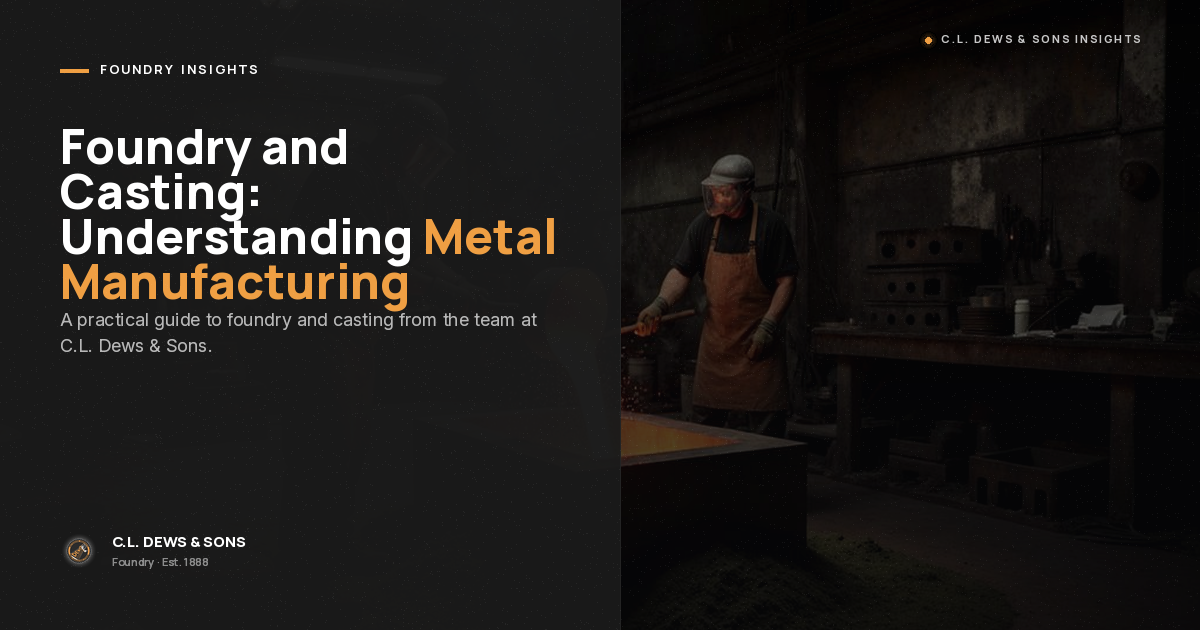
Foundry and Casting: The Essential Guide to Metal Manufacturing
People use the words interchangeably, but they are not the same thing. One is a place. The other is a process. Understanding how they connect tells you a lot about the quality of the parts you buy.
If you have shopped for metal parts, you have probably heard the terms foundry and casting used as if they mean the same thing. They do not. A foundry is a facility, a working shop where solid metal is melted, poured, and turned back into finished components. Casting is the specific process of shaping that liquid metal by pouring it into a mold and letting it solidify. In other words, casting is one of the main things a foundry does, but a foundry is more than a single process. Getting that distinction right helps you ask better questions and buy better parts.
At C.L. Dews & Sons Foundry, we have been pouring metal in Hattiesburg, Mississippi for generations, so this is a conversation we have often. This guide walks through what a foundry actually is, what casting really means, how the two work together, and what separates a shop that produces sound, reliable parts from one that ships porous, cracked castings that fail in service.
Foundry and Casting: What Each Term Actually Means
What Is a Foundry?
A foundry is a manufacturing facility built around the melting and pouring of metal. It houses furnaces to bring iron, steel, aluminum, or bronze up to a liquid state, a molding area where the shapes are prepared, a pouring floor, and a cleaning and finishing area where the raw part is shaken out, ground, and inspected. A full-service operation like ours also runs a pattern shop that builds the tooling and a machine shop that takes the rough casting to final dimensions. So the foundry is the ecosystem: the building, the equipment, the crew, and the accumulated know-how that turns a drawing into a physical part.
What Is Casting?
Casting is the forming process itself. You melt metal, pour it into a cavity shaped like the part you want, and let it cool until it solidifies into that shape. The cavity is the mold, and the pattern is the master model used to create that cavity. Casting is one of the oldest manufacturing methods on earth, and it is still the most efficient way to produce complex shapes, internal passages, and heavy sections that would be wasteful or impossible to machine from a solid block. When someone says they need a part “cast,” they are describing the process. When they say they are sending it to the “foundry,” they are naming the place where that process happens.
Foundry
A facility with furnaces, molding lines, a pouring floor, and finishing equipment. It is where metal is melted and where many processes, casting among them, happen under one roof. A foundry can offer several casting methods, plus machining, grinding, and fabrication.
Casting
The act of pouring molten metal into a mold and letting it solidify into a finished shape. It is a method, not a location. Sand casting, investment casting, and die casting are all specific casting processes a foundry might use depending on the part.
How Foundry and Casting Work Together in Practice
Walk a job through our shop and the relationship becomes obvious. It starts long before any metal is melted. A pattern is made to match the part, allowing for the small amount the metal will shrink as it cools. That pattern is packed in sand to form a mold cavity, and cores are set in place to create any hollow interior features. Only then does the casting step happen: metal is melted to the right temperature, treated and checked, and poured in a controlled stream that fills the cavity cleanly.
After the metal solidifies and cools, the mold is broken open, the part is shaken out, and the gates and risers used to feed metal into the mold are removed. From there the casting moves to grinding, heat treatment if the alloy calls for it, and machining to final tolerances. Every one of those steps lives inside the foundry, but only one of them is the casting itself. That is the heart of the foundry and casting relationship: casting is the moment of shaping, and the foundry is everything that makes that moment produce a part you can trust.

Long before any metal is poured, a pattern is packed into molding sand to form the cavity that will shape the part.
The Core Casting Processes Used in a Modern Foundry
Sand Casting
Metal is poured into a mold packed from bonded sand. It handles almost any size, from small brackets to multi-ton castings, and is ideal for the wear parts and heavy components we produce. Our sand casting process is the workhorse of most industrial foundries.
Investment Casting
A wax pattern is coated in ceramic, then melted out to leave a precise mold. It delivers tight tolerances and smooth surfaces for intricate parts, at a higher cost per piece and usually for smaller components.
Die Casting
Molten metal is forced under pressure into a reusable steel die. It excels at large runs of small, thin-walled parts in alloys like zinc and aluminum, where the tooling cost is spread across many thousands of pieces.
Permanent Mold Casting
Reusable metal molds, filled by gravity rather than high pressure, give better consistency than sand for medium production volumes. It sits between sand and die casting in cost and finish.
The right choice depends on the part. A high-chrome cast iron crusher liner headed for a quarry is a natural sand casting job because of its size and the wear-resistant alloy involved. A small, detailed component in the thousands might justify a die. Part of what a good foundry does is steer you toward the process that fits your volume, your material, and your budget, rather than forcing every job through the one method it happens to own.
What Separates a Quality Foundry From a Basic Casting Shop
Here is the part most buyers never see. Two shops can pour the same alloy into the same shape and get very different results. A casting can look perfect on the outside and hide voids, trapped oxide films, or gas porosity that only reveal themselves when the part cracks under load. The failure of a single step can ruin an otherwise good casting, which is why disciplined foundries treat the whole pour as a chain of controlled decisions rather than a splash of hot metal.
A sound casting is not luck. It is the result of a clean melt, a calm fill, and controlled solidification, in that order, every single time.
Start With a Clean Melt
The metal is prepared, checked, and treated before it ever reaches the mold. Impurities and oxides in the melt travel straight into the part, so bringing the liquid up to a known standard is the foundation everything else rests on.
Fill Without Turbulence
Molten metal that falls too far or churns as it enters the mold folds its own surface skin into the casting, creating built-in cracks. A well-designed gating system keeps the metal front moving smoothly and steadily upward so the surface never gets entrained.
Keep Air and Gas Out
Bubbles from a poorly designed runner or gas released by the cores can pass through the liquid and leave porosity behind. Proper venting, filters, and pouring technique stop those bubbles before they become defects.
Feed the Shrinkage
Metal shrinks as it freezes. Risers and chills are placed so that liquid feeds the thick sections as they solidify, directing any shrinkage cavity out of the part and into a sacrificial reservoir instead.
Verify Before It Ships
Dimensional checks, material testing, and inspection confirm the part is sound. The experience to read a casting and know where trouble hides is what decades on the floor actually buy you.
None of this is visible in a quote. It shows up years later in whether the part is still doing its job. When you evaluate a Hattiesburg foundry and steel fabrication partner, or any supplier, the questions worth asking are about melt control, gating design, and inspection, not just price per pound. For a broader look at industry standards and best practices, the American Foundry Society is a solid neutral resource.
Choosing the Right Foundry and Casting Partner
Once you understand that the foundry is the place and casting is the process, choosing a supplier gets simpler. You are not just buying a casting. You are buying the melt practice behind it, the molding discipline around it, and the finishing and machining that follow. A shop that keeps all of that under one roof controls quality at every handoff, which is exactly why we run our foundry, fabrication, and machine shop together rather than shipping half-finished parts between vendors.
That integration matters most on the parts that cannot fail: crusher wear parts for mining and aggregate operations, bridge components for infrastructure, and custom castings for the machinery that keeps a plant running. When the same team pours the metal, grinds it, and machines it to spec, there is no finger-pointing when something needs to be right. If you are weighing custom metal casting for an industrial application, that continuity is the difference between a part you install and forget and one you spend the next year troubleshooting.
The Bottom Line on Foundry and Casting
Foundry and casting are not competing terms, and they are not interchangeable ones either. The foundry is the facility, casting is the process, and casting is just one of the things a full foundry does. The real story lives in how well a shop controls its melt, its fill, and its solidification, because that is what turns molten metal into a part that lasts.
Understanding that relationship puts you in a stronger position, whether you are specifying a component, comparing quotes, or trying to figure out why a previous casting failed. Ask about the process, not just the price, and you will end up with better metal.
Need a Casting Done Right?
From high-chrome wear parts to custom industrial components, C.L. Dews & Sons Foundry pours, finishes, and machines it all in Hattiesburg. Send us your drawings and let our team quote your next project.
Explore Our Foundry Services →
