
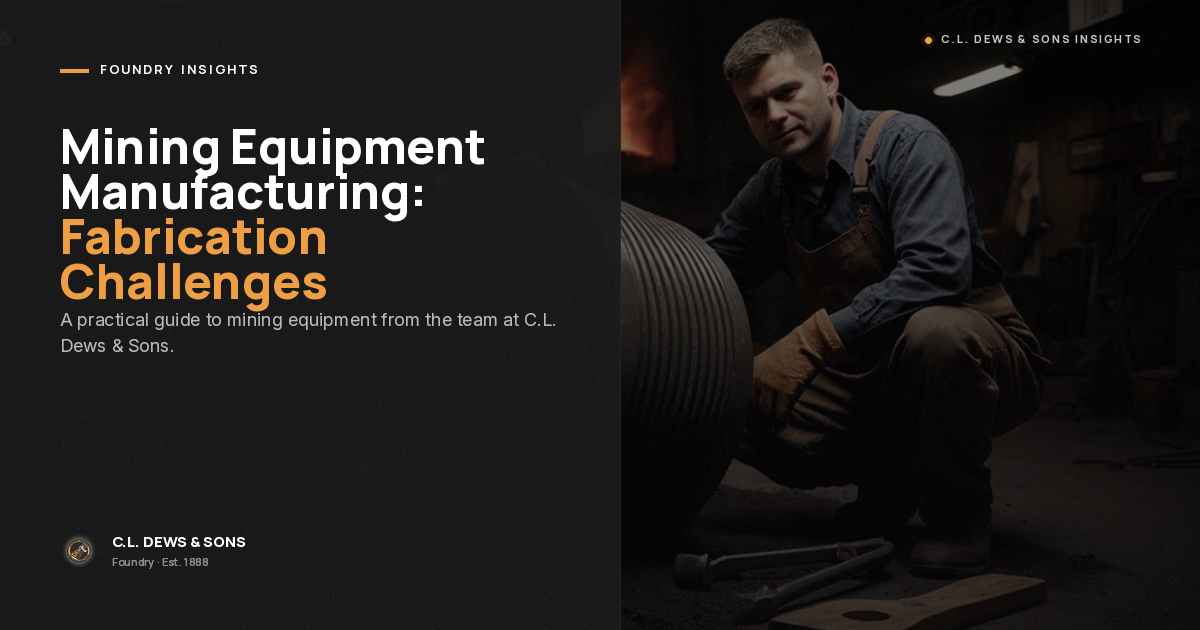
Mining Equipment Manufacturing: A Complete Look at the Critical Fabrication Challenges Behind Proven, Durable Parts
Crushers, screens, and draglines are only as good as the wear-facing castings inside them. Here is what actually makes those parts hard to manufacture, and how we engineer around it.
In This Guide
When people ask what mining equipment is required to run a quarry, a hard-rock mine, or an aggregate operation, the honest answer starts with a familiar list: jaw crushers, cone crushers, impact crushers, vibrating screens, conveyors, draglines, excavators, and haul trucks. But the more useful question, the one that actually decides whether that machinery earns its keep, is how the wear-facing components inside those machines are built. Mining equipment lives or dies on the metallurgy and fabrication behind a handful of parts that absorb the full brunt of rock.
At C.L. Dews & Sons Foundry, four generations of casting and machining in Hattiesburg have taught us one thing clearly: manufacturing a part for mining equipment has almost nothing in common with making a part for a climate-controlled assembly line. The forces are higher, the tolerances unforgiving, and the cost of getting the metallurgy wrong shows up as a torn liner three weeks into a job. This guide walks through the real fabrication challenges and the engineering decisions behind them.
What Mining Equipment Has to Survive
Before any conversation about manufacturing, you have to understand the punishment. The components that fail first in any mining operation are the ones in direct, repeated contact with the rock: jaw plates, cone mantles and concaves, blow bars, hammer tips, screen panels, chute liners, and pump impellers. These parts face three separate attacks at once, and a part engineered for one of them can still fail badly at the others.
The first attack is abrasion, the slow grinding loss of material as hard mineral slides across a surface. The second is impact, the sudden shock load when a fist-sized chunk of ore drops into a crushing chamber. The third is fatigue, the quiet accumulation of microscopic damage from millions of load cycles that eventually splits a part with no warning. A liner that is hard enough to resist abrasion may be brittle enough to shatter under impact. That tension is the whole game in mining equipment manufacturing, and it is why material selection is never a catalog decision.
Environment makes it worse. Wet mineral slurries add corrosion. Temperature swings between a cold morning start and a full production shift add thermal stress. A casting that performs in a lab can behave very differently once it is bolted into a vibrating screen running 20 hours a day. Real durability has to be designed in from the molten metal up, which is exactly where the fabrication challenges begin.
The Core Fabrication Challenges in Mining Equipment Manufacturing
Matching the alloy to the wear mode
High-chrome white iron resists sliding abrasion better than almost anything, but it is brittle. Manganese steel work-hardens under impact and is ideal where shock dominates. Picking wrong is the single most common cause of short part life.
Heavy, uneven section thickness
Crusher parts combine thick wear faces with thin mounting features. Thick sections cool slowly and want to shrink, so feeding the metal correctly to avoid internal voids is a genuine engineering problem, not a pour-and-hope step.
Controlling solidification and shrinkage
As iron freezes it contracts, and graphite precipitation pushes back. Getting that balance right determines whether the core of a thick liner is dense and sound or riddled with porosity that becomes a crack starter under load.
Machining a part harder than the tooling
A finished white iron liner can be harder than standard cutting tools. Final mounting faces and bolt holes still have to hit tolerance, which calls for specialized machining strategies and patience most general shops do not have.
Each of these challenges feeds the next. The alloy you choose dictates how the metal solidifies, which dictates how you have to gate and feed the mold, which dictates how the finished casting machines. This is why we treat a mining component as a single engineered system rather than a shape to be filled with metal. Our specialized foundry services for mining equipment components exist precisely because these decisions cannot be separated from one another.

Choosing the Right Alloy Is Half the Battle
Cast metals for mining run across a wide and frankly daunting spectrum, from grey irons through ductile and compacted graphite irons to the hard white irons used for wear resistance. Carbon is the controlling element. Push carbon and chromium up and you get a structure full of hard iron carbides that shrug off abrasion. That same structure has very little give, so the part needs a design and a duty cycle that keep it out of high-impact situations.
This is where experience separates a good part from a guess. For a cone crusher grinding fine, abrasive material, our high-chrome cast iron wear parts with chromium in the 12 to 30 percent range and hardness up to 700 HB are usually the right call. For a primary jaw crusher swallowing large, blocky feed, a tougher manganese steel that hardens as it works often outlasts a harder but more brittle alternative. There is rarely a universally best metal, only the right metal for that machine, that feed, and that wear mode.
High-Chrome White Iron
- Exceptional resistance to sliding abrasion
- Very high hardness, up to roughly 700 HB
- Lower tolerance for heavy repeated impact
- Ideal for cone liners, slurry pumps, chute plate
Manganese Steel
- Work-hardens at the surface under impact
- Tough core resists cracking and shock
- Stays serviceable through blocky, heavy feed
- Ideal for jaw plates and primary crusher duty
Industry standards capture some of this logic. The abrasion-resistant cast irons we pour are graded against specifications such as ASTM A532, the standard for abrasion-resistant cast irons, which sorts these alloys by composition and intended duty. Standards are a floor, though, not a finish line. The judgment about which class a particular part needs still comes from understanding the machine it goes into.
Why Hardness Alone Will Wreck a Part
The most expensive mistake in this field is treating hardness as the only number that matters. A buyer reads that a competing liner is harder, assumes harder means longer life, and orders it. Three weeks later it cracks clean across a bolt boss, and the unplanned downtime costs more than a season of liners. Hardness governs abrasion resistance. It says almost nothing about whether a part survives impact and fatigue, and in heavy mining machinery those two failure modes do most of the real damage.
Fatigue is the sneaky one. A cast part under cyclic load does not need a long runway to fail. If the casting already contains a small internal defect, that defect behaves like a pre-existing crack, and the part skips straight to crack growth with almost no safe initiation period. In other words, the fatigue life of a poorly made casting is largely just the time it takes an existing flaw to propagate to the surface. That is why two liners with identical hardness and identical chemistry can have wildly different service lives. The difference is internal soundness, and you cannot see it from the outside.
For load-bearing features especially, fracture toughness and freedom from defects predict reliability far better than a hardness reading ever will. We design wear parts so the hard, abrasion-facing material sits where the rock is, while the load paths through the part keep enough toughness to survive the shock. That balance, not a single headline hardness number, is what keeps a part in service.

Casting Integrity: The Defects You Cannot See
If fatigue is the failure mode, internal casting defects are usually the root cause. The most damaging are not the big, obvious voids a foundry would catch and scrap. They are the thin, folded films of oxide that get entrained when liquid metal is allowed to splash, tumble, or surge during the pour. Folded into the metal, these films act as ready-made internal cracks, and they are nearly invisible until the part fails along one.
Avoiding them is a manufacturing discipline, not a quality-control afterthought. It comes down to how the metal is melted, how cleanly it is transferred, and how calmly it is allowed to enter the mold. Quiet, well-fed filling that keeps the liquid surface intact produces dense, sound castings. Turbulent filling produces parts that look perfect and fail early. The same care that prevents these defects also makes a casting more resistant to the corrosion and leakage problems that plague parts handling wet, abrasive slurry, because the surface-breaking films that would otherwise become corrosion sites simply are not there.
This is the invisible half of mining equipment manufacturing. A customer cannot inspect filling discipline by looking at a finished liner, which is exactly why the choice of foundry matters so much. When the part is right, nobody notices. When the filling was careless, the mine notices three weeks in.
Choosing a Manufacturing Partner for Mining Equipment
Because so much of part performance is decided by judgment that never appears on a drawing, the manufacturer you choose for mining equipment is not interchangeable. A capable partner does three things a commodity supplier does not: recommends the right alloy for your specific wear mode rather than the one with the best brochure number, controls the casting process tightly enough to deliver sound parts every time, and finishes those hard castings to real tolerances.
That last piece is its own discipline. Mounting faces, bolt patterns, and bearing seats on a part already hardened for wear still have to fit the machine exactly, which is where precision machining to final tolerances earns its place in the process. A liner that is metallurgically perfect but a sixteenth of an inch out of position fights the crusher frame and wears unevenly from day one.
Dews is not just a supplier, they are a true partner. They provide guidance on complicated or incomplete project details from a lifetime of experience. This insight is a value add that seriously impacts the bottom line. This is a family-owned business that feels like family.
Joseph J., long-time customerThat partnership matters most on the parts that are hardest to get right. For the crushing circuit specifically, our crusher wear parts for mining operations are built around the alloy-to-wear-mode matching, casting integrity, and finish-machining discipline described above, because those are the parts where a poor manufacturing decision is most expensive. Getting them right is the difference between scheduled maintenance and a surprise shutdown.
The Bottom Line on Mining Equipment Manufacturing
The mining equipment that runs a modern operation is only as reliable as the wear-facing castings inside it, and those castings are far harder to make well than they look. The challenges are real: matching the alloy to the actual wear mode, feeding heavy and uneven sections without leaving voids, balancing hardness against the toughness a part needs to survive impact and fatigue, keeping the metal clean enough to avoid the hidden defects that become cracks, and finishing a part harder than the tooling that machines it.
Solve those well and a part runs its full life on schedule. Solve them poorly and the failure shows up at the worst possible time, in the field, mid-shift, with production stopped. That is the whole reason we treat every mining component as an engineered system from the molten metal forward.
Have a Part That Keeps Failing Early?
Tell us the machine, the feed, and the wear you are seeing. Our team will recommend the right alloy and casting approach to put real service life back into your equipment.
Explore Our Mining Wear Parts
