
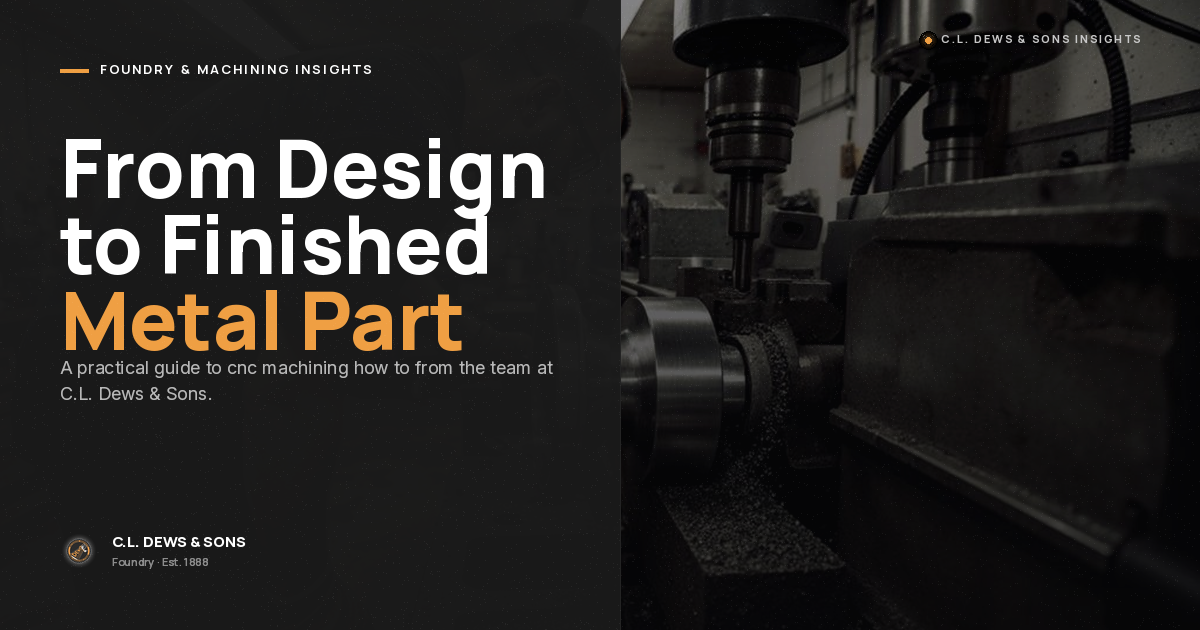
CNC Machining How To: A Step-by-Step Guide to How Metal Parts Are Made
Type “CNC machining how to” into any search bar and you will land on a version of the same question we hear on our shop floor almost every week: how does a rough idea, or a rough casting, actually become a finished metal part you can hold in your hand? It is a fair question, and the answer is more logical than most newcomers expect.
At our Hattiesburg foundry we both pour metal and machine it, so we get to watch parts travel the entire road from a drawing to a shipped component. That vantage point is unusual. Most shops only see one leg of the journey.
This guide breaks the whole process into clear, repeatable steps. By the end you will understand what the machines actually do, why the metal you choose matters as much as the equipment, and where the most common beginner mistakes hide.
- CNC machining is a subtractive process: a computer-guided tool removes material from solid stock or a casting until the finished part is revealed.
- Every part follows the same core path, from CAD design to CAM toolpaths, material setup, cutting, inspection, and finishing.
- Material choice drives everything downstream. The right alloy and a clean casting make machining faster and the finished surface better.
- The biggest beginner mistakes are over-tight tolerances, weak workholding, and skipping the first-article inspection.
- A shop that casts and machines under one roof controls metal quality before the cutting tool ever touches the part.
What CNC Machining Actually Is
CNC stands for computer numerical control. In plain terms, a CNC machine is a cutting tool guided by a computer program instead of a human turning handwheels by feel. The program tells the machine exactly where to move, how fast, and how deep, down to a few ten-thousandths of an inch.
The key word is subtractive. You start with a solid piece of metal, called stock, or a rough casting poured to roughly the right shape. The machine then cuts material away to reveal the finished part. That is the opposite of 3D printing, which builds a part up layer by layer, and different from casting, where molten metal is poured into a mold to take its shape.
Why bother with a computer at all? Repeatability. A skilled operator on a manual machine can make one excellent part. A CNC machine makes the five-hundredth part identical to the first, all day, every day. That consistency is the whole reason modern manufacturing runs on these machines, and it rests on the same CNC machining fundamentals that have guided precision work for decades.
CNC Machining How To: The Process From Design to Finished Part
Any honest CNC machining how to explanation has to start with the drawing, because nothing gets cut until someone defines exactly what the part should be. From there, the sequence is remarkably consistent no matter what you are making.
Step 1. It Starts With a Design
Everything begins with a CAD model, short for computer-aided design. This is the digital blueprint, either a 2D print or a 3D solid model, that defines the geometry, the dimensions, and the tolerances, meaning how much the finished size is allowed to vary from the target. A part called out at 2.000 inches with a tolerance of plus or minus 0.001 inch has to land between 1.999 and 2.001. That single number quietly controls how hard, and how expensive, the whole job will be.
Step 2. Turn the Design Into Machine Instructions
The CAD model then moves into CAM software, short for computer-aided manufacturing. CAM converts the shape into toolpaths, the exact routes the cutting tool will travel, and outputs them as G-code, the coordinate language every CNC machine reads. A machinist chooses the tools, the cutting speeds, and the order of operations. This is skilled work: the U.S. Bureau of Labor Statistics tracks machinists and tool and die makers as a distinct, trained occupation for exactly this reason.

Step 3. Select and Secure the Material
Next comes the metal. Stock might arrive as bar, plate, or a solid block, or, in our world, as a rough casting we poured a few days earlier. The piece has to be held dead still while it is cut, so it gets clamped in a vise, gripped in a lathe chuck, or bolted into a custom fixture. Weak workholding is one of the fastest ways to ruin a part, because any movement under cutting force throws the dimensions off instantly.
Step 4. Let the Machine Cut
Now the machine goes to work, and there are two core motions to understand. In turning, the part spins while a stationary tool shaves it down, which is how a lathe makes round features like shafts and bushings. In milling, the tool spins while the part stays fixed, which is how flat faces, slots, and pockets get cut. Roughing passes hog away bulk material fast, then light finishing passes sneak up on the final dimension and surface. When a part has complex angles, a multi-axis machine moves the tool and part on four or five axes at once to reach every feature in a single setup. If you want that kind of complexity handled in-house, that is exactly what our multi-axis CNC machining services exist to do.
Step 5. Inspect Against Tolerances
A finished-looking part is not a finished part until it is measured. Machinists check critical dimensions with calipers, micrometers, and bore gauges, and for tight work a coordinate measuring machine (CMM) probes dozens of points automatically. If a feature falls outside the tolerance from Step 1, the part is reworked or scrapped. This is where good shops separate themselves: they catch the problem before it ships, not after your line goes down. For a hands-on look at the controls behind these checks, our guide on how to use a CNC machine walks through the operator side in detail.
Step 6. Deburr, Finish, and Ship
Cutting leaves sharp edges called burrs, so parts are deburred by hand or machine. Depending on the job, they may also get a surface finish, a coating, heat treatment, or a plating pass for corrosion resistance. Only then does the part get packed and shipped. That full arc, from CAD file to a boxed component, is the real answer to the CNC machining how to question.
Why the Material Matters as Much as the Machine
Newcomers assume the machine does all the work. In practice, the metal you feed it decides how well, and how fast, the job goes. This is the part of the story most guides skip, and it is where a foundry that also machines has a real advantage.
Take cast iron, a metal we pour constantly. Grey iron is a machinist’s friend: the tiny graphite flakes running through it break the chips into small pieces and act almost like a built-in lubricant, so it cuts cleanly and easily. Ductile iron is far tougher and better for parts that take shock loads, but that same toughness makes it fight the tool a little harder. Choosing the right grade up front changes tool life, cycle time, and the surface finish you can hold.
Then there is casting quality. A hard sand or oxide inclusion trapped in a rough casting can catch the edge of a cutting tool and chip it, or tear out of the surface during a finishing pass and leave a small crater the machinist has to clean up. Gas porosity hidden below the skin can open into a visible pit the moment the cut breaks through it. None of that is the machine’s fault. It is the metal, and it was decided long before the part reached the spindle.

When one company casts the part and then machines it, the metal quality is controlled before the tool ever touches it. Clean pours, the right alloy, and inspected chemistry mean fewer surprises on the machine and a better finished part. That is why we run precision CNC machining and prototyping in the same building where we pour the metal.
CNC Machining How To: Beginner Mistakes to Avoid
Most early frustration with machining comes down to a short list of avoidable errors. If you are specifying parts for the first time, watch for these.
- Over-tight tolerances. Calling out plus or minus 0.0005 inch on a feature that does not need it can double the cost for no functional benefit. Tolerance only where the part actually requires it.
- Ignoring workholding. A part that cannot be held rigidly cannot be cut accurately. Design in a flat, a clamping boss, or a face the machine can grip.
- The wrong material for the job. Picking an alloy for one property while ignoring how it machines leads to slow, expensive runs and short tool life.
- Skipping the first-article inspection. Always measure the first part in a run before committing to hundreds. Catching an error on part one is cheap. Catching it on part three hundred is not.
- Underestimating chips and coolant. Long stringy chips and poor coolant flow damage finishes and tools. It is a real variable, not an afterthought.
None of this requires an engineering degree. It requires talking to your machine shop early, ideally before the design is locked, so the people who will cut the part can flag problems while they are still cheap to fix.
Where Casting and CNC Machining Come Together
The reason we keep coming back to material and single-sourcing is simple: it is where most of the real-world savings and headaches live. A casting that arrives at a separate machine shop with a hidden defect becomes that shop’s problem to discover, with less context and a second purchase order attached. When the same team pours and machines the part, there is one schedule, one quality system, and one group accountable from raw metal to finished component.
“Dews Foundry is the gold standard in steel fabrication, casting and machining. Their product knowledge, communication and quality are always consistent.”
Justin Y., 5-star Google reviewIf you are learning the trade, keep going: read, ask questions, and if you can, watch a real part get cut. The concepts click fast once you see chips fly. And if you have a part that needs to move from a drawing to real metal in your hand, that is exactly the road we run every day.
Have a Part That Needs Casting, Machining, or Both?
C.L. Dews & Sons Foundry pours and machines custom metal parts for industry across the Southeast. Ductile iron, grey iron, brass, bronze, aluminum, and specialty alloys, cast in-house and machined to spec under one roof. Send us your drawings and we will quote them honestly.
Request a QuoteHattiesburg, Mississippi. Casting and machining under one roof.

