
Strong Foundry Glue: Expert Guide to Industrial Bonding Solutions
The strongest bond in a metal shop is rarely one product in a tube. It is a whole family of binders, resins, and structural adhesives, and knowing which one to reach for is the difference between a clean pour and a scrapped part.
In This Guide
What Strong Foundry Glue Really Means on the Shop Floor
Ask a machinist for the strongest glue and they will point you toward a two-part epoxy. Ask a foundry, and the answer gets more interesting. In a working metal shop, strong foundry glue is not one product in a tube. It is a whole family of binders, resins, and structural adhesives that hold sand molds together, lock cores in place, and join finished metal parts without a single weld. Every casting that leaves our floor started life inside a mold held together by exactly this kind of chemistry.
There are really two worlds hiding inside the phrase strong foundry glue, and confusing them leads to expensive mistakes. The first world is the mold: the binder that turns loose sand into a rigid shape strong enough to hold hundreds of pounds of molten iron without collapsing. The second world is assembly: the structural adhesives, epoxies, and anaerobic compounds that join, seal, and repair metal parts after casting and machining are finished.
Both are glue in the loosest sense. Both rely on getting one surface to hold fast to another. But the chemistry, the strengths, and the failure modes are completely different, so a serious shop treats them as two separate disciplines. This guide walks through both, and the practical rules our team uses to pick the right one for the job.
Sand Binders: The Original Strong Foundry Glue
For most of history, the workhorse binder was simple clay mixed with water. Packed around a pattern, this green sand holds its shape well enough to pour iron into, and the natural forgiveness of a clay bond is a big part of why cast iron became a backbone of the industrial revolution. Green sand is cheap, reusable, and still runs in high-volume foundries today. Getting the clay-to-water ratio right is a craft in itself, which is why disciplined sand mold casting remains a core competency rather than an afterthought.
Sodium Silicate: The Low-Cost Chemical Bond
One of the first true chemical binders was sodium silicate, often called waterglass. Blow carbon dioxide gas through sand mixed with sodium silicate and it hardens in seconds into a rigid mold or core. It is inexpensive, low in odor, and environmentally friendly compared with many alternatives, which is why it has stayed in service for decades. The trade-off is breakdown. A silicate bond can be stubborn to shake out after the metal cools, so a foundry balances its speed and low cost against the extra labor of cleaning the finished part.
No-Bake Resin Systems: Strength on Demand
Modern high-production work leans on chemical resin binders, families like furan, phenolic, acrylic, and polyurethane. Mixed with sand and a catalyst, these resins cure at room temperature into molds with excellent surface finish, tight dimensional accuracy, and clean breakdown after the pour. That combination of strength and fine detail is why no-bake resin systems dominate the most demanding jobs.
Every binder has a personality, though. When iron was first poured into some early polyurethane-bonded molds, a new surface defect appeared: a glossy carbon film, now known as lustrous carbon, that formed as the resin broke down under heat. Decades of formulation work have largely tamed that problem, and the lesson stuck with the trade. The strongest foundry glue is not the one with the highest number on a datasheet. It is the one whose cure speed, gas behavior, and breakdown match the specific alloy you are pouring.
Built to Hold, Then Let Go
- Turn loose sand into a rigid, pourable shape
- Must survive the heat and pressure of molten metal
- Have to break down cleanly for easy shakeout
- Clay, sodium silicate, furan, phenolic, polyurethane
Built to Join and Stay
- Bond finished, machined metal parts permanently
- Spread load across the whole joint, not a seam
- Resist vibration, chemicals, and service temperature
- Epoxy, anaerobic compounds, high-temperature repair
The strongest foundry glue is never the product with the biggest bond number. It is the chemistry that fits the metal, the part, and the way the joint will actually be loaded in service.
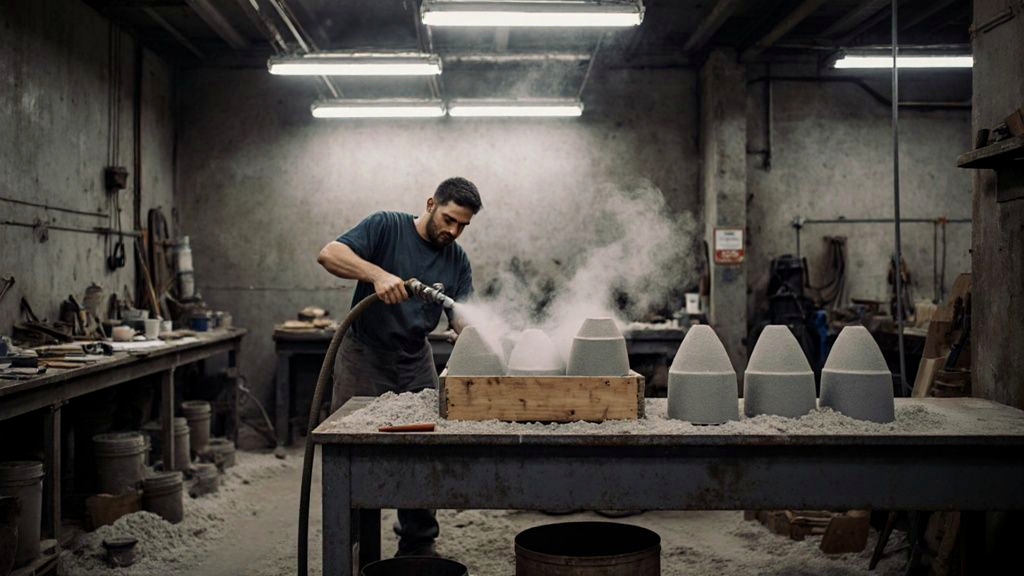
A sodium silicate core hardening in seconds under a carbon dioxide gas line.
High-Strength Structural Adhesives for Metal Fabrication
The structural side of strong foundry glue begins where the casting ends. Once a part is poured, cleaned, and machined, a different kind of bonding takes over. Structural adhesives let a shop join, seal, and repair metal in situations where welding is impractical, would distort a precision surface, or would damage heat-sensitive components nearby.
Structural Epoxies
When people search for the absolute strongest glue, they usually land on two-part structural epoxy, and for good reason. A quality metal-bonding epoxy can develop shear strengths well above 3,000 psi and, unlike a weld, spreads that load across the entire bonded area instead of concentrating it at a single seam. Epoxies also fill gaps, resist harsh chemicals, and electrically isolate dissimilar metals to slow galvanic corrosion. For attaching a wear plate without heat distortion, or bonding steel to aluminum, a structural epoxy often beats both a fastener and a weld.
Anaerobic Adhesives: Threadlockers and Retaining Compounds
Anaerobic adhesives cure only in the absence of air and the presence of metal, which makes them ideal for assembled hardware. Threadlockers keep bolts on vibrating equipment from backing out over thousands of cycles. Retaining compounds lock bearings, bushings, and sleeves into their housings with a grip that can exceed the press fit it replaces, while spreading load evenly around the joint instead of relying on friction alone.
High-Temperature Repair Compounds
Foundries also keep metal-filled and ceramic repair compounds on hand for patching furnace linings, sealing leaks, and rebuilding worn surfaces that see real heat. These specialized adhesives hold at temperatures that would soften ordinary glue, which is exactly what a hot, abrasive environment demands. Used well, they buy time and extend the life of equipment that would otherwise sit idle waiting on a replacement casting.

Two-part structural epoxy bonding a steel wear plate, no heat distortion involved.
Bonding or Welding: Choosing the Right Foundry Glue
Whether the work involves a mold binder or a structural adhesive, our team weighs the same handful of practical questions before committing to any bonding solution. Get these right and the joint quietly does its job for years. Get them wrong and even the most expensive product on the shelf will fail early.
Surface Preparation
Clean, degreased, and properly abraded metal bonds far better than a smooth or oily surface. Most adhesive failures do not start with the glue. They start with a surface that was never ready to hold it.
Load Direction
Adhesives are strongest in shear and compression and weakest in peel and cleavage. We design each joint so the bond carries load the way it is strongest, rather than fighting the direction it hates.
Service Temperature
A compound that is unbeatable at room temperature may soften near a furnace. The adhesive’s rated temperature has to match the real working environment of the part, not the temperature in the shop that day.
Cure Time and Throughput
Fast-setting anaerobics suit an assembly line, while slow, high-strength epoxies suit critical structural joints that can rest in a fixture. Matching cure speed to production rhythm keeps the whole shop moving.
That same discipline runs from the sand up. The judgment that picks a binder for a mold is the judgment that later picks an adhesive for an assembly, which is why we keep casting, machining, and fabrication under one roof. You can see it across our full range of foundry services, our steel foundry operations, and the finishing work handled by our CNC machining team. One continuous chain of material decisions turns raw sand into a finished, dependable part.
The Takeaway: There Is No Single Strongest Glue
There is no one strongest foundry glue that wins every job. The resin binder that builds a flawless mold would be useless for bonding a wear plate, and the epoxy that joins that wear plate would never survive a molten pour. Strength in a foundry is always about fit: the right chemistry, matched to the right metal, loaded the right way.
Master that, and bonding stops being the weak link in a build. It becomes one more variable you control, from the first packed mold to the last assembled part. That is the quiet advantage a four-generation shop in Hattiesburg, Mississippi brings to every casting that leaves the floor.
Need Castings and Fabrication Done Right?
From sand mold to finished, bonded assembly, our team handles the full chain of metal work in one place. Talk to us about the parts your operation depends on.
Explore Our Foundry Services
