
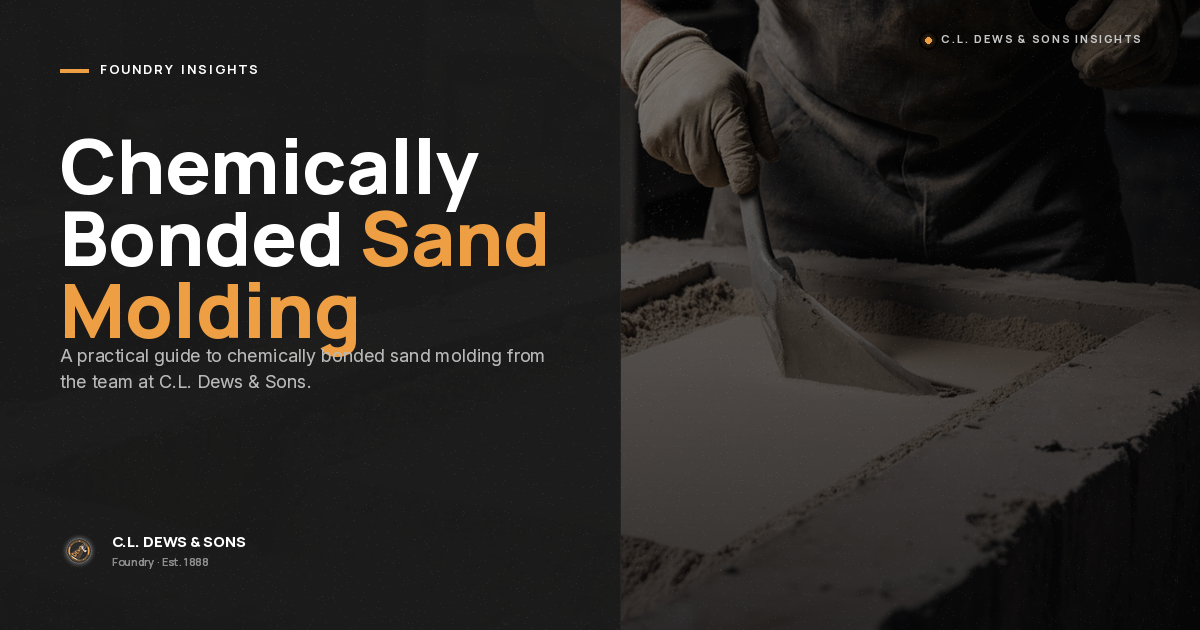
Learn how chemically bonded sand molding works, when no-bake molds make sense, and where this process fits into industrial casting decisions.
Updated September 2026
Chemically bonded sand molding, often called no-bake molding, is a sand casting method that mixes sand with a resin binder and a catalyst so the mold hardens through a chemical reaction at room temperature, instead of relying on clay and water. The result is a rigid mold that can support more complex geometry, better dimensional control, and cleaner casting detail than many standard molding methods.
No casting method is automatically the best choice for every job. Green sand, shell molding, permanent molds, and other processes all have their place depending on part size, alloy, production volume, required finish, wall thickness, core complexity, machining needs, and total cost.
For industrial castings, mold selection directly affects scrap risk, cleanup time, dimensional repeatability, and whether the finished part can perform as intended. Chemically bonded sand molding earns its value when a casting requires a stronger, more stable mold than a basic sand mold can reliably provide.
What Chemically Bonded Sand Molding Means

Chemically bonded sand molding in action, from prepared no-bake molds and pouring to finished industrial cast components.
In traditional green sand molding, sand is held together with a clay-and-water mixture. In chemically bonded sand molding, the sand is mixed with a resin binder and a catalyst or hardener. Once mixed, the binder reacts chemically and hardens at room temperature. That hardened sand forms a strong mold cavity or core that can receive molten metal.
Because the mold does not rely on moisture for strength, chemically bonded sand molds can provide greater mold rigidity and dimensional stability. This is why the process is often used for castings with more demanding geometry, larger sections, internal cavities, or features that need to hold their shape throughout pouring and solidification.
The term “no-bake” comes from the fact that the mold hardens without being baked in an oven, which is why the process is also called no-bake sand casting. The chemical reaction does the work. Depending on the binder system, the mold may cure in minutes or take longer before it is ready for handling, coating, assembly, and pouring.
How the No-Bake Molding Process Works
The process starts with the casting requirements, not with the sand. Before a foundry chooses chemically bonded molding, it has to understand the part drawing, alloy, wall sections, expected tolerances, pattern condition, core needs, and inspection requirements.
A typical chemically bonded sand molding workflow looks like this:
1. Review the Casting Design
The foundry reviews the drawing, pattern, alloy, machining stock, tolerances, and any areas where mold movement or core shift could create problems.
2. Select the Sand and Binder System
Sand grain size, binder type, catalyst level, and mold coating all influence mold strength, finish, gas behavior, and shakeout.
3. Mix the Sand, Binder, and Hardener
The binder system must be mixed evenly. Poor mixing can create weak mold areas, inconsistent curing, or casting defects. In a typical no-bake molding system, a continuous mixer meters sand, resin, and catalyst and discharges straight into the flask, so the mix is placed while it is still workable.
4. Form the Mold Around the Pattern
The sand mixture is packed or placed around the pattern to create the mold cavity. Cores may also be made using chemically bonded sand when internal passages or recesses are required.
5. Allow the Mold to Cure
The chemical reaction hardens the sand. Once cured, the mold can be stripped from the pattern and prepared for assembly.
6. Apply Coating if Needed
Mold coatings may be used to improve surface finish, control metal penetration, or protect the mold surface during pouring.
7. Assemble, Pour, Cool, and Shake Out
The mold is closed, molten metal is poured, the casting solidifies, and the sand is broken away after cooling.
8. Clean, Inspect, and Machine
The casting may require riser removal, shot blasting, grinding, dimensional inspection, heat treatment, or machining depending on the final application. At Dews, cleaning, grinding, and CNC machining happen in the same Hattiesburg facility as the pour.
If you want a broader view of how sand molds are built and poured, our guide to sand mold for metal casting explains the full mold-making process from pattern preparation to final casting quality.
Common Binder Systems Used in Chemically Bonded Sand
Different foundries use different binder systems depending on the alloy, casting size, environmental controls, production requirements, and equipment available. The most common systems include:
Phenolic Urethane No-Bake
Phenolic urethane no-bake systems are widely used because they cure at room temperature and provide strong molds with good dimensional control. They are common in jobbing foundries and are often used for medium and large castings where mold stability is important.
The process can produce good surface finish and accurate mold detail, but it requires careful control of binder levels, catalyst levels, sand temperature, and working time. Too much or too little binder can create quality problems, increase gas risk, or make shakeout harder than necessary.
Furan No-Bake
Furan binder systems are another common chemically bonded option. They can provide strong molds and are often used in ferrous casting applications. Furan systems can work well for larger molds, but they require proper handling and process control.
As with any chemical binder, the foundry must manage odor, emissions, curing behavior, sand reclamation, and worker safety requirements.
Sodium Silicate Systems
Sodium silicate, sometimes called water glass, is an inorganic binder that can be hardened through chemical or gas processes. It has advantages in some applications because it avoids certain organic binder emissions, but it can also create challenges with shakeout and sand reclamation if not properly controlled.
The best binder is not the one that sounds most advanced. The best binder is the one that fits the casting, alloy, mold size, finish requirement, production volume, and foundry process.
Chemically Bonded Sand vs. Green Sand

Green sand remains one of the most useful and cost-effective molding methods in metal casting. Any article that treats green sand as outdated junk is not telling the truth. Green sand is fast, economical, reusable, and well suited for many production castings.
Chemically bonded sand molding simply solves a different problem.
Green sand depends on compacted sand, clay, and water. It works well when the mold can be made and handled without excessive risk of deformation, erosion, or dimensional movement. Chemically bonded sand uses a resin system to create a stronger mold, which can be useful when the casting is larger, more complex, or more sensitive to mold movement.
Here is the practical comparison:
| Factor | Green Sand Molding | Chemically Bonded / No-Bake Molding |
|---|---|---|
| Binder system | Clay and water | Resin binder and hardener |
| Mold strength | Good for many standard castings | Higher rigidity after curing |
| Production fit | Often strong for repeatable production | Strong for low-to-medium volume and complex work |
| Surface finish | Good to moderate | Often better, depending on sand and coating |
| Tooling cost | Usually lower | Moderate, depending on pattern and process |
| Complexity | Good for many shapes | Better for complex geometry and larger molds |
| Main tradeoff | Moisture control and mold handling | Binder cost, gas control, reclamation, and emissions |
For a deeper look at where green sand still makes sense, see our guide to the metal casting green sand process.
When Chemically Bonded Sand Molding Is the Right Choice
Chemically bonded sand molding is usually worth considering when the casting needs more control than a basic mold can reliably provide.
It is often a strong choice for:
Large Castings
Useful when mold rigidity matters and the mold needs to hold its shape through handling, assembly, and pouring.
Low-to-Medium Volume Parts
A practical fit for industrial jobs where flexibility and mold control matter more than maximum production speed.
Complex Geometry
Helpful for castings with difficult shapes, internal features, cores, or sections that need stronger mold support.
Replacement Parts
Valuable when dimensional accuracy affects fit, machining, installation, or the service life of the final component.
Better Pre-Machining Finish
Can improve mold detail and surface quality before cleanup or machining, depending on sand, coating, and process control.
Higher Scrap-Risk Jobs
Worth considering when mold movement, core shift, or poor dimensional control could make a failed pour expensive.
This process can be especially useful for industrial replacement parts, pump components, housings, wear parts, machine bases, and castings where the cost of a failed pour is too high to gamble on a weaker mold.
The value is not just “better finish.” The real value is process control. A rigid chemically bonded mold can reduce movement, improve repeatability, and help the finished casting stay closer to the intended dimensions.
Need Help Choosing the Right Casting Method?
Send Dews Foundry your drawing, alloy requirement, quantity, and application details. We can help evaluate whether chemically bonded sand molding, green sand, or another process makes the most sense for your part.
Request a Casting ReviewWhen Chemically Bonded Sand Molding Is Not the Right Choice
No-bake molding is not magic. It has real limits, and ignoring them is how bad casting decisions happen.
It may not be the best choice when:
- The casting is simple and green sand can handle it at lower cost.
- Production volume is high enough to justify another process.
- The part does not need the extra mold strength.
- Binder cost would outweigh the quality benefit.
- The design has not been reviewed for gas, feeding, or shrinkage risk.
- The foundry does not have the equipment or process control to run the binder system correctly.
Chemically bonded sand also creates more process variables than some buyers realize. Binder percentage, catalyst level, sand condition, mold temperature, work time, strip time, venting, coating, and pouring practice all matter. If those variables are not controlled, the process can create defects instead of preventing them.
A stronger mold is useful only when the whole casting process is managed correctly.
Casting Defects This Process Can Help Reduce
A chemically bonded mold can help reduce certain casting problems when the application is a good fit.
Mold Movement
Because the mold cures into a rigid form, it can better resist movement during handling, assembly, and pouring. That can help with dimensional consistency.
Poor Surface Detail
No-bake molds can hold detail well, especially when paired with the right sand grain size and coating. This can reduce cleaning time and improve the starting condition before machining.
Core Shift
Chemically bonded cores can be strong and dimensionally stable. That matters when the casting has internal passages, pockets, or geometry where core movement would ruin the part.
Mold Erosion
A stronger mold face can help resist erosion during pouring, although gating design and metal flow still matter. A bad gating system can damage even a well-made mold.
Excessive Machining Stock
When the mold holds shape more accurately, the casting may require less cleanup or machining stock. That does not eliminate machining, but it can make the downstream work more predictable.
Defects and Risks It Can Still Create
This is where many weak articles lie by omission. Chemically bonded sand molding can reduce some risks, but it can also create others.
Gas Defects
Chemical binders can generate gas during pouring. If the mold or core is not vented properly, that gas can become trapped and create porosity or surface defects.
Core Blows
A core blow happens when gas from a core pushes out through the liquid metal and leaves bubbles or a cavity in the casting. Resin-bonded cores give off gas as the binder breaks down in the heat of the pour, so each core has to have a low enough gas content, be vented so the gas escapes through the core print instead of through the metal, or both. Casting engineering practice also rules out patching cores and molds with impermeable clay-based repair paste, which blocks that escape path.
Turbulent Filling
A rigid mold protects the cavity, not the metal. When liquid metal enters too fast, its surface oxide can fold into the casting and leave films that later open up as porosity or cracks. The casting engineering reference we work from puts the critical in-gate velocity near 0.5 meters per second for most liquid metals, and closer to 0.4 meters per second for iron, steel, and bronze. That is why a no bake foundry still has to design the gating and control the pour. The mold cannot correct metal that was damaged on the way in.
Poor Shakeout
Some binder systems make shakeout more difficult if binder levels are too high or the process is poorly controlled. That can increase cleaning time and cost.
Binder-Related Surface Defects
Incorrect binder levels, uneven mixing, or poor curing can affect mold strength and surface quality.
Sand Reclamation Challenges
Chemically bonded sand may require more attention during reclamation than green sand. The foundry has to manage spent binder, sand reuse, and process consistency.
Safety and Exposure Concerns
Foundry work involves real safety considerations, including dust, heat, molten metal, and chemical handling. Industrial sand used in foundry operations can be a source of respirable crystalline silica exposure, which is why OSHA provides guidance on crystalline silica for workplaces that handle silica-containing materials.
Good foundry practice is not just about making the mold. It is about controlling the process safely and consistently from sand handling to shakeout.
Design Considerations Before Choosing No-Bake Molding
Before a buyer or engineer specifies chemically bonded sand molding, the casting design should be reviewed for manufacturability. The molding method can help, but it cannot rescue a poor design by itself.
Important design factors include:
Wall Thickness
Large changes in wall thickness can create feeding and shrinkage problems. A stable mold helps, but the casting still needs proper risers, gates, and solidification planning.
Draft and Pattern Condition
Patterns must allow the mold to be stripped cleanly. If the pattern is worn, damaged, or poorly designed, the mold will copy those problems. Dews builds patterns for custom castings in its own pattern shop, so pattern questions are handled in the same building as the casting.
Core Requirements
If the casting needs internal cavities, the core package becomes critical. Chemically bonded cores can be useful, but they must be supported, vented, and located correctly.
Machining Allowance
A casting that will be machined after pouring needs proper stock allowance. Too little stock risks cleanup failure. Too much stock wastes time and material.
Alloy Selection
The metal being poured affects shrinkage, pouring temperature, mold coating choice, and defect risk. A mold that works well for one alloy may need adjustment for another.
Inspection Requirements
The more demanding the inspection, the more important the front-end process review becomes. Dimensional checks, hardness requirements, surface finish expectations, and machining requirements should be discussed before production starts.
How Dews Foundry Looks at Mold Choice
At Dews Foundry, the molding method is not selected because one process sounds better in a brochure. It is selected based on the part.
A casting for mining, construction, recycling, industrial repair, or equipment maintenance has to survive real service conditions. That means the foundry has to look at the geometry, alloy, wear expectations, machining needs, and whether the mold can produce the part consistently enough to justify the cost.
That review happens with the downstream work in view. C.L. Dews & Sons has poured metal in Hattiesburg since 1941, and the same facility handles pattern making, casting, cleaning, and machining. High-chrome cast iron crusher wear parts, ductile iron and cast steel components, and castings that need flat, parallel faces from Blanchard grinding all start with the same question: which mold will produce this casting reliably.
Chemically bonded sand molding becomes attractive when mold rigidity, dimensional control, and complex geometry matter enough to offset the added binder and process cost. Green sand remains practical when the part can be made reliably with a faster, more economical mold. The right answer is the process that produces the casting correctly, repeatably, and at a cost that makes sense.
The Real Decision
This is not “old process vs. new process.” It is not “green sand vs. no-bake” as a popularity contest. The right mold is the one that gives the casting the best chance to meet the job, hold the required dimensions, and perform in the field.
Frequently Asked Questions About Chemically Bonded Sand Molding
Is chemically bonded sand molding the same as no-bake molding?
In many foundry discussions, yes. No-bake molding is a common type of chemically bonded sand molding where the sand hardens through a chemical reaction at room temperature instead of being baked in an oven.
Is no-bake molding better than green sand?
Not always. No-bake molding can offer better mold rigidity and dimensional control, but green sand is often more economical and efficient for many standard castings. The best process depends on the casting design, volume, alloy, and quality requirements.
What metals can be poured into chemically bonded sand molds?
Chemically bonded sand molds can be used with many cast alloys, including iron, steel, bronze, brass, and aluminum, depending on the foundry’s capabilities and process controls.
Does chemically bonded sand molding improve surface finish?
It can. A rigid mold, controlled sand grain size, and proper coating can improve surface finish. However, final surface quality also depends on gating, pouring temperature, alloy behavior, mold coating, and cleanup.
Is chemically bonded sand molding good for large castings?
Yes, it is often useful for large or complex castings because the cured mold can provide greater strength and stability. That said, the casting still needs proper engineering, feeding, venting, and handling.
Does no-bake molding eliminate casting defects?
No. It can reduce certain risks, but it does not eliminate defects. Gas, shrinkage, inclusions, poor venting, bad gating, and design problems can still cause failures.
Ready to Review Your Casting Project?
Share your part drawing, alloy requirements, quantity, tolerances, and application details with Dews Foundry. We will help determine whether no-bake molding, green sand, or another casting process is the right fit.
Contact us now
