
Sand Mold for Metal Casting: A Proven, Complete Step-by-Step Guide to the Sand Casting Process
From pattern-making and coreboxes to pouring molten alloy, a sand mold for metal casting is the oldest and still most versatile production route in heavy industry. Here is how the process actually works, what each material does, and where the method delivers the most value.
In This Guide
What a Sand Mold for Metal Casting Really Is
Sand casting is one of the oldest metal-forming processes still widely used in modern manufacturing, and for good reason. The molding material is relatively economical, patterns can be reused, and the process can accommodate everything from individual castings to production runs of cast iron, steel, brass, bronze, and aluminum components. Many wear parts, pump housings, valve bodies, gear blanks, and other industrial components can be produced using sand molds.
Sand casting remains especially important because of its versatility and broad range of applications. The American Foundry Society identifies sand casting as by far the most prevalent casting technique. Sand is used to form the external shape of a casting and can also be used to create cores for internal passages and cavities.
Why Sand Is the Workhorse Mold Material
Silica sand handles temperatures north of 3,000°F, holds its shape under the weight of molten steel, and can be reclaimed and reused after every pour. No other mold medium combines that thermal range, mechanical strength, and economy. Investment casting, die casting, and permanent mold processes each have their place, but none of them match sand for large parts, complex internal geometry, or short-run flexibility.
The Materials Inside the Mold
A working sand mold is more than a pile of sand. The recipe controls how the cavity holds its shape, how cleanly the part releases, and how the surface of the casting turns out. Four ingredients matter most.
Silica Base Sand
Round-grain silica is the structural backbone, sized between AFS 50 and AFS 80 grain fineness for most ferrous work. Finer sand yields a smoother casting; coarser sand vents better and resists thermal shock.
Clay or Chemical Binder
Bentonite clay holds green-sand molds together with water alone. Chemically bonded systems use phenolic, furan, or sodium-silicate resins for higher strength and tighter dimensional control on critical work.
Water or Catalyst
Green-sand molds rely on moisture between 2 and 4 percent to activate the clay. No-bake systems trade water for a chemical catalyst that hardens the binder at room temperature.
Additives and Coatings
Sea coal, cellulose, and refractory wash coatings reduce burn-on, improve surface finish, and prevent metal penetration into the sand on heavy steel and high-chrome iron pours.
Different shops favor different recipes. Green-sand systems dominate high-volume iron foundries because they are fast and inexpensive to recycle. No-bake or air-set systems are the standard for steel castings, large parts, and any work where surface finish and dimensional accuracy outweigh raw production speed. At our foundry we run both, choosing the system that fits the alloy and the customer’s specification rather than forcing every job into a single line.
Step-by-Step: How a Sand Mold for Metal Casting Is Built and Poured
Pattern and Coreboxes
A craftsman or CNC machinist builds a pattern that mirrors the finished part, oversized to account for shrinkage as the metal cools. Separate coreboxes shape any internal cavities the casting requires.
Mold Packing
Prepared sand is rammed around the pattern inside a two-piece flask, called the cope (top) and drag (bottom). Compaction must be uniform, dense enough to hold detail but vented to release gas.
Pattern Removal and Core Setting
The flask is split, the pattern is drawn cleanly out of the sand, and any cores are positioned into the cavity. Gates, runners, and risers are added so molten metal can flow in and feed shrinkage.
Mold Closing and Pouring
The cope is lowered onto the drag, clamped or weighted, and the molten alloy is poured at a controlled rate from a ladle. Pouring temperature is alloy-specific and tightly monitored.
Solidification and Shakeout
The casting cools inside the mold until it is structurally sound, then the sand is broken away on a vibrating shakeout table. The sand is reclaimed; the casting moves to finishing.
Cleaning, Heat Treat, and Inspection
Gates and risers are cut off, surfaces are blast cleaned, and the casting is heat treated to its required mechanical properties. Final inspection verifies dimensions and integrity before shipment.
The pattern, the binder system, and the pouring temperature decide whether a casting comes off the line as a finished part or as scrap. Everything else is downstream of those three choices.
Common Sand Casting Alloys and Where They Excel
Sand casting is alloy-agnostic in a way few other processes are. Almost any metal that can be melted in a furnace can be poured into a properly prepared cavity, which is why the same shop floor can produce a brass valve, a ductile iron pump body, and a manganese steel crusher liner on the same day.
| Alloy Family | Common Grades | Where It Wins |
|---|---|---|
| Gray Cast Iron | Class 30, 35, 40 | Engine blocks, machine bases, pump housings. Excellent vibration damping and machinability. |
| Ductile Iron | 65-45-12, 80-55-06 | Crankshafts, gearboxes, pressure pipe. Tensile strength close to steel at lower cost. |
| Carbon & Alloy Steel | 1020, 1045, 4140, 8620 | Heavy mining components, structural fittings, anything requiring weldability and toughness. |
| High-Manganese Steel | ASTM A128 grades | Crusher mantles, jaw plates, impact hammers. Work hardens under impact for extreme wear life. |
| High-Chrome White Iron | 15Cr-3Mo, 25Cr | Slurry pump parts, mill liners, abrasive aggregate handling. Outstanding abrasion resistance. |
| Brass & Bronze | C84400, C90300, C95400 | Bushings, marine fittings, valve bodies. Corrosion resistance and bearing properties. |
The alloy choice drives every other variable in the process: pouring temperature, riser placement, mold material, cooling rate, and post-pour heat treatment. A foundry that pours the full range of grades, including high-chrome and manganese, has the metallurgical depth to handle critical industrial work that single-alloy shops cannot.
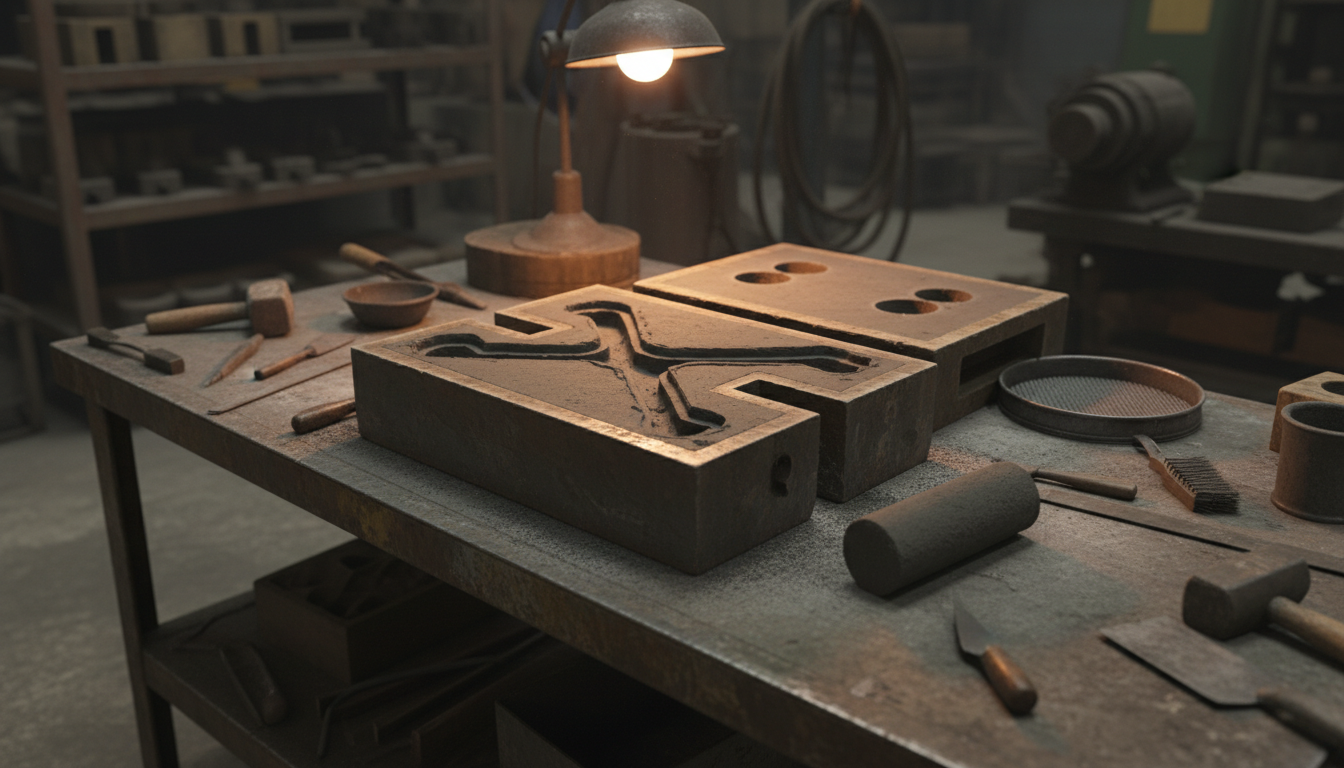
A packed sand mold opened to reveal the cavity, gating, and core prints, the foundation of every successful pour.
Tolerances, Surface Finish, and Quality Control
Sand castings are not as dimensionally precise as machined parts straight off the pattern, and they are not meant to be. Standard sand-cast tolerances run plus or minus 1/32 inch on small features and plus or minus 1/16 inch or wider on larger dimensions, governed by ISO 8062 and the shop’s pattern allowance practice. Surface finish typically falls in the 250 to 500 microinch RMS range, depending on sand grain size and binder system.
That is exactly why integrated foundry-and-machine-shop operations exist. The casting brings the part to near-net shape with the alloy and metallurgical properties the application demands; finish machining brings the critical features into final tolerance. On heavy industrial parts, this combination is dramatically more economical than machining the full geometry from billet stock.
Quality Control That Catches Problems Early
Modern foundries run multiple checks: spectrographic analysis of every melt to verify chemistry, sand testing for moisture and compaction strength, ultrasonic and magnetic particle inspection for internal defects, and dimensional layout against pattern drawings. When you specify a casting, ask the supplier what their first-article inspection looks like. That answer separates serious foundries from order-takers.
Industries That Depend on Sand Casting
Sand casting feeds nearly every heavy-industrial supply chain in North America. The reason is simple: when a part is large, structurally complex, or required in a specialty alloy, no other process competes on cost or capability.
Mining & Aggregate Processing
Crusher mantles, bowl liners, jaw plates, mill liners, and pump parts in manganese and high-chrome alloys. The single largest market for heavy industrial castings.
Heavy Equipment & Construction
Excavator buckets, track components, hydraulic housings, counterweights, and structural fabrications. Sand casting is the only economical route for these size classes.
Energy, Pumps & Valves
Valve bodies, pump volutes, impellers, manifolds, and flange fittings rated for pressure, heat, and corrosive service. Bronze and stainless grades are routine.
Industrial Machinery & Custom Fabrication
Gearbox housings, machine bases, brackets, pulleys, and replacement parts for legacy equipment where the original supplier is long gone but the pattern can still be re-cast.
Beyond the mainstream, sand casting also supports railroad fittings, agricultural implements, marine hardware, and architectural metalwork. Anywhere a designer needs a complex shape in a tough alloy and does not need aerospace-grade tolerances on every surface, sand casting is the answer.
Choosing a Foundry for Your Sand Casting Project
Selecting the right foundry shapes the cost, lead time, and reliability of every part you ship. Three factors separate dependable suppliers from the rest.
Alloy Range and Metallurgical Depth
A shop that pours only one or two grades will quote everything in those grades, even when a different alloy would serve the application better. Look for foundry services for metal casting that cover the full spectrum from gray and ductile iron through high-manganese and high-chrome wear alloys, with documented melt-chemistry control on every heat.
Pattern, Casting, and Machining Under One Roof
Every handoff between vendors adds cost, lead time, and risk of miscommunication on datums, tolerances, and inspection criteria. A vertically integrated supplier that builds patterns, packs molds, pours metal, and finish machines the casting on the same site keeps the part traceable from raw sand to shippable product. As a Hattiesburg foundry specializing in steel casting, our pour floor and machine shop share the same building, the same quality system, and the same scheduling team.
Track Record on Critical Parts
Ask for case studies on parts similar to yours: alloy, weight class, complexity, and end-use environment. A foundry with decades of work on mining wear parts, pump components, or heavy industrial castings has solved the failure modes a newer shop is still learning about. Longevity in this trade is a quality signal, not a marketing one.
The cheapest casting quote is rarely the lowest total cost. Pattern fit, alloy chemistry, machining allowance, and inspection discipline all show up later, in field performance and warranty rates.
Conclusion: Sand Casting Is a Mature Process That Still Sets the Standard
For more than a century, the sand mold for metal casting has been the dominant route for heavy industrial parts, and the reasons have not changed. The mold material is cheap and recyclable, the process accepts almost any alloy, and the resulting castings hit a sweet spot of strength, complexity, and cost that no competing method has dislodged.
What has changed is the discipline behind the process. Modern foundries combine traditional craft with chemically bonded sands, computer-controlled melt chemistry, in-process inspection, and integrated finish machining. When all of those elements come together under one roof, the result is a part that arrives ready to install, performs to specification, and lasts in service longer than the cheaper imported alternative. That is the standard a serious sand casting partner should hold itself to, and it is the standard worth specifying when you are sourcing critical industrial parts.
Need Castings for Your Next Industrial Project?
From single prototypes to long production runs in iron, steel, manganese, and high-chrome alloys, our integrated foundry and machine shop deliver the parts your operation depends on.
Request a Casting Quote
