

What is a Bridge Bearing? A Practical Guide for Bridge and Highway Projects
Learn how bridge bearings support loads, control movement, and help protect bridge and highway structures from stress, wear, and long-term performance issues.
Bridge and highway projects depend on many components most drivers never notice. Girders, decks, piers, and abutments usually get the attention, but bridge bearings are just as important to long-term performance. If your team is asking what is a bridge bearing, the practical answer is that it is the support device that helps a bridge carry loads while still allowing the controlled movement every bridge experiences.
For contractors, engineers, agencies, and infrastructure buyers, understanding what is a bridge bearing is practical. It affects fabrication details, installation planning, inspection access, maintenance costs, and service life. A poorly selected, fabricated, installed, or maintained bearing can create stress where the bridge was not designed to handle it.
What is a Bridge Bearing?
A bridge bearing is a structural device placed between the bridge superstructure, such as the deck and girders, and the substructure, such as piers and abutments. In simple terms, what is a bridge bearing? It is the engineered connection point that transfers loads from the bridge span into the supports below. It also allows controlled movement from traffic, temperature changes, braking, wind, settlement, and other forces so stress does not build up in the deck, girders, or supports.
A complete answer to what is a bridge bearing should also include bridge articulation: the planned arrangement of fixed, guided, and expansion supports. This plan determines which supports restrain movement and which allow movement. Without the right layout, a bridge can bind, shift, crack, or wear prematurely.
Key Functions of Bridge Bearings in Bridge Structures
The main purpose of a bridge bearing is to transfer loads and control movement between the bridge superstructure and substructure. In service, it supports vertical loads, allows rotation, and either permits or restrains horizontal movement based on the bridge design. This is why what a bridge bearing is should not be treated as a generic pad or plate, but as an important part of the bridge’s load path and alignment system.
Facilitating Thermal Expansion
Temperature changes cause bridges to expand and contract, especially on longer spans. Bearings accommodate this movement, so excessive force is not pushed into the piers, abutments, or deck. This is why engineers consider what is a bridge bearing early in design, making sure the bearing type and movement capacity match the bridge’s temperature range, span, geometry, and support layout.Supporting Vehicular Loads
Bridge bearings help carry both dead loads, such as the weight of the bridge, and live loads, such as vehicles, pedestrians, and maintenance equipment. They transfer these loads from the superstructure into the substructure safely and predictably. On highway bridges, properly selected bearings also support repeated traffic loading while allowing the required rotation and movement at the supports.Controlling Dynamic Forces
Bridges face dynamic forces from traffic, wind, braking, and, in some areas, seismic activity. Standard bridge bearings help manage movement and force transfer, but they are not automatically seismic isolation devices. Specialized seismic isolation bearings are used only when earthquake design requirements call for them, which keeps the explanation of what is a bridge bearing accurate and not overpromised.Common Types of Bridge Bearing
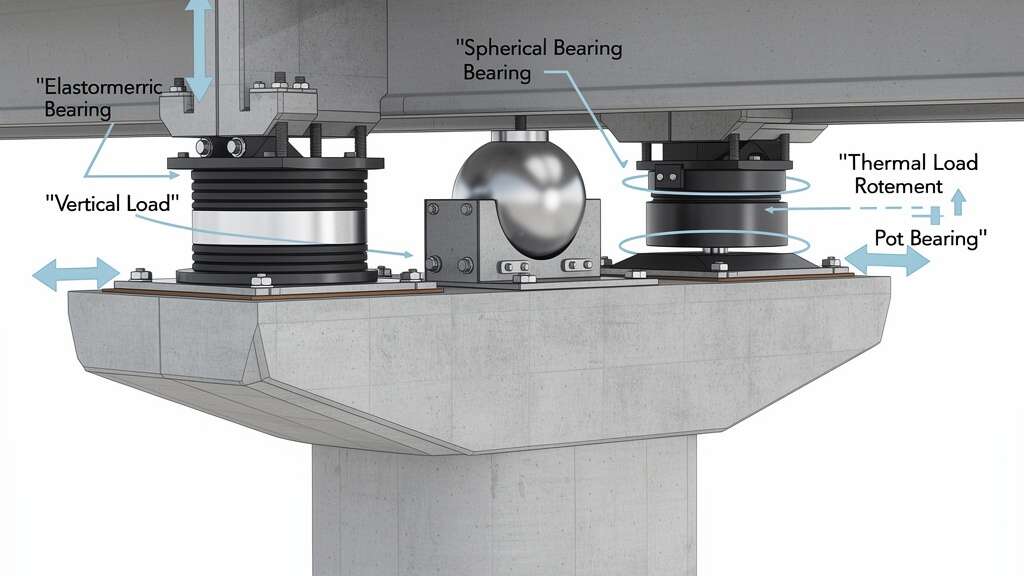
Diagram showing common bridge bearing types and how they support vertical loads, rotation, and thermal movement between the bridge superstructure and substructure.
Bridge bearings are not one-size-fits-all. The right type depends on the bridge’s load, span length, expected movement, rotation, site conditions, and maintenance requirements. The Federal Highway Administration provides a useful bearing design example showing how elastomeric bridge bearings are checked for movement, shear deformation, compressive deflection, and rotation requirements. Below are the most common types of bridge bearings used in bridge structures.
1. Elastomeric Bearings
Elastomeric bearings are among the most widely used bridge bearings. They are made from rubber-like elastomeric material, often reinforced with steel plates.
They are used to:
- Support vertical loads
- Allow small rotations
- Accommodate horizontal movement caused by thermal expansion and contraction
- Provide a simple, durable, low-maintenance bearing solution
These are common in highway bridges, short- to medium-span bridges, and many standard bridge applications.
2. Pot Bearings
Pot bearings are designed for bridges with higher loads and rotation requirements. They consist of a steel pot containing a confined elastomeric disc.
They are used to:
- Carry heavy vertical loads
- Allow rotation at the support
- Work as fixed, guided, or free-sliding bearings depending on the design
- Support larger or more complex bridge structures
Pot bearings are often used when elastomeric bearings are insufficient for the required load or movement conditions.
3. Disc Bearings
Disc bearings use a polyurethane disc to accommodate rotation while supporting vertical loads. They are often used in modern bridge designs where high load capacity and controlled movement are required.
They are used to:
- Handle high vertical loads
- Allow rotation in multiple directions
- Provide reliable performance in compact bearing assemblies
- Support fixed, guided, or expansion movement conditions
Disc bearings are commonly used in larger bridges, curved bridges, and structures with more demanding movement requirements.
4. Spherical Bearings
Spherical bearings use a curved sliding surface to allow rotation. They are especially useful when a bridge needs to accommodate large rotations or complex movement.
They are used to:
- Support high vertical loads
- Allow rotation in multiple directions
- Handle complex bridge geometry
- Work with sliding surfaces to permit horizontal movement
Spherical bearings are often used in long-span bridges, curved bridges, and bridges with heavy or unusual loading conditions.
5. Sliding Bearings
Sliding bearings allow horizontal movement between bridge components. They often use low-friction materials such as PTFE against stainless steel.
They are used to:
- Accommodate thermal expansion and contraction
- Reduce friction during horizontal movement
- Work together with other bearing types, such as pot or spherical bearings
- Help prevent stress buildup in the superstructure
Sliding bearings are useful where a bridge needs significant longitudinal or transverse movement.
6. Fixed Bearings
Fixed bearings restrain horizontal movement at a selected support while still transferring vertical loads. Depending on the design, they may also allow rotation.
They are used to:
- Anchor the bridge at a defined point
- Control the overall movement pattern of the bridge
- Resist horizontal forces such as braking, wind, or seismic forces
- Maintain bridge alignment
A bridge usually needs at least one fixed point so movement is controlled rather than random.
7. Guided Bearings
Guided bearings allow movement in one direction while restraining movement in another. For example, a guided bearing may allow longitudinal movement but prevent transverse movement.
They are used to:
- Direct bridge movement along a planned path
- Control lateral displacement
- Support expansion while maintaining alignment
- Help manage forces in skewed, curved, or multi-span bridges
Guided bearings are important in bridge articulation because they help determine how the structure moves under temperature and traffic loads.
8. Rocker and Roller Bearings
Rocker and roller bearings are older mechanical bearing types. They were commonly used in older bridge designs to allow rotation and longitudinal movement.
They are used to:
- Permit rotation at supports
- Allow longitudinal movement through rolling or rocking action
- Support older steel bridge structures
These bearings can perform well when maintained properly, but they are more vulnerable to corrosion, debris buildup, and frozen movement. They often require closer inspection than modern elastomeric or sliding bearing systems.
9. Seismic Isolation Bearings
Seismic isolation bearings are specialized bearings used in earthquake-prone areas. They are designed to reduce the transfer of seismic forces from the ground into the bridge structure.
They are used to:
- Improve bridge performance during earthquakes
- Reduce seismic force transfer
- Allow controlled displacement during seismic events
- Protect the superstructure and substructure from excessive earthquake demand
These are not standard bearings for every bridge. They are selected only when seismic design requirements justify their use.
How Engineers Select Bearings
Engineers do not choose bridge bearings by guesswork. They evaluate vertical loads, horizontal loads, rotations, movement requirements, bridge span, skew, curvature, grade, environmental exposure, constructability, inspection access, and long-term maintenance needs. Because every structure has different load and movement demands, the answer to what is a bridge bearing can vary slightly from one bridge project to another.
A short, straight bridge may use a relatively simple elastomeric bearing arrangement, while a curved, skewed, long-span, or heavily loaded bridge may require guided bearings or high-load multi-rotational bearings. If seismic forces are a major design factor, the engineer of record may consider specialized seismic systems. Selection also depends on fabrication and installation, as bearing plates, sole plates, masonry plates, guide bars, anchor rods, keeper plates, and related steel components must match the approved drawings and specifications.
Bridge Bearings and Steel Fabrication
Bridge bearings often involve more than the bearing element itself. Many projects require fabricated steel components that interface with the bearing assembly and the bridge structure. These components must be made to the required dimensions, materials, weld details, hole locations, and tolerances. In fabrication terms, what is a bridge bearing is also about how the support detail is built.This is where Dews Foundry fits the topic honestly. Dews Foundry provides steel fabrication services for construction, infrastructure, mining, prestressed concrete, manufacturing, oil and gas, and related industries. Its capabilities include bridge and highway components, bridge bearings and scuppers, drainage systems, guardrails, handrail systems, and embedded items for prestressed and precast concrete. Learn more about Dews Foundry’s steel fabrication services.
For projects that require tighter dimensional control, machining may also support fabrication quality. Our machine services and CNC machining can support custom and precision component needs as required by the project.
Common Signs of Wear and Damage
Bridge bearings should be inspected regularly because damage can affect how the bridge transfers loads and accommodates movement. Since bearings sit between the superstructure and substructure, even small defects can lead to larger performance issues if they are ignored.
Visible Damage to Bearing Materials
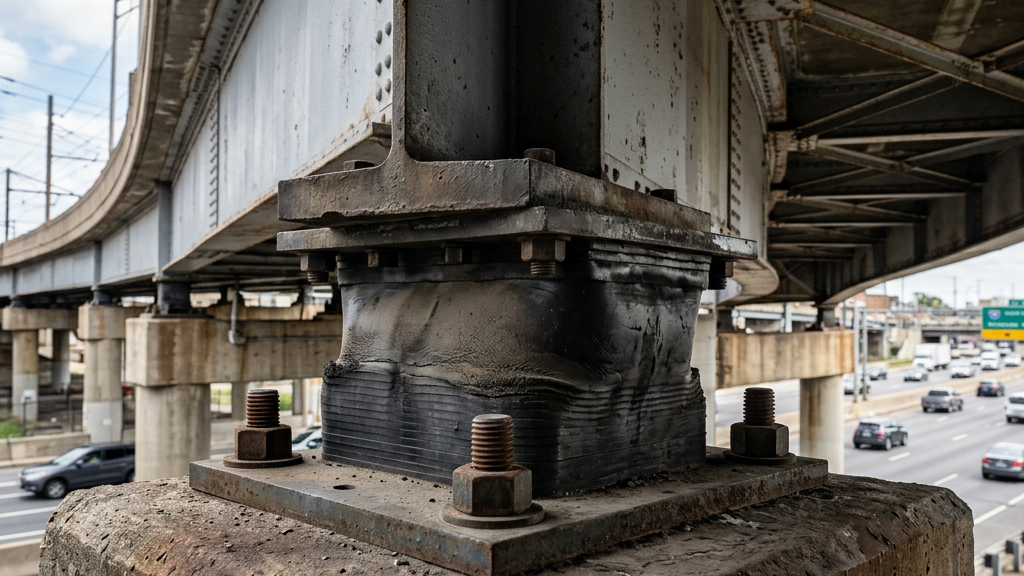
One of the first things inspectors look for is visible damage to the bearing itself. On elastomeric bearings, warning signs may include cracked or split rubber, tearing, excessive bulging, or displacement from the original position. These issues may indicate that the bearing is overloaded, deteriorating, or not seated correctly.
Corrosion and Hardware Problems
Steel components around the bearing should also be checked closely. Corrosion, loose or damaged anchor rods, displaced plates, and rusted connection hardware can reduce the bearing’s ability to perform as designed. If these problems continue, the bearing assembly may lose alignment or fail to transfer loads properly.
Restricted or Locked Movement
A bearing must be able to move or rotate according to the bridge design. On sliding bearings, damaged or contaminated sliding surfaces can prevent smooth movement. On older rocker or roller bearings, rust, debris, or misalignment can stop the intended rocking or rolling action. When movement becomes restricted, unwanted forces can build up in the bridge.
Misalignment and Uneven Bearing Pressure
Visible misalignment, uneven bearing pressure, tilted plates, or unusual gaps around the bearing are also signs of concern. These conditions may suggest that the bridge has shifted, the bearing was installed incorrectly, or the bearing is no longer distributing loads evenly.
Debris Buildup Around the Bearing
Dirt, gravel, rust scale, vegetation, and other debris can collect around bridge bearings over time. This buildup may block movement, trap moisture, and accelerate corrosion. Keeping the bearing area clear helps preserve movement capacity and makes inspections easier.
Why These Warning Signs Matter
These signs matter because the bearing is part of the bridge’s support system. If someone asks what is a bridge bearing during an inspection or repair project, the answer should not stop at its definition. The real question is whether the bearing is still transferring loads, allowing movement, and supporting the bridge as intended.
Maintenance and Replacement of Bridge Bearings
For maintenance teams, a bridge bearing is more than a support component. It is a key checkpoint for movement, alignment, and load transfer. Regular inspection helps confirm that the bearing is still performing as intended and that small issues are addressed before they become costly structural problems.
During inspection, bridge owners and maintenance teams should check whether the bearings are:
- Clean and free from debris
- Properly aligned with the bridge structure
- Seated correctly on the bearing surface
- Able to move or rotate as designed
- Free from excessive corrosion
- Not cracked, displaced, overloaded, or visibly deteriorated
The area around the bearing should also be kept clear where possible. Dirt, gravel, rust scale, and vegetation can restrict movement, trap moisture, and accelerate corrosion. Any corrosion on steel components should be addressed early before it affects the bearing assembly or surrounding bridge elements.
When Replacement Is Needed
Replacing a bridge bearing is not as simple as removing an old part and installing a new one. Because the bearing is part of the bridge’s load path, replacement must be planned carefully and performed under proper engineering guidance.
Depending on the project, bearing replacement may involve:
- Jacking the bridge superstructure
- Installing temporary supports
- Managing traffic control
- Verifying elevations and alignment through survey checks
- Removing damaged or deteriorated bearing components
- Installing the new bearing or fabricated steel assembly
- Confirming that the replacement can handle the required loads and movements
The replacement bearing or related steel components must match current structural requirements, not just the old bearing’s visible size. In some cases, the replacement may follow the original design. In others, the engineer may specify an updated solution based on current bridge conditions, code requirements, or performance needs.
This is why what is a bridge bearing becomes an important question during rehabilitation work. The project team must understand what the existing bearing was designed to do, its current condition, and whether the replacement should restore the original function or improve the bridge’s long-term performance.
How Dews Foundry Supports Bridge and Infrastructure Projects
Dews Foundry supports bridge and infrastructure work through steel fabrication, machining, and practical manufacturing experience. Based in Hattiesburg, Mississippi, C.L. Dews & Sons Foundry & Machinery has served industrial customers since 1941 and works with construction and infrastructure markets requiring durable, project-specific metal components.
For bridge and highway projects, we can support fabricated components such as bridge bearings and scuppers, drainage grates, guard rails, handrail systems, embedded items, weldments, and related steel assemblies. The important phrase is project-specific. Bridge components should be fabricated in accordance with approved drawings, specifications, and quality requirements, rather than treated as one-size-fits-all products.
If your team is asking what is a bridge bearing because a project requires fabricated bridge or highway components, the next step is to review drawings, materials, tolerances, quantities, schedule, and inspection requirements. You can discuss project needs with us.
Need Fabricated Components for a Bridge or Highway Project?
Send us your drawings, specifications, or project requirements. We will review the details and help determine the right fabrication approach for bridge bearings, scuppers, drainage components, embedded items, or related steel assemblies.
Discuss Your Project →Frequently Asked Questions
1. What is a bridge bearing in simple terms?
A bridge bearing is the support device between the bridge span and the pier or abutment. It transfers load while allowing controlled movement or rotation.
2. Why do bridges need bearings?
Bridges need bearings because they move due to temperature changes, traffic loads, and other forces. Bearings help manage that movement and reduce unwanted stress.
3. What are the most common bridge bearing types?
Common types include elastomeric, pot, disc, spherical, sliding, guided, and fixed bearings, as well as older rocker or roller bearings.
4. Do all bridge bearings provide seismic protection?
No. Standard bearings help transfer loads and accommodate expected movement, but seismic isolation bearings are specialized systems used only when the bridge design requires them.
5. When should bridge bearings be replaced?
Bridge bearings may need replacement when they are cracked, corroded, displaced, locked, misaligned, overloaded, or no longer able to move or support loads as designed.

