
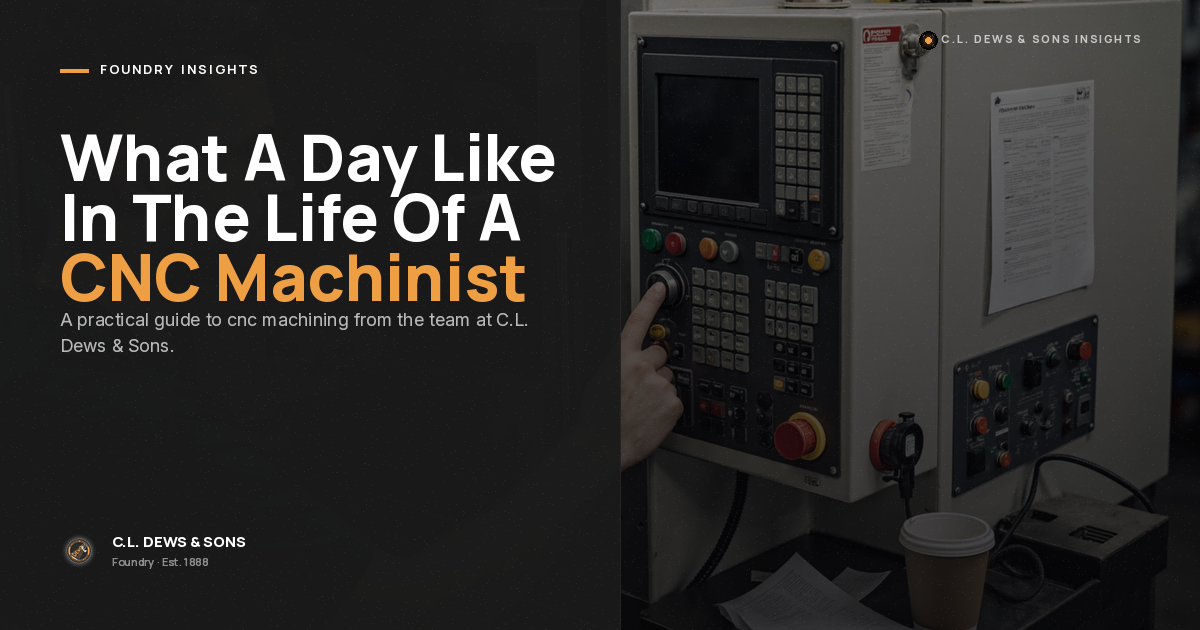
CNC Machining: A Day in the Life of a CNC Machinist
CNC machinists combine technical knowledge, precision measurement and practical problem-solving to turn raw materials, castings and fabricated components into dependable industrial parts.
A CNC machinist does more than run a machine; they review drawings, set up equipment, choose tooling, inspect parts, and solve problems before mistakes become costly. For industrial customers, CNC machining is often the step that turns a casting, fabricated component, or raw metal workpiece into a part that fits, performs, and holds up in real use. At C.L. Dews & Sons Foundry & Machinery in Hattiesburg, CNC machinists support foundry work, steel fabrication, repairs, custom parts, and heavy industrial projects.
Here is the plain version of what a CNC machinist’s day usually involves:
- Reviewing drawings, work orders, dimensions, tolerances, and material requirements before any cutting begins
- Setting up the CNC machine, choosing tools, checking fixtures, and confirming the workpiece is held securely
- Running the CNC machining program while monitoring tool wear, vibration, chip flow, coolant, heat, sound, and surface finish
- Measuring parts with inspection tools to confirm they match the required dimensions
- Troubleshooting problems before they become scrap, rework, or delivery delays
- Documenting completed work so the next part, batch, or repeat order can be made consistently
CNC machining is technical, but it is not cold or automatic. A good machinist has to think ahead, listen to the machine, and understand how small setup choices affect the final part.
The Role of a CNC Machinist
A CNC machinist produces accurate parts using computer-controlled machines that cut, drill, mill, bore, turn or shape a workpiece. The work has to be precise because one misplaced hole, uneven surface or out-of-tolerance bore can stop a part from fitting, sealing, carrying load or surviving in an industrial setting.
In a foundry and machine shop, CNC machining can finish cast parts, add precise features to fabricated components or help repair, duplicate and improve worn industrial parts.
That is why our machine shop is not just an add-on service. It supports foundry and fabrication work while also handling standalone machining projects, including CNC machining, plasma cutting and grinding. When these services are under one roof, the team can move from raw material or casting to a finished component with fewer handoffs and clearer quality control.

Core Responsibilities
The daily responsibilities of a CNC machinist usually include:
- Reading drawings, blueprints, CAD files and job notes
- Confirming material type, size and orientation
- Choosing the right CNC machine for the work
- Selecting cutting tools, inserts, holders, fixtures and measuring tools
- Setting work offsets, tool offsets, speeds, feeds and program details
- Loading and securing the workpiece properly
- Running test cuts or first-piece checks
- Monitoring the machine during cutting
- Measuring the part throughout the process
- Adjusting for tool wear, heat, vibration or surface finish issues
- Recording inspection results or production notes
- Cleaning the machine and preparing for the next job
A rushed setup can ruin a good drawing, a good program and a good piece of material.
Required Skills and Qualifications
A CNC machinist needs technical skill, shop-floor judgement, blueprint reading, shop maths, measuring accuracy, basic programming knowledge and strong troubleshooting ability. Trained through school, an apprenticeship or hands-on experience, the real test is producing parts correctly, safely and consistently.
Good CNC machining also requires material knowledge because steel, cast iron, aluminium, brass, cast parts and fabricated components all behave differently during setup and cutting.
That is where experience matters. A machinist who has only worked on clean blocks of stock may struggle with industrial repair parts, castings or large non-standard components. Custom work often demands more thinking before the machine starts.
Tools and Technologies Used
CNC machining relies on advanced equipment, but the tools are only useful when they are matched to the job. A machinist has to know which machine, cutter, fixture and inspection method makes sense for the part.
Common tools and technologies in a CNC machine shop include:
- CNC mills: Used for cutting flat surfaces, pockets, slots, holes and complex profiles.
- CNC lathes: Used for round or cylindrical components.
- Manual machines: Used for certain repairs, fitting work or one-off adjustments.
- Grinders: Used for surface finishing and precision flatness.
- Plasma cutting equipment: Used for cutting plate or producing rough profiles.
- Measuring equipment: Includes calipers, micrometers, bore gauges, thread gauges, dial indicators and height gauges.
- CAD and CAM software: Used for design review, toolpath planning and CNC program creation.
At Dews Foundry, custom machining supports complex and non-standard parts that may require more than basic cutting. That is important for customers who need a part made to fit a specific machine, replace a discontinued component or meet tighter project requirements.
Overview of CAD and CAM Software
CAD and CAM software help turn part designs into accurate CNC machining instructions, but they do not replace hands-on machinist judgement. The table below shows how each part of the process supports better machining results.
| Area | Role in CNC Machining | Why It Matters |
|---|---|---|
| CAD Software | CAD, or Computer-Aided Design, is used to create or review the digital model or drawing of the part. | It helps the shop understand the part’s shape, dimensions, features and design requirements before machining begins. |
| CAM Software | CAM, or Computer-Aided Manufacturing, turns the part geometry into machine instructions. | It helps define toolpaths, cutting strategies, stepovers, depths of cut and other details the CNC machine will follow. |
| Machinist Review | The machinist checks whether the CAM program makes sense for the actual machine, tool, material and setup. | A program may look correct on screen but still need review for tool reach, chatter risk, material movement, fixture clearance, chip evacuation, finish and tolerance. |
| Customer Information | The shop may need more than a drawing, including the material, tolerance, quantity, application and whether the part is billet, cast or fabricated. | Complete information helps reduce mistakes, delays and costly rework. |
Types of CNC Machines
Different CNC machines are used for different machining tasks, depending on the part shape, material, tolerance requirements and finishing needs. CNC machining is not a one-size-fits-all process.
CNC Mills
A CNC mill uses rotating cutting tools to remove material from a stationary workpiece. Mills are useful for flat surfaces, bolt patterns, pockets, slots, contours, and other industrial part features that require accurate shaping.
CNC Lathes
A CNC lathe rotates the workpiece while the cutting tool shapes it. Lathes are commonly used for round components such as shafts, bushings, pins, sleeves, rings, and similar parts.
Multi-Axis CNC Machines
Multi-axis CNC machines can move in more directions, which allows them to produce more complex geometry with fewer setups. This can improve accuracy because the part does not need to be repositioned as often during machining.
CNC Plasma Cutting
CNC plasma cutting is different from milling or turning because it uses a high-temperature plasma arc to cut a metal plate. It is often used when parts need to be cut to shape before additional fabrication, machining, or finishing.
Grinding Services
Grinding services also matter in a machine shop because some parts need flatness, surface finish, or tighter dimensional control beyond rough cutting. In industrial work, the finished surface can be just as important as the final shape.
Typical Daily Routine
A CNC machinist’s day usually moves through setup, cutting, inspection and problem-solving, although the exact routine depends on the shop, machine, part and production schedule.
The biggest mistake is thinking CNC machining is only about machine run time. Setup, checking, adjustments and inspection often decide whether the final part succeeds.

Morning Preparation: Reviewing Designs and Setting Up
The morning usually starts with the job packet, drawing, work order or digital file. The machinist reviews the part requirements and checks the key details:
- What material is being machined?
- What are the critical dimensions?
- What tolerances matter most?
- Does the part need milling, turning, drilling, boring, grinding or multiple operations?
- Is this a new job, repeat job, repair job or production run?
- Are there notes about surface finish, heat treatment, orientation or inspection?
- Are the right tools, fixtures and measuring instruments available?
Once the requirements are clear, the machinist selects tooling, prepares the machine, loads the workpiece and makes sure everything is secured before cutting starts. Proper workholding matters because a loose or poorly supported part can shift, damage the tool, affect the machine or produce a bad part.
Safety is just as important in CNC machining because rotating parts, flying chips, sparks, pinch points and cutting tools can put both the machinist and the shop floor at risk. OSHA’s machine guarding requirements provide a useful reference for understanding common machine-area hazards.
After the machine is ready, the machinist may run a simulation, dry run or first operation carefully to confirm that the program behaves as expected. On complex or high-value parts, this caution is not optional. It is cheaper to slow down at setup than to scrap the part later.
Midday Operations: Executing Machining Tasks
Once the setup is proven, the machinist moves into the main cutting work. The CNC machine follows the programmed toolpath, but the machinist still monitors the process.
During CNC machining, the machinist watches and listens for signs that something is wrong:
- Tool chatter
- Unusual cutting sounds
- Excessive vibration
- Poor chip formation
- Heat buildup
- Coolant problems
- Surface finish defects
- Tool wear
- Part movement
- Machine alarms
A skilled machinist can often hear trouble before a measurement confirms it because a clean cut sounds different from a tool that is rubbing, chattering or working too hard.
The same part may go through several CNC machining steps, such as facing a casting, opening a bore, drilling and tapping holes, cleaning fabricated edges or finishing round components through turning, milling or grinding. Repeatable toolpaths create consistency, while the machinist catches problems that automation can miss.
Afternoon Tasks: Quality Control and Adjustments
Inspection is not something that only happens at the end. A machinist may measure the first piece, check dimensions between operations and inspect the final part before it leaves the machine area.
Common inspection tools include:
- Calipers for general measurements
- Micrometers for more precise outside dimensions
- Bore gauges for internal diameters
- Thread gauges for threaded holes or shafts
- Dial indicators for alignment or runout
- Height gauges for layout and vertical measurements
- Surface finish checks when finish affects fit or function
If a dimension starts trending out of tolerance, the machinist may adjust offsets, replace a worn tool, change the cutting approach or pause the job for review. That is not failure. It is good CNC machining because issues are caught while they are still controllable.
By the end of the day, cleaning the machine, removing chips, checking tools and updating job notes help the next job or shift run more smoothly.
For a deeper explanation of the process from program to finished component, read our article covering what CNC machining is and how the complete process works .
Need a Custom Part Machined?
Send us your drawing, material requirements, quantity and project details so our team can review the machining work.
Discuss Your ProjectCommon Challenges in CNC Machining
Common CNC machining challenges include:
- Maintaining tight tolerances across multiple setups
- Preventing tool chatter on long, thin or interrupted cuts
- Handling castings or repair parts with irregular shapes
- Managing heat and tool wear during long cutting cycles
- Keeping large parts stable during machining
- Matching new machined features to existing worn equipment
- Producing repeat parts consistently
- Balancing speed with surface finish and accuracy
In foundry and fabrication work, one of the biggest challenges is that parts are not always perfect blocks of material. Castings can vary slightly, fabrications can have weld distortion and replacement parts may be worn, bent or missing clean reference surfaces. This makes setup and inspection more important.
Importance of Precision and Quality Assurance
Precision is the main reason CNC machining matters. The goal is not just to make metal look finished, but to make a part match the required dimensions.
Even a small error, such as an oversized bore, misaligned bolt pattern or uneven machined face, can affect fit, installation, alignment or performance. Quality assurance helps catch those issues before the part reaches the customer.
Ensuring Tight Tolerances
A tolerance is the acceptable amount a part can vary from the required dimension. Some features allow small variations, while critical surfaces, bores or fits may need much tighter control. Tight tolerances depend on stable setup, correct tooling, controlled cutting, accurate measurement and a machinist who knows when to adjust.
Several factors can affect tolerance during CNC machining:
Tool and Machine Condition
Tool wear and machine condition can gradually affect accuracy and finish.
Fixture Rigidity
Poor support or movement during cutting can push a feature outside its required tolerance.
Material and Heat
Material hardness, cutting pressure and heat buildup can change how the part behaves.
Setup and Measurement
Operator setup, part geometry and the chosen measurement method all influence the final result.
Tolerance should match function. Overly tight tolerances can increase cost and lead time without improving the part. Loose tolerances on a critical surface can cause fit or performance problems. A capable machine shop can help customers understand where precision matters and where it does not.
Conducting Manufacturability Checks
A manufacturability check reviews whether the part can be made efficiently and accurately with the selected process.
Before CNC machining begins, the shop may review:
- Whether the material is suitable
- Whether the part can be held securely
- Whether tools can reach all required features
- Whether the tolerances are realistic
- Whether the surface finish is achievable
- Whether the part requires multiple setups
- Whether casting, fabrication, machining or grinding should happen first
- Whether design changes could reduce cost or improve reliability
This step is especially useful for custom machining. A small design change may make the part easier to fixture, inspect or protect from distortion during cutting. That does not mean changing the part’s function. It means making sure the part can be manufactured properly.
The Machinist’s Contribution to the Industry
CNC machinists support industries that rely on accurate, durable parts, including mining, construction, recycling, infrastructure, manufacturing, oil and gas, and agriculture.
At Dews Foundry, CNC machining works alongside foundry services, steel fabrication, crusher wear parts and machine shop support. Many industrial parts may start as castings, require fabrication, need CNC machining and then go through grinding or finishing before they are ready for use.
Real-World Applications of Machined Parts
CNC machined parts can include:
- Shafts
- Bushings
- Pins
- Housings
- Brackets
- Wear components
- Mounting plates
- Bearing surfaces
- Custom repair parts
- Fabricated components with machined features
- Cast parts finished to final dimensions
In heavy industrial work, CNC machining matters because the part has to fit the machine, survive real use and help reduce downtime. A clean-looking component is not a success if it fails in the field, so function always comes first.
Clear communication also matters. The more the machinist understands the part’s purpose, the better the team can manage risks involving material, tolerance, finish and fit.
Celebrating Successes: Completing Complex Projects
The best moments in CNC machining usually happen quietly. A difficult repair part fits on the first installation. A production batch passes inspection. A worn component is duplicated accurately enough to put equipment back into service. A casting becomes a finished part ready for use.
Those wins matter because industrial customers often come to a machine shop with a real problem, not a casual project. Equipment may be down, a replacement part may be unavailable, a deadline may be tight or a tolerance may be critical.
Continuous Learning and Skill Development
CNC machining keeps changing because machines, software, tooling, materials and customer requirements keep changing. A machinist who stops learning eventually falls behind.
Continuous learning may include stronger programming skills, new CAM strategies, improved inspection methods, updated safety practices, new tooling systems or more experience with difficult materials.
Keeping Up with Technological Advancements
Modern CNC machining uses better software, stronger machines, improved tooling and more advanced inspection methods, but those tools only work well when the machinist knows how to use them.
A new toolpath, machine or software feature can improve speed and accuracy, but only when setup, cutting conditions, tool life and inspection are handled correctly. That balance between technology and human judgement is what keeps CNC machining a skilled trade.
Opportunities for Career Advancement
A CNC machinist can grow into more advanced roles over time. Common paths include setup machinist, CNC programmer, lead machinist, quality inspector, shop supervisor, manufacturing technician or process improvement specialist.
The machinists who advance usually become stronger in three areas:
- They understand the machine.
- They understand the material.
- They understand the customer’s part.
That last area is underrated. The best machinists do not only ask, “Can I cut this?” They ask, “Will this part work the way it is supposed to work?”
Conclusion: The Rewards and Challenges of Being a CNC Machinist
A day in the life of a CNC machinist is built around precision, patience and practical problem-solving. Every setup, cut, measurement and adjustment affects the final part, which is why CNC machining depends on both reliable technology and human judgement.
For customers, the takeaway is simple: the quality of a machined part depends on more than the machine. It depends on the people reviewing the drawing, setting up the job, checking the dimensions and solving problems before the part reaches your equipment.
Frequently Asked Questions
What does a CNC machinist do every day?
A CNC machinist sets up, operates, monitors and inspects work produced on CNC machines. Daily tasks usually include reviewing drawings, selecting tools, securing the workpiece, running the CNC machining program, checking dimensions, adjusting offsets and troubleshooting issues during production.
Is being a CNC machinist physically demanding?
Yes, the job can be physically demanding. CNC machinists may stand for long periods, handle tools, move materials, clean machines and work around heavy equipment. The work also requires constant focus because a small mistake in setup or measurement can affect the final part.
What skills are most important for CNC machinists?
Important skills include blueprint reading, shop maths, measuring accuracy, mechanical understanding, tooling knowledge, problem-solving, safety awareness and basic CNC programming knowledge. CAD and CAM experience and material knowledge are also valuable for more advanced CNC machining work.
How long does it take to become a CNC machinist?
The timeline varies. Some machinists learn through technical programs or apprenticeships, while others build their skills through on-the-job training. Basic machine operation may be learned relatively quickly, but becoming a strong setup machinist or CNC programmer usually takes years of hands-on experience.
Why does CNC machine setup matter so much?
Setup controls accuracy. If the workpiece is not clamped correctly, the tool is wrong or the offsets are inaccurate, the CNC machine may produce a bad part even when the program is correct. Good setup reduces scrap, protects tools, improves repeatability and helps the finished part meet its specification.
What should I send to a machine shop for custom CNC machining?
Send a drawing or CAD file when available, along with the material type, quantity, critical dimensions, tolerance requirements, surface finish requirements, photos of the existing part when it is a replacement, and the required deadline. Complete information makes it easier for the shop to quote and produce the part accurately.
Talk to Dews Foundry About Your Machining Requirements
Contact our team to discuss custom components, repair parts, castings, fabrications or other industrial machining work.
Contact us today
