
What Is CNC Machining? The Complete Process Overview
From a coded program to a finished steel part held within a few thousandths of an inch: a plain-English walkthrough of how computer-controlled cutting turns raw metal into precision components.
In This Guide
If you have ever held a precision steel flange, a pump housing, or a custom machined fitting and wondered how a rough block of metal became a part accurate to a few thousandths of an inch, the answer is almost always the same technology. What is CNC machining? In plain terms, it is the use of computer-controlled cutting tools to remove material from a solid workpiece until it matches a digital design exactly. At C.L. Dews & Sons Foundry, we have turned raw metal into finished, ready-to-install components since 1888, and this is the process that lets us hold tolerances no hand-cranked machine could match.
This complete process overview walks through how the technology actually works, from the digital model to the inspected part, the machines involved, the metals it cuts, and why it has become the backbone of modern manufacturing. Whether you are an engineer sourcing parts or a buyer comparing shops, understanding the fundamentals helps you spec better work and know exactly what you are paying for.
What Is CNC Machining? A Plain-English Definition
CNC stands for Computer Numerical Control. A CNC machine reads a set of numeric instructions, called a program, and uses them to drive cutting tools and the workpiece along precise coordinates. Instead of an operator turning handwheels by feel, a controller moves the axes to exact positions hundreds of times per second, repeating the same path part after part with no drift.
The “numerical control” idea dates to the late 1940s, when coded instructions on punched tape first guided milling machines for aircraft parts. The principle has not changed: a part is described as numbers, and the machine executes those numbers. You can read more about the history of numerical control for the full background. What has changed is the speed, the rigidity of the machines, and the software that generates the code.
The practical payoff is repeatability. A skilled manual machinist can make one excellent part. A CNC machine makes the five hundredth part identical to the first, which is why every industry that depends on interchangeable components, from energy to heavy equipment, runs on it.
The CNC Machining Process, Step by Step
CAD: Design the Part
It starts with a 3D model built in CAD software, or a customer print we translate into one. The model defines every dimension, radius, and tolerance the finished part must hold.
CAM: Generate the Toolpaths and G-code
CAM software converts the model into toolpaths, then exports G-code: the line-by-line instructions telling the machine where to move, how fast, which tool to use, and how deep to cut.
Setup: Workholding and Tooling
The raw stock or casting is clamped in a vise, chuck, or fixture and squared to a known reference point. Cutting tools are loaded, measured, and their offsets entered so the controller knows exactly where each tip sits.
Machining: Remove the Material
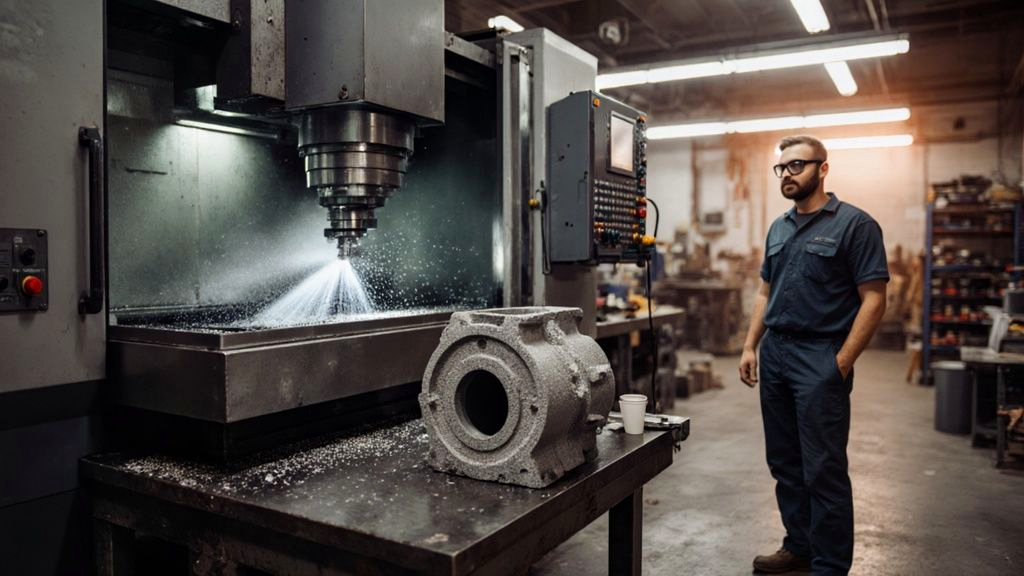
The program runs. Spinning tools, or a spinning workpiece on a lathe, shear away metal in roughing passes, then lighter finishing passes. Coolant flushes chips and controls heat so the part stays dimensionally stable.
Inspection and Finishing
The part is deburred, cleaned, and measured against the print with calipers, micrometers, gauges, or a CMM. Only parts that fall inside tolerance ship. Out-of-spec work gets corrected at the source.
The order rarely changes, but the detail inside each step is where experience shows. Choosing the right tool, feed rate, and cutting depth for a given metal is the difference between a clean surface finish and a scrapped part. That judgment is something software suggests but a seasoned machinist confirms.

A finishing pass on a turned shaft: light cuts and steady coolant flow hold the part dimensionally stable.
The Main Types of CNC Machines
“CNC” describes a control method, not a single machine. The same numeric-control principle drives several distinct tool families, and most precision parts pass through more than one of them.
Milling Machines (Machining Centers)
A rotating cutter removes material from a fixed workpiece. Mills cut slots, pockets, holes, and contoured surfaces, and they are the workhorse of most shops.
Lathes and Turning Centers
The workpiece spins while a stationary tool shapes it. Lathes excel at cylindrical parts: shafts, bushings, pins, threaded fittings, and bored bores.
Multi-Axis Machining Centers
Adding a fourth and fifth axis lets the tool approach the part from nearly any angle, cutting complex geometry in a single setup instead of several.
Grinders, Routers, and EDM
Specialized CNC tools handle ultra-fine finishes, softer materials, or hardened metal that conventional cutters cannot touch, rounding out a full shop.
For straightforward prismatic parts, a three-axis mill does the bulk of the work, which is why 3-axis CNC machining remains the most common process in the industry. When a part has angled faces, undercuts, or features on multiple sides, our multi-axis CNC machining services cut it complete in fewer setups, which both speeds the job and tightens accuracy by removing the error that creeps in every time a part is re-fixtured.
Every time a part is unclamped and re-clamped, a little error sneaks in. The real advantage of multi-axis work is not speed alone: it is holding tighter tolerances by touching the part fewer times.
What Materials Can CNC Machining Cut?
One reason the process is so widely used is its range. The same machine, with the right tooling and settings, can cut a soft brass fitting in the morning and a hardened alloy steel gear in the afternoon. The metal simply dictates the speeds, feeds, and tooling, not whether the job is possible.
Carbon and Alloy Steels
The backbone of industrial parts. Tough and strong, they demand rigid setups and the right cutter geometry to machine cleanly.
Stainless Steel
Corrosion resistant and in demand, but work-hardening. It rewards sharp tools, steady feeds, and patience.
Cast Iron
Machines predictably and dampens vibration well, which is why it is favored for housings, bases, and pump bodies.
Brass and Bronze
Copper-based alloys cut fast, hold tight tolerances, and finish beautifully, making them ideal for bushings, valves, and fittings.
Aluminum, with its light weight and excellent machinability, rounds out the everyday list, and harder specialty alloys are within reach with carbide or ceramic tooling. The point is range: the process adapts to the metal in front of it rather than forcing one approach on every job.
From Casting to Finished Part: Where Machining Fits in a Foundry
Here is the part most general guides miss. A raw casting comes out of the mold close to its final shape, but never to final tolerance. Sand-cast surfaces are rough, mating faces are oversized on purpose, and bolt holes are often just cored starting points. Machining is what turns a near-net casting into a part that bolts up and seals on the first try.
This is why good foundry work and good machining are designed together, not bolted on afterward. When we engineer a casting, we build in location points: small, deliberate reference surfaces a machinist can clamp to and measure from. Those datums let every machined feature share one common origin, so the bore, the face, and the mounting holes all line up to each other instead of drifting apart.
Running both under one roof closes the loop. The team that poured the metal knows exactly where the stock allowance sits and where the part needs final precision, which is the core of our CNC machining foundry services. A casting that arrives at the machine with the right datums and the right extra material gets finished faster, with less scrap, than one handed off cold between two separate vendors.

A rough casting clamped to its built-in datums, ready for the mating face to be cut to final size.
Why CNC Machining Matters for Precision Manufacturing
Strip away the technology and the value comes down to three things: accuracy, repeatability, and complexity. A controller does not get tired on the night shift or lose its place on the four hundredth part. It executes the same coordinates every cycle, which is the only practical way to make components that must be interchangeable across a production run.
That consistency is what lets a buyer order a hundred identical parts and trust that the last one fits the same assembly as the first. It is also what makes complex geometry economical: once a program is proven, the hard thinking is done, and the machine reproduces it on demand. Pairing that control with our precision CNC machining capabilities means a customer can move from a single prototype to a full production run without re-engineering the part along the way.
For industries where a failed part means a shutdown, an injury, or a recall, that reliability is not a luxury. It is the entire reason the process exists, and it is why precision manufacturing and computer numerical control have become effectively the same conversation.
The Bottom Line on CNC Machining
So, what is CNC machining? It is the disciplined conversion of a digital design into a physical metal part through computer-controlled cutting, carried out in repeatable steps from CAD model to final inspection. It is how rough material becomes precision hardware, and how a single proven program becomes a thousand identical components.
At Dews Foundry, it is also the step that completes the journey from molten metal to finished part. We cast it, we machine it, and we measure it, all under one roof, so the part that leaves our floor is ready to install, not just close.
Need a Casting Machined to Spec?
From rough castings to finished, inspected components, our team handles the full process under one roof. Tell us about your part and we will show you the path from print to production.
Explore Our Machining Services →
