
CNC Machining Foundry Services for Heavy-Duty Castings and Industrial Parts
How casting, machining, grinding, heat treatment, and fabrication work together to turn rough castings into durable industrial parts that fit, perform, and last.
Foundry work does not end when the metal cools because many raw castings still need machining before they are ready for service. A strong CNC Machining Foundry process turns rough castings into finished components with accurate surfaces, bored holes, drilled features, and cleaner finishes. By combining casting, machining, grinding, and fabrication, this process helps create durable parts that fit, perform, and last in demanding industrial applications.
With foundry services, steel fabrication, CNC machining, custom machining, surface grinding, Blanchard grinding, turning, milling, drilling, and boring under one roof, C.L. Dews & Sons Foundry & Machinery helps customers get durable industrial parts that are built to fit, perform, and last.
What is Computer Numerical Control Machining?
CNC machining uses programmed instructions to control machine tools that cut, drill, mill, bore, or shape a workpiece. As Britannica explains, computer numerical control is the control of machine tools through direct input from a computer program, which is why CNC machining is useful for repeatable and precise manufacturing work. In a CNC Machining Foundry setting, it is often used after casting or fabrication to refine a part that already has its basic shape. This process helps create tighter, more accurate features where fit, alignment, and performance matter.
For example, a cast component may need:
- Machined mounting surfaces
- Drilled and tapped holes
- Bored openings
- Milled edges or slots
- Flat and parallel surfaces
- Precision grinding for improved fit
- Custom features for replacement or repair work
Dews’ machine shop supports this kind of work through CNC machining, precision grinding, turning, milling, drilling, boring, and custom component fabrication.
Automation
Minimizes manual intervention, improves workflow consistency, and helps reduce unnecessary labor time.
Repeatability
Helps produce consistent results across similar parts by reducing variation from one operation to the next.
Digital Control
Uses programmed toolpaths to machine complex features with improved accuracy and process control.
Key Principles of a CNC Machining Foundry Process
A successful CNC Machining Foundry process is not just about cutting metal. It is about improving the features that affect how a finished part fits, installs, and performs in real working conditions.
Accuracy
A CNC Machining Foundry process improves the accuracy of critical features such as flat surfaces, bored holes, drilled patterns, and machined edges. This matters because finished parts must fit properly with existing equipment, assemblies, or mounting points.
Repeatability
Once a machining program and setup are proven, the same operation can be repeated across multiple parts with greater consistency than manual finishing alone. This helps reduce variation and support dependable results from one part to the next.
Practical Fit
Not every part needs extreme or unrealistic tolerances. In real foundry and machine shop work, the correct tolerance depends on the part, material, equipment, and end use.
For Dews customers, that often means practical, job-ready precision: flat surfaces where parts need to seat properly, bored or drilled features that support assembly, and finished components that can be installed with confidence.
Meeting Demands for Tighter Tolerances and Complex Geometries
Modern engineering relies on parts fitting together properly, especially when components require tighter tolerances, complex surfaces, or difficult-to-machine features. A raw casting may need additional finishing because cooling and solidification can introduce slight variations, while some details are better refined after casting. CNC machining helps address these challenges by bringing critical features closer to the required design, drawing, or digital specification.
⚠️ Industry Challenges
- Tighter tolerance requirements
- Complex geometric requirements
- Casting variability from cooling
- Long lead times and high scrap risk
- Labor-intensive manual finishing
✅ CNC Solutions
- Improved machining accuracy
- Multi-axis machining capability
- Helps compensate for casting variation
- More streamlined production workflows
- Consistent, repeatable results
CNC Machining Foundry: The Link Between Castings and Finished Components
The role of a CNC Machining Foundry is simple: take a cast or fabricated part and finish the critical areas that must meet the customer’s requirements. That may include milling a flat surface, boring a precise hole, drilling a bolt pattern, grinding a face flat, or machining a custom feature that allows the part to work with existing equipment.
For Dews, CNC Machining Foundry work supports more than general metal cutting. It supports our larger mission: helping customers get durable industrial parts that are made to fit their equipment and operating conditions.
One thing we have learned from heavy-industry work is that “close enough” is not good enough when a customer is trying to get equipment back online. A part can be made from the right material and still cause problems if the mating surface is off, the bolt holes do not line up, or the finish creates fit-up issues. That is why machining and grinding are not just finishing steps. They are quality steps.
Unleashing Precision in Post-Casting Operations
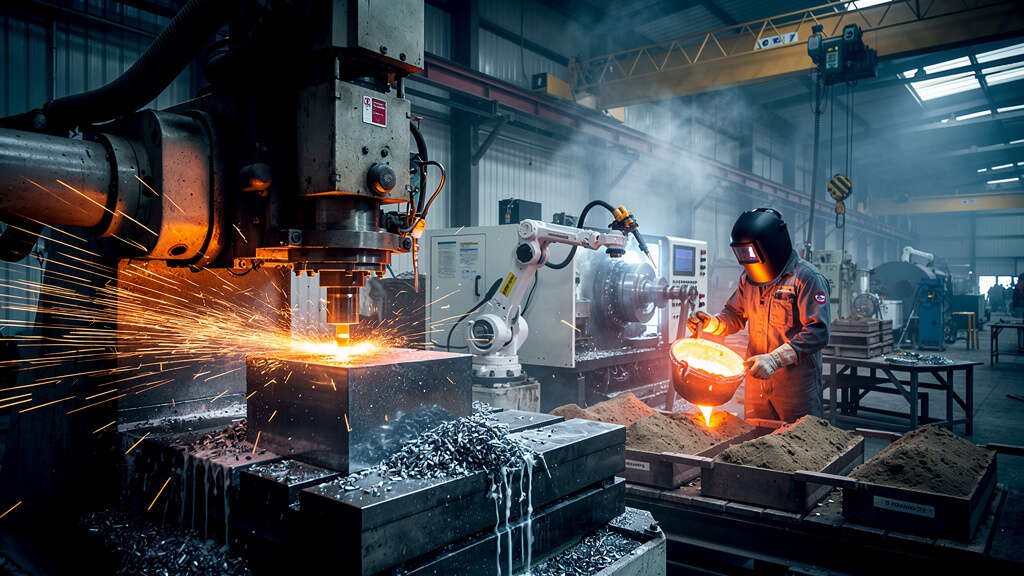
From molten metal to finished precision, the process depends on both foundry strength and skilled machining.
Post-casting work is where a rough casting becomes a part that is ready to install, assemble, or put into service. By combining machining, grinding, and finishing, a CNC Machining Foundry process helps improve the features that affect fit, flatness, alignment, and long-term performance.
Turning Raw Castings into Usable Parts
A raw casting is often just the starting point because surfaces, holes, and other critical features may still need finishing. CNC Machining Foundry services help machine those details based on a customer’s drawing, design, sample part, or replacement need. This creates a more consistent finished component that is ready for proper fit and reliable use.
At Dews, this work pairs naturally with our foundry capabilities. Our Foundry Services include high-chrome cast iron wear parts, gray cast iron production, pattern work, heat treatment, and Blanchard grinding. When those capabilities are supported by machining, customers get a more complete manufacturing solution.
Surface Finish, Flatness, and Fit
Precision is not only about dimensions; surface finish and flatness also affect how well a part fits and performs. Dews’ Blanchard and surface grinding services help create flat, parallel surfaces on cast and fabricated parts that need reliable contact or mounting areas. With a 66″ Blanchard grinder, Dews can also process larger components more efficiently.
For a CNC Machining Foundry operation, this combination of machining and grinding is important because not every part needs the same finishing method. Some parts need milling. Some need boring. Some need grinding. Some need a combination of all three.
Driving Productivity and Efficiency
Productivity in foundry work is not just about moving faster. It is about reducing wasted steps, limiting rework, and helping customers get dependable parts when their equipment cannot afford delays.
Reducing Extra Handling and Rework
A strong CNC Machining Foundry workflow reduces extra handling, manual finishing, and rework by completing key features in a controlled setup. This helps customers get replacement parts faster, which matters when equipment is worn, damaged, or already offline. For demanding industries like mining, aggregate, and recycling, we support this need with high-chrome cast iron parts such as blow bars, curtain liners, side liners, rotor shoes, sand washer paddles, log washer flights, and chute liners.
Better Use of Skilled Labor
CNC machining does not replace skill; it depends on machinists who understand the material, setup, tooling, workholding, cutting conditions, and final use of the part. The machine is only part of the process, while the judgment behind the setup is what prevents a finished component from becoming a costly mistake. In a CNC Machining Foundry environment, the team must understand both the realities of casting and the demands of precision machining.
Addressing Foundry-Specific Challenges
Foundry parts are not one-size-fits-all. Materials, casting variation, machining requirements, and final application all affect how a CNC Machining Foundry process should be planned.
Advanced CNC Technologies and Dews Capabilities
Advanced machining is most useful when it supports the real demands of the part, not just when it sounds impressive. For Dews, CNC technology works alongside casting, heat treatment, grinding, and custom fabrication to help produce components that are accurate, durable, and ready for demanding industrial use.
CAD/CAM, Multi-Axis Machining, and Custom Work
Modern CNC machining uses CAD/CAM workflows to turn digital models or drawings into accurate toolpaths. This helps machine complex features with better control and efficiency. In a CNC Machining Foundry operation, it is especially useful for cast or fabricated parts with unusual profiles, hard-to-reach surfaces, or custom requirements.
Dews’ custom machining services include multi-axis CNC machining, prototyping, precision grinding, custom component fabrication, and finishing services. These capabilities are especially useful for complex and specialized projects where an off-the-shelf part will not solve the problem. Learn more on our Custom Machining page.
Heat Treatment, Grinding, and Final Performance
Machining is only one part of the process, especially for wear parts, where material selection and heat treatment also affect performance. We use controlled heat treatment ovens to maximize casting hardness, achieving a 600–700HB rating for parts exposed to high abrasion. A CNC Machining Foundry process works best when machining, material selection, heat treatment, and finishing are treated as connected steps.
Key Takeaways
“`- A CNC Machining Foundry process helps turn raw castings into finished, usable components.
- CNC machining improves accuracy, repeatability, surface quality, and fit.
- Dews Foundry supports industrial customers through foundry services, CNC machining, grinding, fabrication, and custom machining.
- High-chrome cast iron wear parts, gray iron castings, heat treatment, and Blanchard grinding are important parts of Dews’ manufacturing capabilities.
- CNC machining is especially useful for mounting surfaces, bored holes, drilled patterns, custom features, and replacement parts.
- The best CNC Machining Foundry results come from matching the machining process to the material, drawing, and real-world application.
Ready to Improve Your Casting or Machining Project?
If your operation needs a cast, fabricated, or machined component that has to fit right and hold up in demanding service, Dews Foundry can help. Our team combines over 80 years of foundry experience with CNC machining, custom machining, grinding, fabrication, and practical heavy-industry knowledge.
Reach Out to Our Team
