
What Are the Benefits of SMAW Welding?
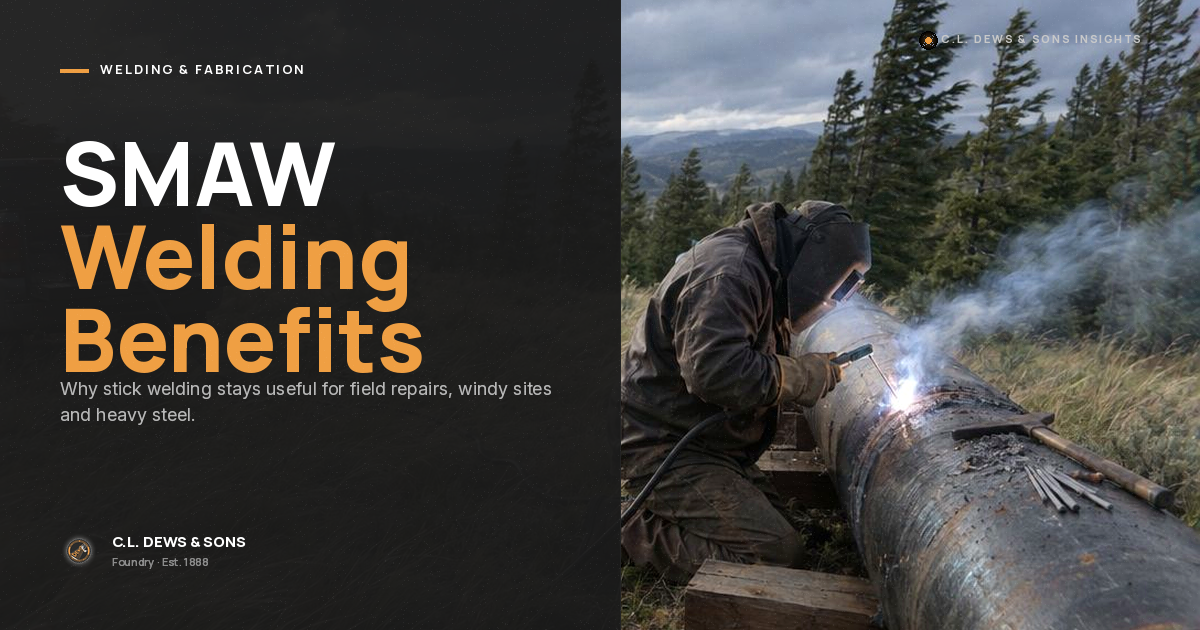
Shielded Metal Arc Welding offers a practical combination of portability, versatility and field capability across a range of fabrication and repair applications.
Shielded Metal Arc Welding (SMAW), also known as stick welding, is widely used in manufacturing, construction, fabrication and repair work. Its relatively simple equipment, portability and lack of an external shielding-gas supply make SMAW welding particularly useful for field welding and locations where access may be limited.
In this blog, we’ll explore the main benefits of SMAW welding and why it remains a practical option for various welding applications. Dews Foundry uses SMAW alongside FCAW and GMAW as part of its steel fabrication capabilities.

What is SMAW Welding?
SMAW welding is a manual arc welding process that uses a consumable electrode coated in flux to lay the weld. The process involves striking an electric arc between the electrode and the workpiece, which generates heat to melt both the electrode and the base material. The flux coating creates a protective gas and slag layer, shielding the weld from atmospheric contamination.
Benefit 1: Versatility Across Applications
One of the standout advantages of SMAW welding is its versatility. This method can be used to weld a wide range of metals, including:
- Carbon steel
- Stainless steel
- Cast iron
- Alloyed steels
The appropriate electrode, welding procedure and operating parameters must be selected according to the base metal and application.
Applications
- Construction projects
- Shipbuilding
- Industrial repairs
This versatility makes SMAW useful across many structural, repair and field-welding applications where the process and consumables are appropriate for the material and joint.
Benefit 2: Cost-Effectiveness
SMAW welding can be cost-effective for many field, repair and lower-volume applications because its equipment requirements are relatively simple and it does not require an external shielding-gas supply.
Reasons for Cost Efficiency
- Minimal equipment requirements
- Consumable electrodes are available for a wide range of common applications
- No need for external shielding gas
However, total welding cost depends on the application. For repetitive production or large multipass welds, processes such as FCAW or GMAW may provide higher deposition rates and greater productivity.
Benefit 3: Portability and Simplicity
Unlike many other welding techniques, SMAW welding equipment is lightweight and portable, making it ideal for on-site welding jobs. Its equipment setup can also be relatively straightforward, although producing consistent welds that meet applicable specifications requires appropriate training, technique and procedure control.
Advantages
- Easy to transport
- Operable in remote or hard-to-access locations
- Minimal setup time
Benefit 4: Strong and Durable Welds
When the correct electrode, joint preparation and welding procedure are used, SMAW can produce sound, high-strength welds suitable for structural and heavy fabrication applications. Weld performance depends on factors such as the base material, electrode classification, amperage, polarity, welding position and operator technique.
Ideal For
- Heavy structural components
- Structural and industrial fabrication
- Industrial machinery
Pro Tip: Ensure proper electrode selection to achieve optimal weld strength for specific materials.

Benefit 5: Ability to Weld in Adverse Conditions
SMAW welding stands out for its ability to perform well under challenging environmental conditions, including:
- Windy outdoor settings
- Remote or difficult-to-access locations
- Field fabrication and repair work
Appropriate electrical, weather and worker-safety precautions are still essential. Wet or high-humidity conditions should not be treated as an inherent advantage of SMAW because they can increase electrical hazards during welding.
Comparison Table: SMAW vs. Other Welding Techniques
Actual performance varies according to the equipment, material, consumables, joint design and welding procedure. In general, the processes compare as follows:
| Feature | SMAW Welding | GTAW (TIG Welding) | GMAW (MIG Welding) |
|---|---|---|---|
| External Shielding Gas | No | Usually required | Usually required |
| Field Portability | High | Varies by setup | Varies by setup |
| Wind Tolerance | Generally good | Lower without adequate protection | Lower without adequate protection |
| Deposition/Productivity | Moderate to low | Generally low | Generally higher |
| Operator Skill Required | Significant | Significant | Varies by application |
SMAW is not the most productive process for every fabrication job. Electrodes must be replaced regularly, slag generally requires removal between passes, and wire-fed processes such as FCAW or GMAW may provide higher deposition rates for repetitive or high-volume work. Process selection should therefore consider the material, joint, welding position, environment and production requirements.
Conclusion
SMAW welding remains an important welding process because of its versatility, portability, relatively simple equipment requirements and suitability for many field applications. For projects suited to the process, it can provide a practical option for structural components, industrial machinery, repairs and outdoor fabrication.
Planning a Steel Fabrication Project?
Talk to Dews Foundry about your fabrication and welding requirements so the right process can be considered for your application.
Talk to Our Team
