
What Is CNC Machining? The Complete Beginner’s Guide to Computer Numerical Control
From a coded program to a precision steel part: a plain-English explanation of how CNC machining actually works, what it can cut, and why it powers modern manufacturing.
In This Guide
CNC machining quietly powers nearly every modern industry, from the aerospace bracket inside the airliner you fly to the gear inside the elevator you took this morning. If you have ever wondered what is CNC machining and felt the answers online were either oversimplified or buried in jargon, this guide is for you. We break the technology down in plain language, walk through how the machines actually cut metal, and explain why CNC has become the backbone of precision manufacturing in 2026.
What Is CNC Machining? A Plain-English Definition
CNC stands for Computer Numerical Control. So what is CNC machining, in one sentence? It is a manufacturing process where pre-programmed computer software dictates the movement of factory tools and machinery. Instead of a person manually turning a hand wheel to advance a cutter into a block of steel, a CNC machine reads coded instructions (most commonly G-code) and drives the cutting tool through a series of exact positions, speeds, and depths.
The result is a part that emerges within tolerances measured in thousandths of an inch, repeated identically across thousands of units. CNC removes the variability of human hands while keeping the creative freedom of human designers. A model drawn in CAD software gets translated into toolpaths, the toolpaths get loaded into the machine, and the machine executes them faster, tighter, and more consistently than any manual operator could.
A Brief History Behind the Acronym
Numerical control predates modern computers, with John Parsons helping pioneer punched-card systems for controlling machine tools used to produce complex aircraft components in the late 1940s. In 1952, MIT demonstrated a three-axis digitally controlled milling machine, an important milestone in the development of numerical-control machining. As electronics and computer technology advanced, these systems evolved into computer numerical control, or CNC, which became an established part of modern manufacturing. The National Institute of Standards and Technology (NIST) documents the development of numerical-control machine tools and their role in manufacturing automation.
How a CNC Machine Actually Works
CAD Design
An engineer creates a 3D model of the part using Computer-Aided Design software like SolidWorks, Fusion 360, or Mastercam. The model defines every surface, hole, fillet, and tolerance the part needs.
CAM Programming
Computer-Aided Manufacturing software converts that geometry into toolpaths. The programmer chooses cutters, feed rates, spindle speeds, and the order of operations, balancing surface finish against cycle time.
Setup and Workholding
The raw material, often called the workpiece, gets clamped into the machine using vises, fixtures, or chucks. Tool offsets are measured, the work zero is established, and the program is loaded into the machine controller.
Cutting
With a button press, the spindle accelerates, the axes move, and material is removed. Coolant floods the cutter to manage heat and chip evacuation. The operator monitors the first part, then the machine runs the rest of the batch with minimal supervision.
The CNC Machining Process, Step by Step
CAD: Design the Part: It starts with a 3D model built in CAD software, or a customer print we translate into one. The model defines every dimension, radius, and tolerance the finished part must hold.
CAM: Generate the Toolpaths and G-code: CAM software converts the model into toolpaths, then exports G-code: the line-by-line instructions telling the machine where to move, how fast, which tool to use, and how deep to cut.
Setup: Workholding and Tooling: The raw stock or casting is clamped in a vise, chuck, or fixture and squared to a known reference point. Cutting tools are loaded, measured, and their offsets entered so the controller knows exactly where each tip sits.
Machining: Remove the Material: The program runs. Spinning tools, or a spinning workpiece on a lathe, shear away metal in roughing passes, then lighter finishing passes. Coolant flushes chips and controls heat so the part stays dimensionally stable.
Inspection and Finishing: The part is deburred, cleaned, and measured against the print with calipers, micrometers, gauges, or a CMM. Only parts that fall inside tolerance ship. Out-of-spec work gets corrected at the source.
The order rarely changes, but the detail inside each step is where experience shows. Choosing the right tool, feed rate, and cutting depth for a given metal is the difference between a clean surface finish and a scrapped part. That judgment is something software suggests but a seasoned machinist confirms.
The Main Types of CNC Machines
There is no single “CNC machine.” The category covers a family of equipment, and each style is suited to a specific manufacturing problem. Knowing which one a job calls for is half the battle when you start sourcing parts.
CNC Mills
Mills hold the workpiece on a moving table while a rotating cutter removes material. Three-axis mills cover most prismatic work; four and five-axis mills handle complex contours like turbine blades and structural brackets without re-fixturing.
CNC Lathes
Lathes spin the workpiece against a stationary cutter, ideal for cylindrical parts like shafts, bushings, and threaded fittings. Modern mill-turn lathes combine rotation with milling, finishing complete parts in a single setup.
CNC Routers
Routers operate on softer materials (wood, plastics, foam, aluminum sheet) across a large flat bed. They are common in cabinet shops, signage operations, and prototype work.
Plasma, Laser & Waterjet
These machines do not cut with a rotating tool. They use a focused energy stream to slice through plate material along a programmed path. Waterjet has the advantage of cutting cold, which protects heat-sensitive alloys.
CNC EDM
Electrical Discharge Machining erodes metal with controlled sparks between an electrode and the workpiece. EDM excels at fine internal features, mold cavities, and hardened tool steel parts that defeat conventional cutters.
5-Axis Multi-Tasking Centers
The high end of the CNC world. A single machine can mill, turn, drill, and tap at any tool angle, completing parts that once required three or four separate setups across multiple machines.
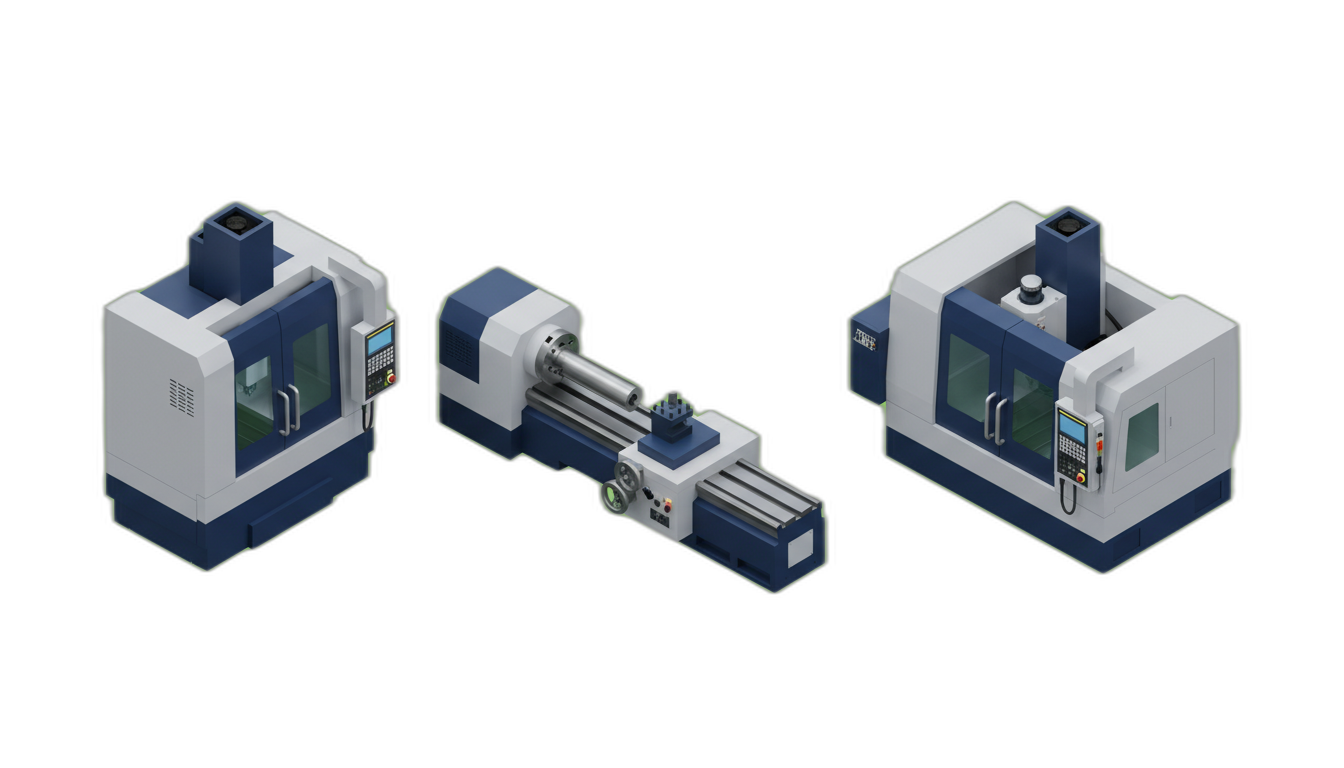
Each CNC platform handles a different geometry envelope. Choosing the right one is half the engineering work.
Materials CNC Machining Can Cut
The list of compatible materials is long because rigid CNC machines can be paired with cutters engineered for nearly any substrate:
- Carbon steel, alloy steel, tool steel, and stainless
- Aluminum, brass, copper, and bronze
- Cast iron and cast manganese alloys, post-machined to final spec
- Titanium and nickel-based superalloys for aerospace and energy applications
- Engineering plastics like PEEK, Delrin, and UHMW
- Composites and graphite
For our shop, CNC machining is the finishing step that turns rough castings into installation-ready components. We pour the part, then route it directly into our multi-axis CNC machining services for tight-tolerance features, mounting holes, and bearing surfaces.
Why Manufacturers Rely on CNC Machining
Repeatability
A program that produces an acceptable first article will produce an identical thousandth article. Variation between parts is measured in microns, not tenths of an inch, which means assemblies fit together the first time and inspection rejection rates plummet.
Speed
Once a setup is dialed in, CNC machines run unattended through breaks, lunches, and overnight lights-out shifts. A skilled programmer can shave minutes off a cycle, and those minutes translate into thousands of dollars over a long production run.
Complex Geometry
Five-axis machines can hold a tool at any angle to the work, opening up shapes that no manual mill can produce: undercuts, blended free-form surfaces, integral mounting features, and impellers with twisted blades.
Operator Consistency
The machine does not get tired, distracted, or worry about its grip on the hand wheel. The skill lives in the program, the fixture, and the inspection plan. Two different operators on two different shifts produce the same parts.
Documentation
Every CNC program is a reproducible record. Six years from now, when a customer reorders the same component, the same code on the same machine produces the same result. That kind of long-term traceability is impossible with manual methods.
The economic case for CNC is rarely about a single part. It is about the cost of being wrong on the hundredth part of a thousand-piece order. CNC narrows the gap between the first part and the last to the point where it almost disappears.
CNC Machining vs. Manual Machining
Manual machining still has a place: one-off prototypes, repair work, and jobs where setup time would dwarf cycle time. But the moment you need more than a handful of identical parts, CNC pays for itself. The breakeven is often as low as 20 to 50 pieces, depending on complexity. Beyond that point, manual methods cannot compete on cost-per-part or quality consistency.
Operator Drives Every Cut
- Fast for one-off repairs and prototypes
- Tolerance limited by the operator’s skill
- Hard to repeat across operators or shifts
- Difficult on contoured or angled surfaces
- Best for low-volume, simple geometry
Program Drives Every Cut
- Repeatable to 0.0001″ or better
- Identical from first part to last part
- Runs unattended, including overnight
- Handles complex five-axis geometry
- Best for production volume and tight tolerance
CNC also unlocks geometries that are physically difficult on manual equipment: deep pockets with thin walls, helical grooves, contoured airfoils, and combined milled-and-turned features. If you can model it cleanly in CAD, a competent CNC programmer can usually cut it.
Common Misconceptions About CNC Machining
A few myths persist among manufacturers new to the technology, and they tend to lead to bad sourcing decisions.
“CNC is only for large production runs.”
False. Five-axis CNC routinely handles prototype work because the same program runs whether you need one part or one thousand. The setup cost amortizes faster than people expect, and once a program is proven, reorders are nearly free to schedule.
“CNC eliminates the need for skilled operators.”
Also false. The skill shifts from hand-eye coordination to programming, fixturing, and process development. The best CNC shops still employ machinists with decades of experience, because instinct about how a part wants to cut is hard to encode in software.
“CNC is too expensive for small shops.”
Hobby-grade CNC routers and benchtop mills now sell for well under $5,000, and competent industrial used machines start around $25,000. The barrier to entry has dropped substantially in the last decade, making CNC accessible to single-operator shops.
From Casting to Finished Part: Where Machining Fits in a Foundry
Here is the part most general guides miss. A raw casting comes out of the mold close to its final shape, but never to final tolerance. Sand-cast surfaces are rough, mating faces are oversized on purpose, and bolt holes are often just cored starting points. Machining is what turns a near-net casting into a part that bolts up and seals on the first try.
This is why good foundry work and good machining are designed together, not bolted on afterward. When we engineer a casting, we build in location points: small, deliberate reference surfaces a machinist can clamp to and measure from. Those datums let every machined feature share one common origin, so the bore, the face, and the mounting holes all line up to each other instead of drifting apart.
Running both under one roof closes the loop. The team that poured the metal knows exactly where the stock allowance sits and where the part needs final precision, which is the core of our CNC machining foundry services. A casting that arrives at the machine with the right datums and the right extra material gets finished faster, with less scrap, than one handed off cold between two separate vendors.
How to Get Started With CNC Manufacturing for Your Project
If you have a part that needs to be made, the path is straightforward. Follow this five-step process and you will avoid most of the costly back-and-forth that delays first-article delivery.
Finalize Your CAD Model
Lock in geometry and add explicit tolerances on critical features. The looser your tolerance callouts, the cheaper the part, so do not over-specify what is not functional.
Identify the Critical Surfaces
Decide which surfaces matter most for fit, function, and finish. Mark them clearly on the drawing so the machinist knows where to focus inspection.
Match the Shop to the Part
Pick a manufacturing partner whose equipment and capacity match your part: mill work, turning, or both. A shop set up for small precision work is the wrong call for a 60-inch casting.
Send a Complete RFQ
Submit the model, drawing, material spec, quantity, and target lead time together. Incomplete RFQs are the single biggest cause of quote delays.
Approve First-Article Inspection
Always review the first-article inspection report before authorizing the full run. Catching a mismatch on part one is dramatically cheaper than catching it on part one thousand.
For parts that combine cast or fabricated bodies with machined features, our precision CNC machining capabilities span the full range, three-axis through five-axis, on workpieces up to 60 inches in any direction. We pour, machine, finish, and inspect under one roof, which removes the freight cost and tolerance stack risk of bouncing parts between vendors.
The Bottom Line: What Is CNC Machining Worth to Your Operation?
CNC machining is no longer an exotic capability reserved for aerospace primes. It is the workhorse process behind almost every metal component you can name, and understanding the basics is the first step toward sourcing parts that hit your spec the first time. From G-code to grinding chips, the loop from CAD model to finished component is shorter and more reliable than at any point in manufacturing history.
If you take only one thing away from this guide, let it be this: the question is rarely whether to use CNC, but how to specify your part so the CNC process delivers everything you need on the first article. Tight drawings, clear critical surfaces, and the right shop partner will get you there.
Need Cast and Machined Parts From One Source?
Dews Foundry pours the metal and finishes it on our own CNC equipment, so your tolerance stack stays under one roof from raw casting to inspection-ready component.
Explore Our Custom Machining →
