
Beginner’s Guide to Industrial Metal Casting: From Molds to Finished Parts
Learn how industrial metal casting turns molten metal into durable, finished components through careful mold design, material selection, pouring, cooling, and finishing.
Metal parts do not become dependable by accident. Behind every crusher liner, chute liner, wear plate, bridge component, and custom machine part is a controlled process that starts with engineering judgment and ends with a component built for real operating conditions. That is the practical value of industrial metal casting: it allows manufacturers, contractors, mines, aggregate producers, recyclers, and infrastructure teams to turn molten metal into durable parts with the shape, strength, and wear resistance their equipment requires.
For companies that depend on heavy machinery, the goal is not simply to make a metal shape. The goal is to produce a casting that fits correctly, survives abrasion and impact, and performs consistently after installation. At Dews Foundry, that work connects foundry experience with fabrication, machining, and service for demanding industrial applications.
What is Metal Casting?
Industrial metal casting is a manufacturing process in which molten metal is poured into a prepared mold cavity. Once the metal cools and solidifies, the mold is removed or opened, and the casting is cleaned, inspected, and finished as needed. In industrial metal casting, every step matters because small mistakes in pattern design, alloy selection, melting temperature, pouring practice, or finishing can affect the final part.
The process can be used for simple shapes, but its real value appears when parts require complex geometry, heavy sections, specialized alloys, or performance characteristics that would be difficult or wasteful to achieve by machining from a solid block. Castings are used across many sectors because they can combine form and function in one manufactured component.
A typical casting workflow includes several stages. First, a pattern or model of the part is prepared. Next, a mold is made around that pattern. Metal is then melted, treated, and poured into the mold. After cooling, the casting is removed, cleaned, and prepared for any secondary work. Depending on the job, that secondary work may include heat treatment, cutting, grinding, welding, machining, or assembly. Professional industrial metal casting is not one isolated task; it is a sequence of controlled decisions.
Industrial Casting vs. Home Metal Casting
Home casting and industrial metal casting may follow the same basic idea of pouring molten metal into a mold, but they serve very different purposes. The table below shows why industrial casting requires more control, expertise, and performance standards than hobby-level casting.
| Category | Home Casting | Industrial Metal Casting |
|---|---|---|
| Main purpose | Used for small hobby projects, simple parts, decorative pieces, or learning basic casting concepts. | Used to produce durable, functional components for heavy equipment, infrastructure, manufacturing, mining, aggregate, and other demanding industries. |
| Project scale | Usually involves small pours, simple molds, and limited production needs. | Often involves larger pours, tighter specifications, repeatable production, and parts designed for real operating conditions. |
| Technical requirements | May only require basic knowledge of melting, pouring, mold setup, and cooling. | Requires expertise in metallurgy, patternmaking, mold behavior, shrinkage, gating, risers, cooling rates, safety controls, and finishing requirements. |
| Material selection | Materials are often chosen for availability, cost, or ease of use. | Materials are selected based on wear resistance, impact resistance, hardness, strength, service environment, and expected part life. |
| Quality expectations | A part may be acceptable if it looks good and serves a light-duty purpose. | A part must perform reliably, fit accurately, and withstand harsh conditions without premature failure. |
| Risk of hidden issues | Defects may be less critical if the casting is decorative or non-load-bearing. | Internal defects, inconsistent hardness, poor alloy selection, or inaccurate machining can lead to downtime, equipment damage, or part failure. |
| Finishing needs | May involve simple cleanup, sanding, or polishing. | May require heat treatment, grinding, machining, inspection, fabrication, or assembly before the part is ready for use. |
| Buyer value | Useful for experimentation and learning the basics of metal casting. | Valuable because it combines material science, manufacturing discipline, and practical field experience to produce dependable parts. |
Common Materials Used in Foundry Work
Foundries use different metals and alloys depending on the part’s purpose, operating environment, and performance requirements. Some castings need high strength. Others need better wear resistance, corrosion resistance, machinability, or heat tolerance. Choosing the right material is one of the most important steps in producing a reliable casting.
Gray Iron
Gray iron is one of the most common materials used in foundry work. It is valued for its good castability, machinability, and vibration-damping properties. Because of these qualities, gray iron is often used for machine bases, housings, pump bodies, engine blocks, and general cast components. For industrial applications, gray iron is useful when the part needs dimensional stability and good performance under compression, but does not require high impact resistance.
Ductile Iron
Ductile iron is stronger and tougher than gray iron. Its structure gives it better impact resistance and flexibility, making it suitable for heavy-duty parts that need to handle stress without cracking easily. It is commonly used for gears, brackets, pipe fittings, suspension parts, and other components that need a balance of strength, toughness, and castability.
Steel Castings
Steel castings are used when strength, toughness, and load-bearing performance are major requirements. They are common in construction, mining, transportation, heavy equipment, and structural applications. Compared with iron castings, steel castings can offer better toughness and resistance to impact, but they may require more careful processing and finishing.
Stainless Steel
Stainless steel is used in casting applications where corrosion resistance is important. It performs well in environments exposed to moisture, chemicals, heat, or sanitary requirements. Common uses include food-processing equipment, marine components, valves, pumps, and chemical-processing parts. It is usually chosen when ordinary steel or iron would corrode too quickly.
High-Chrome Cast Iron
High-chrome cast iron is especially important for abrasive and high-wear environments. It is commonly used for crusher wear parts, chute liners, grinding parts, impact plates, and components used in mining, aggregate, and recycling equipment. This material is valued for its strong abrasion resistance. For a company like Dew’s Foundry, high-chrome cast iron is highly relevant because it aligns with heavy-duty wear parts and industrial metal casting applications.
Aluminum Alloys
Aluminum alloys are lightweight, corrosion-resistant, and relatively easy to cast. They are commonly used in automotive parts, aerospace components, housings, brackets, and decorative castings. Aluminum is a good choice when weight reduction matters, but it may not be suitable for applications that require extreme wear resistance or heavy impact strength.
Bronze
Bronze is often used for parts that need good wear resistance and corrosion resistance. It also performs well when parts move against other metal surfaces. Common bronze castings include bushings, bearings, marine hardware, pump components, and artistic castings. It is often chosen when smooth operation and long service life are important.
Brass
Brass is commonly used for valves, fittings, hardware, decorative pieces, and smaller mechanical components. It is easy to machine, corrosion-resistant, and has an attractive appearance. While brass is useful in many applications, it is typically more relevant to plumbing, hardware, and decorative work than heavy-duty industrial wear parts.
Copper Alloys
Copper alloys are used when conductivity, corrosion resistance, or heat-transfer performance is needed. These materials are common in electrical components, heat exchangers, marine parts, and specialized industrial applications. They are not always the first choice for heavy wear, but they are valuable when thermal or electrical performance matters.
Material Selection Matters
The best foundry material depends on the job the part must perform. For Dew’s Foundry-style applications, the most relevant materials to emphasize are gray iron, ductile iron, steel castings, and high-chrome cast iron. These materials connect more directly to heavy equipment, crusher parts, wear parts, fabrication, machining, and demanding industrial environments.
Common Applications of Industrial Castings
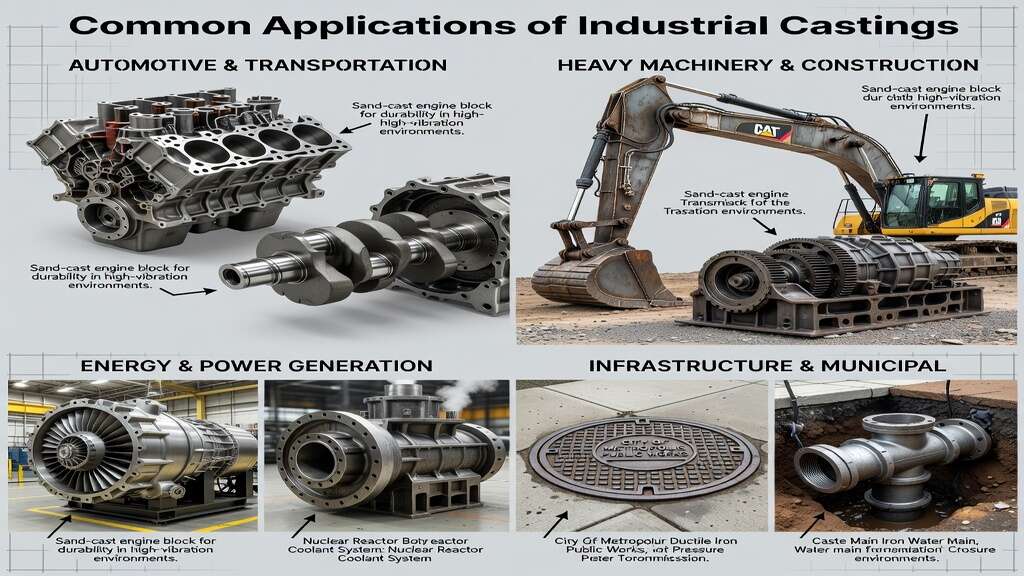
Industrial metal casting supports durable components for automotive, construction, energy, municipal infrastructure, and heavy equipment applications.
Industrial castings are commonly used in industries where equipment faces abrasion, impact, heavy loads, and demanding operating conditions. For companies like Dew’s Foundry, these applications are especially relevant because many customers need durable parts that can handle harsh environments without frequent failure or replacement.
Common applications include:
- Mining operations, where crushers, screens, conveyors, and processing systems handle abrasive rock, ore, and minerals.
- Aggregate production, where equipment must process stone, gravel, sand, and other tough materials every day.
- Recycling facilities, where unpredictable feedstock can cause heavy wear on liners, impact parts, and material-handling equipment.
- Construction and infrastructure projects, where durable fabricated and machined components must meet real-world installation and performance needs.
- Manufacturing and heavy equipment repair, where custom castings, replacement parts, and finished components may be needed to keep machinery operating.
In these sectors, downtime is expensive. A failed wear part can stop production, delay delivery, damage connected equipment, or force emergency repairs. That is why industrial metal casting is directly tied to operating cost. A stronger part, a better fit, or a more suitable alloy can reduce replacement frequency and improve uptime.
Dew’s Foundry supports customers with machining and fabrication services that help turn raw castings into finished, installation-ready components. Many castings need drilled holes, milled surfaces, welded assemblies, or custom adjustments before they can be used. For crusher-related needs, Dew’s Foundry also offers aggregate and mineral crusher parts designed for abrasive rock-processing environments.
The Basic Steps in the Industrial Metal Casting Process
Although every project has its own requirements, most industrial metal casting work follows a practical sequence. Each step helps ensure the finished part is shaped correctly, made from the right material, and prepared for its intended application.
- Understanding the Part and Its Application: The process starts with understanding what the part needs to do. This includes identifying the equipment it fits, the loads it must handle, and whether it will face abrasion, impact, heat, or other demanding conditions. These details help guide important decisions about the pattern, alloy, mold design, and finishing requirements.
- Preparing the Pattern and Mold: Next, the pattern and mold are prepared. The pattern represents the shape of the final part, with adjustments for shrinkage and casting requirements. The mold must capture the correct shape while allowing molten metal to flow properly. Gating and riser design are also important because they help control how metal enters the mold cavity and how the casting is fed as it cools.
- Melting and Pouring the Metal: Once the mold is ready, the selected metal is melted and brought to the proper pouring temperature. It is then poured into the mold under controlled conditions. This step requires care because poor temperature control or improper pouring can lead to defects such as porosity, misruns, cold shuts, or shrinkage problems.
- Cooling, Shakeout, and Cleaning: After pouring, the metal is allowed to cool and solidify inside the mold. Once it is ready, the casting is removed during the shakeout process. Excess material from gates or risers is removed, and the casting is cleaned so it can be inspected and prepared for any additional finishing work.
- Secondary Processing and Finishing: The final step is secondary processing. Depending on the part, this may include heat treatment to achieve the desired hardness or microstructure.
Machining may also be needed for accurate fit, while fabrication may be required if the casting becomes part of a larger assembly. This is where professional industrial metal casting connects directly with practical shop-floor requirements.
Common Casting Defects and Why Process Control Matters
Casting defects usually happen when key process variables are not properly controlled. In industrial metal casting, factors such as melt quality, mold design, pouring temperature, feeding, cooling, and pattern accuracy all affect the quality of the finished part.
Common casting defects include:
- Gas porosity, which can occur when trapped gases or poor melt handling create small holes inside the casting.
- Shrinkage cavities, which may form when the casting is not properly fed as the metal cools and solidifies.
- Inclusions, which happen when slag, sand, or other unwanted material becomes trapped in the casting.
- Dimensional problems, which can result from pattern errors, mold movement, shrinkage miscalculations, or poor process control.
These problems are more than cosmetic. A defect in a decorative object may only affect appearance, but a defect in a crusher part, structural component, or industrial machine part can shorten service life, reduce performance, or create safety risks. That is why industrial metal casting depends on experience, inspection, and repeatable methods.
The American Foundry Society provides broad educational resources on metalcasting, workforce development, and process knowledge for the U.S. foundry industry. Readers who want a wider industry perspective can explore it as a related non-competitor resource.
Why Professional Foundry Services Matter
A professional foundry does more than pour metal; it helps customers choose the right alloy, improve part design, increase wear resistance, and plan any needed machining. For industrial buyers, the cheapest casting is not always the best choice if it fails early or causes downtime. Industrial metal casting becomes a business advantage when the finished part fits properly, lasts longer, and performs reliably in demanding conditions.
Dew’s Foundry has a long-standing focus on American-made foundry, fabrication, and machining services from its Hattiesburg, Mississippi facility. For local and regional customers, the Hattiesburg foundry and machine shop page gives a clearer view of how those capabilities support industries that need custom parts, repairs, and heavy-duty components.
When Should You Work With an Industrial Foundry?
A business should work with an industrial foundry when off-the-shelf parts are unavailable, underperforming, obsolete, or too slow to source. Professional support is also useful when a wear part keeps failing through cracking, rapid abrasion, poor fit, or inconsistent service life. Industrial metal casting helps buyers correct those issues by improving the part design, alloy choice, heat treatment, or application fit instead of replacing the same weak component repeatedly.
A foundry partner is especially useful when casting, fabrication, and machining all need to work together. A raw casting may still need precise surfaces or assembly work before it can perform. Coordinating those steps with one experienced team can reduce delays and improve accountability.
Work With C.L. Dews & Sons Foundry
Metal casting is simple to explain but difficult to execute with the consistency required for industrial parts. C.L. Dews & Sons Foundry & Machinery supports customers who need more than generic components, including high-chrome cast iron wear parts, custom fabrication, and machining. For industries such as mining, aggregate, recycling, construction, infrastructure, oil and gas, and manufacturing, industrial metal casting helps keep equipment running, reduce downtime, and extend component life.
If your operation needs a custom casting, replacement wear part, machined component, or fabricated solution, Dew’s Foundry can help evaluate the part, the application, and the right path forward. A good casting should not just look right on paper. It should survive the job it was made to do.
Need a Durable Industrial Casting?
Whether you need a custom casting, replacement wear part, or finished component, Dew’s Foundry can help evaluate the application, material, and finishing requirements.
Learn More About Our Foundry Services →
