
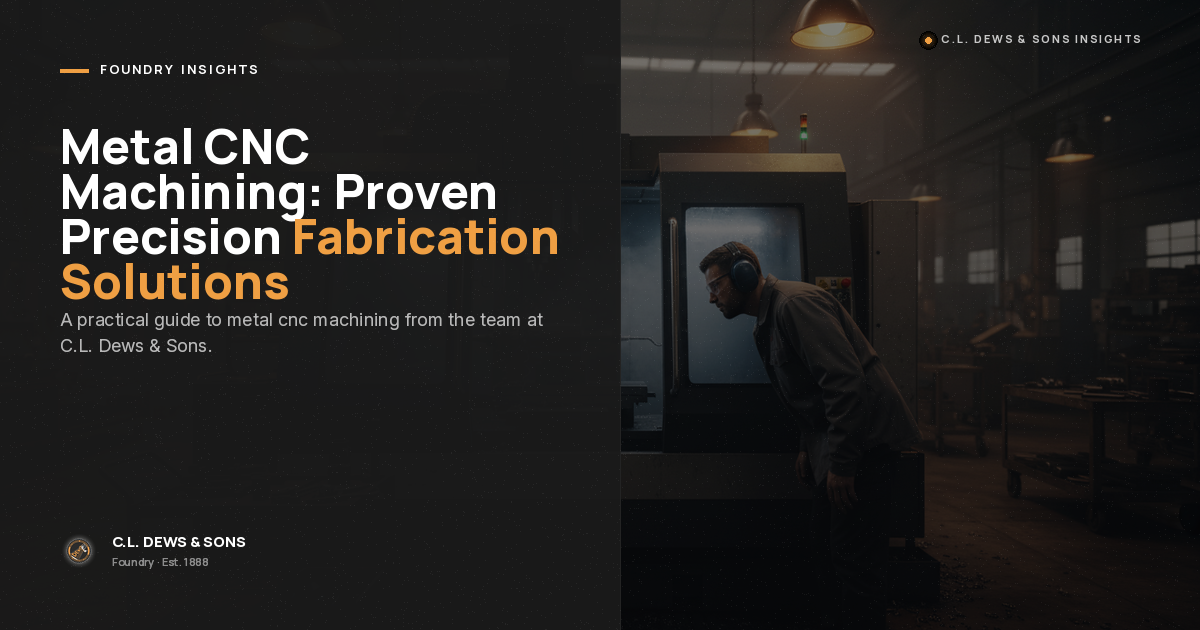
Metal CNC Machining: Proven Precision Fabrication Solutions for Complex Projects
When a cast part has to meet a tight tolerance, a strict surface finish, and a non-negotiable delivery date, the finishing process matters as much as the pour. Here is how a disciplined approach to fabrication keeps complex parts on spec from raw casting to final inspection.
Engineers shopping for precision fabrication often start the conversation with a print, a material callout, and a tolerance window. What they really want is confidence: confidence that the geometry on the drawing will leave the shop floor inside spec, every time. That confidence comes from metal CNC machining backed by experienced programmers, calibrated equipment, and a clear handoff between casting and finishing. Our team has spent decades refining that handoff so customers receive parts that drop into assembly without rework.
This guide walks through how metal CNC machining delivers the precision, repeatability, and throughput that complex fabrication projects demand. We cover the technology, the materials, the quality controls, and the questions buyers should ask before signing a purchase order.
Why Metal CNC Machining Matters for Complex Fabrication
Conventional manual finishing introduces variability the moment an operator clamps a part. Hand-cranked feeds, swapped fixtures, and visual tool changes all compound into stack-up error. Computer numerical control removes that variability by driving every axis from a verified program. The result is a finishing process that holds the same geometry on the first part, the hundredth part, and the ten thousandth part.
For fabrication projects that combine castings, weldments, and machined surfaces, that repeatability is the entire value proposition. A coupling that mates to a precision shaft cannot drift even a thousandth of an inch between production runs without causing assembly headaches downstream. Customers who specify multi-axis CNC machining services on their drawings are buying that repeatability outright.
The Cost of Geometric Drift
A small geometric error on a single part is a nuisance. The same error replicated across a production run becomes a recall. When a tolerance miss is caught at final inspection, the affected parts are rework candidates at best and scrap at worst. CNC programs lock the geometry into the machine, removing the most common source of drift before the cutter ever touches the material.

Precision tooling, programmed feeds, and consistent coolant flow keep cutting forces predictable, which is what holds tight tolerances over long production runs.
How Modern Multi-Axis Systems Deliver Precision
Single-setup finishing matters because every fixture change is another chance to lose datum alignment. A part that requires three setups on a three-axis mill has three chances for the operator to clamp slightly off the previous reference. A five-axis program completes the same job in one setup, with the workpiece rotating into the cutter rather than being rotated by hand.
Programmable Tool Paths
CAM software translates a 3D model into the toolpath that the controller executes. Every approach angle, retract motion, and feed rate is verified in simulation before a chip is cut.
Closed-Loop Servo Control
Linear scales and rotary encoders report axis position in real time. The controller corrects positional error within microseconds, which is what enables sub-thousandth accuracy on production parts.
Tool Length and Probe Compensation
Automatic tool measurement systems compensate for wear and tool changes without operator intervention. Touch probes verify the workpiece datum before machining begins.
Live Tooling and Bar Feed
Turn-mill centers combine lathe spindles with driven tools, completing turned and milled features without a second machine. Bar feeders enable lights-out production on smaller cylindrical parts.
For a deeper look at the equipment our team brings to these jobs, see our precision CNC machining capabilities overview.
Materials We Handle and Their Machining Considerations
A program that holds tolerance on aluminum will tear a stainless steel part if the feeds, speeds, and tool geometry are not tuned for the alloy. Material selection drives almost every machining decision downstream, which is why our programmers verify the heat number and certification before a part hits the spindle.
Common Alloy Families
- Carbon and alloy steels: Workhorse materials for structural and load-bearing parts. Tooling life is predictable; chip control is straightforward with the right rake and chipbreaker geometry.
- Stainless steels: Corrosion resistance comes at the cost of work hardening. Programs use sharper rake angles, generous coolant, and consistent feed to prevent the surface from glazing.
- Manganese and abrasion-resistant cast steels: The backbone of mining and aggregate parts. These alloys work-harden aggressively and demand the right cutter geometry to avoid premature wear.
- Ductile and gray iron castings: Excellent machinability when the casting is clean. Finishing operations after pour are where our foundry roots and our CNC capabilities reinforce each other.
- Bronze, brass, and copper alloys: Soft and gummy without the right feed rate. Sharp tools and aggressive coolant clear chips that would otherwise weld to the cutter.
A casting that arrives at the CNC station with locating bosses already designed for fixturing finishes faster, holds tolerance better, and ships sooner. The conversation between foundry and machining should start at the drawing review, not at the loading dock.
From Foundry Casting to Finished CNC Part
A traditional supply chain treats the foundry and the machine shop as separate vendors. The casting is shipped, inspected, sometimes re-inspected, then queued for finishing. Each handoff introduces transit time, paperwork, and a fresh set of inspection gates. When the same shop owns both processes, those friction points disappear.
Our foundry has been pouring carbon, alloy, stainless, and manganese castings since 1888. Pairing that capability with modern CNC equipment means we can review a customer drawing once, design the casting and the machining setup together, and deliver a finished part without the weeks of transit and queue time that typical multi-vendor flows incur. That integration is the quiet edge behind every precision fabrication project we accept.

Final inspection on a coordinate measuring machine verifies that every critical dimension lands inside the tolerance band before a part ships.
Quality Assurance and Tolerance Control
A precision part is only as trustworthy as the inspection that follows it. Programs that consistently produce conforming geometry still require verification, both for our internal records and for the customer’s incoming inspection. Our quality system layers three levels of measurement so problems are caught early rather than at final shipment.
In-Process Probing
Touch probes inside the machine envelope measure the workpiece before and during the cutting cycle. If the casting locates 0.003 inches off where the program expected, the controller offsets the toolpath rather than scrapping the part. In-process probing is the single best defense against casting variation.
First Article and Sampling
Every new program is verified against a first article inspection report before production runs begin. After approval, sampling intervals are set based on the run length, the critical-to-quality features, and the customer’s specification. Documented results travel with the shipment so the customer’s incoming inspection can verify our work against the same standards.
Final CMM Verification
A coordinate measuring machine validates the critical dimensions on every batch. CMM data provides a documented record of measured dimensions and can be used to support tolerance verification and quality documentation. When required, the measurement report can become part of the certification package the customer receives.
Industry guidance on CMM measurement, calibration, traceability, and measurement uncertainty is well documented by the National Institute of Standards and Technology. NIST specifically addresses how calibration and measurement uncertainty relate to coordinate measuring machines and other complex measurement instruments.
Choosing the Right Partner for Your Fabrication Project
Buyers comparing metal CNC machining suppliers often focus on quoted hourly rate, which is rarely the metric that determines total program cost. A shop with a low hourly rate but limited inspection capability will deliver parts that pass the first audit and fail the next. A shop with strong programming, in-process probing, and traceable material certification delivers parts that ship and stay shipped.
What to Ask Before Awarding the Job
- What is the actual axis configuration of the spindle that will run this part? Three-axis, four-axis, or full five-axis changes the achievable geometry and setup count.
- What inspection equipment validates the finished part, and what calibration interval does it follow?
- Can the supplier provide material certifications traceable to the heat or pour number?
- Does the supplier own the casting source, or is the upstream foundry a separate vendor with its own lead times?
- What is the standard turnaround on first article inspection, and how does the supplier handle revisions?
Answers to those questions reveal the difference between a job shop and a precision fabrication partner. The right partner will welcome the questions and have documented answers ready before the conversation ends.
Precision Is a Process, Not a Promise
Every successful metal CNC machining program starts long before the spindle spins. It starts in the drawing review, where a programmer flags features that need a different setup. It continues through the toolpath simulation, where collisions are caught in software rather than on the table. It is verified through in-process probing, first article inspection, and final CMM data that travels with the shipment.
When fabrication projects demand tight tolerance, complex geometry, and a documentation trail that holds up to audit, that disciplined process is what protects the buyer. It is what we build into every job that leaves our shop.
Ready to Move Your Next Precision Part Forward?
Send us your drawing and material callout. Our team will walk through the setup plan, the inspection approach, and the realistic lead time before you commit.
Request a Machining Quote
