
What Factors Fulfill Prototyping Needs in Product Development?
A prototype provides evidence that a product will fit, function and withstand its expected operating conditions before a manufacturer commits to full production.
To fulfill prototyping needs effectively, manufacturers must first identify what they need to learn, then choose a prototype method that can answer that question without wasting time or material.
Not every prototype must be a finished, fully functional product. Some prototypes only need to confirm dimensions or assembly clearances, while others must use production-grade materials so engineers can evaluate strength, wear, temperature resistance or machining behavior.
The right approach depends on product complexity, development cost, user requirements, manufacturing constraints and applicable safety or regulatory obligations. These factors help determine whether a digital model, appearance mock-up, machined component, test assembly or production-equivalent prototype is appropriate.
Why Prototyping Is Essential
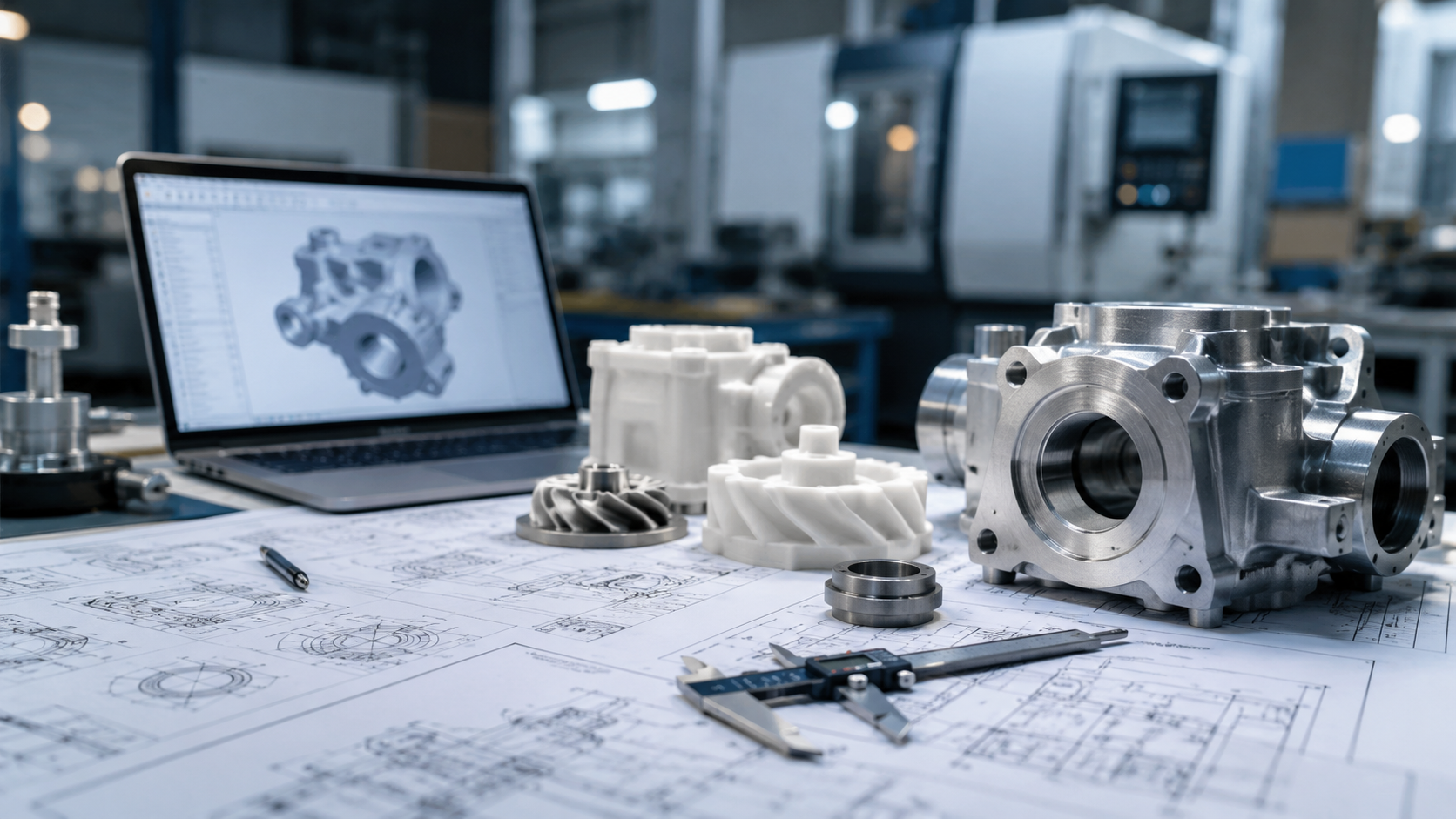
Prototyping gives product teams a practical way to test assumptions before committing to tooling, full production or installation. A drawing may look correct on a screen but still contain problems that only become obvious when the component is manufactured, assembled or placed under load.
A prototype can help a team:
- Check whether parts fit together as intended
- Evaluate dimensions, tolerances and clearances
- Compare materials or manufacturing methods
- Test selected mechanical or functional requirements
- Gather feedback from users, operators or maintenance personnel
- Identify difficult or expensive production features
- Confirm that the design can be inspected consistently
- Improve drawings and specifications before a larger production run
The purpose is not to prove that every aspect of a product is perfect in one attempt. A useful prototype should answer a defined question. For example, an early model might confirm overall geometry, while a later machined component might be used to test fit, load capacity or surface requirements.
This distinction matters because a prototype does not automatically reduce development costs. Poorly planned prototyping can create extra expense if the team tests the wrong feature, uses unnecessarily expensive materials or builds a polished model before basic design decisions have been settled.
A more disciplined process begins with a question such as:
- Will the component fit the existing assembly?
- Can the selected material withstand the intended load?
- Can the part be machined without excessive setups?
- Are the specified tolerances necessary and achievable?
- Can operators safely use and maintain the product?
- Does the design satisfy the applicable test criteria?
The National Institute of Standards and Technology identifies market validation, prototype development, material selection and durability testing as parts of product design and development. These activities help manufacturers assess technical feasibility and customer requirements before launch. Teams can review NIST’s product design and development resources for additional guidance.
Key Factors That Fulfill Prototyping Needs
The need for a prototype depends on the level of design uncertainty and the consequences of failure. Even a simple part may require thorough testing if it supports critical loads, fits costly machinery or uses an unusual material, while a complex-looking component may need only basic dimensional checks when its function is already well understood.
Complexity of the Product
Product complexity involves more than the number of components. It also includes the geometry, interfaces, operating conditions, tolerances, controls and failure modes involved in the design.
A prototype is more likely to be necessary when a product includes:
- Multiple parts that must align or move together
- Tight fits or limited assembly clearances
- Thin walls, deep pockets or difficult internal features
- Seals, bearings, shafts or mating surfaces
- Electronic, hydraulic or pneumatic systems
- New mechanisms or unfamiliar geometry
- High loads, temperatures, vibration or abrasive conditions
- Interaction between hardware, controls and software
- Limited access for installation, inspection or maintenance
A complex assembly may require several prototype stages because one model cannot answer every engineering question. An early model might evaluate size and layout, while a later functional prototype could test movement, alignment or operator access. A production-equivalent component may then be needed to evaluate material behavior and manufacturing repeatability.
However, complexity does not mean that every project requires repeated full-scale builds. A team can divide the product into smaller risks and test them separately. A test coupon may be enough to evaluate a coating, weld procedure or material property, while a single machined interface may answer a fit question without requiring the entire assembly.
Even a low-complexity product may require prototyping when it supports costly equipment, carries important loads or must align precisely with existing components. The decision should be based on the consequences of failure rather than the part’s appearance. To fulfill prototyping needs efficiently, test the feature with the greatest uncertainty or risk before investing in a complete model.
Cost and Feasibility
Prototype cost should be compared with the cost of making a poor decision without one. That comparison is more useful than claiming that prototyping always saves a fixed percentage because project economics vary widely.
The cost of a prototype may include:
- Engineering and drawing preparation
- CAD and CAM programming
- Raw material
- Patterns, molds, jigs or fixtures
- Machine setup and cutting time
- Purchased components
- Assembly and finishing
- Dimensional inspection
- Functional or destructive testing
- Design revisions and repeat builds
A prototype may cost more per part because setup, programming and inspection expenses are not spread across a larger production run. However, the cost can be justified if it prevents an incorrect order, unsuitable tooling choice or installation problem. Teams can reduce expenses by using the simplest prototype that can answer the design question rather than building a production-grade assembly unnecessarily.
Digital tools such as CAD interference checks and engineering analysis can help compare geometry, loads, deflection and thermal behavior before physical production. Their accuracy depends on reliable inputs and assumptions, so physical testing may still be needed to assess material behavior, wear, friction and real operating conditions. Rapid prototyping can support this process by producing physical models quickly through methods such as additive manufacturing, which may also be used for finished parts.
Before approving a prototype, ask:
- What decision will this prototype support?
- What is the least expensive model that can provide reliable evidence?
- Does it need production material?
- Does it need production tolerances?
- Which features can be simplified without affecting the test?
- What measurements will determine whether the design passes?
These questions prevent the prototype from becoming an expensive showpiece with no clear acceptance criteria.
User Testing and Market Demand
Technical performance does not guarantee that a product will be practical for the people who use, install or maintain it. User feedback can reveal issues that may not appear in drawings or engineering calculations.
Depending on the product, user testing may evaluate:
- Ease of installation
- Control placement and visibility
- Reach, grip and operator posture
- Loading and unloading procedures
- Access for cleaning or maintenance
- Clarity of labels and instructions
- Time required to complete a task
- Risk of incorrect assembly or operation
- Compatibility with existing equipment
For industrial products, users may include operators, technicians, installers, inspectors and purchasing teams. Each group may identify different issues, such as poor visibility, difficult maintenance or inaccessible fasteners. These problems can increase lifecycle costs even when the product performs as intended.
Market testing serves a different purpose. A prototype can help prospective buyers understand the proposed product, but it cannot prove demand by itself. Commercial viability also depends on price, competition, purchasing cycles, available budgets, distribution and the cost of supporting the product after sale.
Teams should avoid treating positive comments about a prototype as guaranteed purchase intent. Better evidence may include customer interviews, paid pilot projects, letters of intent, preorders or documented demand from existing accounts.
To fulfill prototyping needs for user and market evaluation, determine who should review the prototype and what evidence is required. General feedback such as “it looks good” is weak. Specific observations about usability, performance, installation time or willingness to purchase are more useful.
Manufacturing and Material Considerations
A prototype should reflect the manufacturing questions that could affect the final product. Geometry that can be drawn in CAD is not automatically economical, practical or repeatable to manufacture.
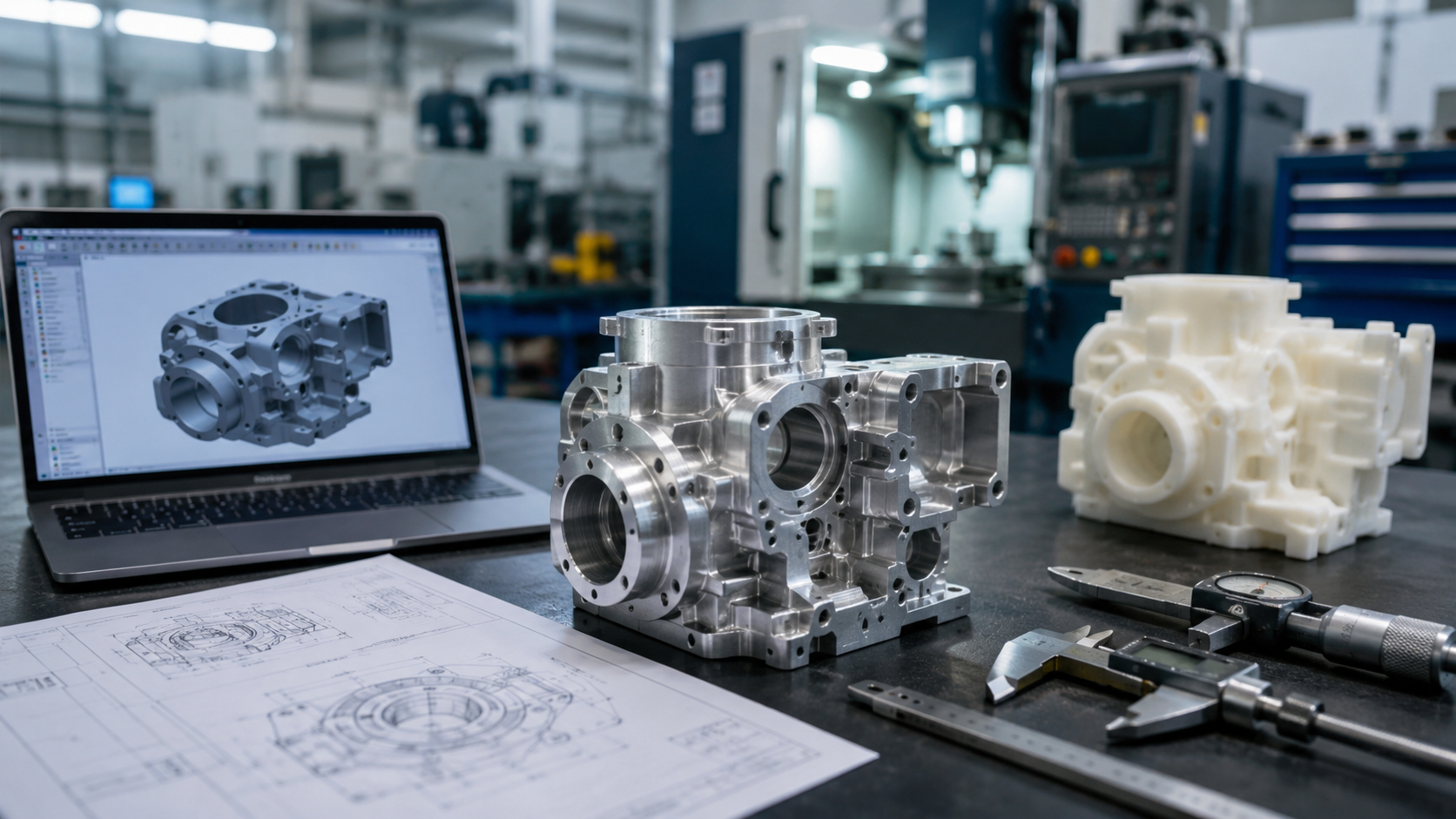
Manufacturing considerations may include:
- Availability and size of raw material
- Machinability of the selected alloy
- Required tools and machine capacity
- Number of setups and part orientations
- Access for cutting, drilling or welding
- Workholding and fixturing
- Casting draft, shrinkage and machining allowance
- Distortion during welding or heat treatment
- Surface finish and coating requirements
- Inspection access and measurement methods
- Realistic tolerances for the manufacturing process
- Expected production quantity
Material selection is equally important. A prototype made from an easy-to-machine substitute may be appropriate for checking geometry, but it may not provide useful evidence about final strength, weight, corrosion resistance, wear or thermal performance.
Production-grade material becomes more important when the purpose is to evaluate:
- Structural performance
- Fatigue or repeated loading
- Impact resistance
- Abrasive wear
- Heat exposure
- Corrosive environments
- Welding behavior
- Machining behavior
- Surface treatment
- Long-term dimensional stability
Material selection should match the application, since overly hard or exotic alloys can increase cost, machining time and tool wear without improving performance. Tight tolerances should only be applied where they are needed for fit, sealing, movement or alignment. Over-specifying every dimension can make the prototype more expensive and harder to inspect.
For metal components, our machine shop services include CNC machining, turning, milling, drilling, boring and grinding. These processes can support dimensional prototypes, replacement parts and components requiring accurate mating surfaces.
Projects involving unusual geometry or one-off parts may also benefit from custom machining services . We provide multi-axis CNC machining, prototyping and small-batch production for specialized metal components.
The best prototype is not necessarily the one that looks most like the finished product. A rough metal part that exposes a tolerance problem can be more valuable than a polished model that proves nothing beyond appearance.
Regulatory and Safety Compliance
Products used in regulated or safety-critical applications may require more structured design controls, documentation and testing. The exact requirements depend on the product, intended use, industry, jurisdiction and applicable standards.
Prototyping can support compliance by allowing teams to:
- Evaluate hazards before production
- Test guards and protective features
- Verify selected design requirements
- Assess foreseeable misuse
- Confirm labeling or instruction needs
- Document design changes
- Produce samples for laboratory testing
- Compare the finished design with approved specifications
A prototype alone does not prove compliance. Depending on the product, manufacturers may also need risk assessments, controlled drawings, material records, test reports, inspection documents, process qualifications and traceability.
Medical-device requirements vary by device type, intended use, risk and regulatory pathway, and the FDA does not require a fixed number of prototype stages. Other products may be governed by regulations, codes, standards, contracts or customer specifications, so these obligations should be identified early to avoid repeating tests or redesigning the prototype.
Need Help Evaluating a Metal Prototype?
Discuss your drawing, material, tolerance and production requirements with the Dews Foundry team before committing to a larger run.
Discuss Your ProjectChoosing the Right Prototype Type
Once the team understands what it needs to learn, it can select a suitable prototype type. The label matters less than the evidence the prototype must provide.
Concept Models
Communicate basic size, shape or arrangement and are useful while the design is still changing.
Appearance Prototypes
Focus on visible form, surface features and presentation but may not be suitable for functional testing.
Dimensional Prototypes
Check geometry, mounting points, clearances and fit with surrounding equipment.
Functional Prototypes
Reproduce selected operations or movements and may use substitute materials where appropriate.
Engineering Prototypes
Use representative components, materials and tolerances for demanding performance evaluation.
Production-Equivalent Prototypes
Use materials and processes close to the intended production method for final testing or validation.
A project does not always move through every prototype type. The correct sequence depends on risk. A replacement machine component produced from an established drawing may move directly to a first article, while a new assembly with uncertain geometry may begin with a low-cost model and progress through several functional versions.
The following decision process can help fulfill prototyping needs without unnecessary iterations:
- Define the design question.
- Identify the consequence of an incorrect answer.
- Select the minimum level of prototype fidelity needed.
- Establish measurable acceptance criteria.
- Build and inspect the prototype.
- Record the results and observed problems.
- Update the drawing, model or specification.
- Decide whether another prototype is necessary.
Each iteration should have a reason. Rebuilding the same design without changing the hypothesis, test method or acceptance criteria is not productive iteration.
Industries Where Prototyping Is Crucial
The required prototype method varies by industry and application. The table below outlines common product-development questions rather than suggesting that every organization follows the same process.
| Industry | Example Applications | Typical Prototyping Focus | Possible Prototype Approach |
|---|---|---|---|
| Automotive and Transportation | Brackets, housings, mounts, battery enclosures and vehicle components | Fit, vibration, thermal conditions, strength, assembly and manufacturability | Machined parts, fabricated assemblies, test fixtures and production-material samples |
| Medical Equipment | Instrument components, housings, fixtures and device mechanisms | Intended use, usability, risk controls, verification, validation and regulatory evidence | Dimensional models, functional assemblies and production-equivalent units where required |
| Aerospace | Structural fittings, tooling, housings and mechanical components | Weight, material properties, dimensional accuracy, fatigue, temperature and inspection | Engineering prototypes, test coupons and production-representative components |
| Mining and Aggregate | Wear parts, guards, mounts, liners and equipment components | Abrasion, impact, fit, maintainability and field replacement | Cast or machined test parts, material samples and trial installations |
| Construction and Infrastructure | Connections, supports, brackets and custom fabricated components | Load transfer, site fit, installation access, corrosion protection and inspection | Fabricated mock-ups, machined interfaces and full-size trial assemblies |
| Industrial Machinery | Shafts, bushings, tooling, housings and replacement components | Alignment, motion, tolerances, material wear and equipment integration | CNC-machined prototypes, functional subassemblies and first articles |
| Consumer Products | Enclosures, controls, tools and household equipment | Ergonomics, appearance, assembly, safety and buyer response | Appearance models, user-test units and limited pilot production |
| Robotics and Automation | End effectors, frames, mounts, actuators and sensor housings | Movement, repeatability, control integration, guarding and payload | Functional assemblies, machined parts and staged hardware-software testing |
The common thread is not that every industry requires extensive prototyping. The level of work should reflect the product’s uncertainty, failure risk, manufacturing investment and evidence requirements.
Moving From Prototype to Production
A successful prototype is not automatically ready for production. The development team must translate what it learned into controlled specifications and a repeatable manufacturing plan.
Before moving forward, review:
- Final dimensions and tolerances
- Material grade and condition
- Surface finish and coating
- Manufacturing sequence
- Tooling and fixture requirements
- Inspection methods
- Approved suppliers
- Test and acceptance criteria
- Assembly instructions
- Design revisions
- Production quantity
- Packaging and handling requirements
All prototype changes should be recorded in the latest drawing or model to prevent version-control errors. Manufacturability should also be reviewed before production, since a feature that works for one prototype may be too costly or time-consuming at scale. Setup time, tool access, material use and inspection requirements become more important as production quantities increase.
For machined parts, the production path commonly begins with a drawing or CAD model, followed by CAM programming, material setup, cutting, inspection and finishing. Our detailed guide to how CNC machining turns a design into a finished metal part explains these stages and the role each one plays in final part quality.
A first article may be appropriate before releasing the full quantity. This allows the customer and manufacturer to confirm that the agreed drawing, material, process and inspection requirements produce an acceptable part.
Possible Prototype Review Outcomes
- The design is ready for production.
- The design is acceptable with documented revisions.
- Additional testing is required.
- A material or process must change.
- The concept does not meet the project requirements.
Stopping or redirecting a weak design is also a valid outcome. The purpose of prototyping is to improve decision-making, not to force every concept into production.
Conclusion
To fulfill prototyping needs effectively, manufacturers must identify the uncertainty they are trying to resolve. Product complexity, development cost, user requirements, material behavior, manufacturing constraints and applicable safety obligations all influence the type of prototype required.
A prototype may be a basic model, a machined interface, a functional assembly or a production-equivalent component. The right choice is the least complicated prototype that can provide reliable evidence for the next decision.
Dews Foundry supports industrial prototyping through CNC machining, custom component manufacturing, precision grinding and small-batch production. By involving an experienced manufacturing team early, businesses can evaluate material, geometry, tolerances and production feasibility before committing to a larger order.
Turn Your Design Into a Reliable Metal Prototype
Send Dews Foundry your drawing, CAD model or project requirements to discuss machining, materials, tolerances and production feasibility.
Get in touch with our team today
