
The Advantages of Precision CNC Machining Services for Modern Manufacturing
Precision CNC machining supports faster production, consistent quality, and better-performing industrial components.
A machined component does not need to be perfect, but it must meet the required dimensions, tolerances, surface finish, and functional specifications. Precision CNC machining services help manufacturers achieve these requirements consistently while reducing production time, material waste, and rework. However, accurate results still depend on the drawing, material, programming, tooling, workholding, machine condition, inspection process, and the experience of the machining team.
For manufacturers working with custom components, replacement parts, machined castings, or production-ready designs, CNC machining provides a controlled way to turn digital specifications into functional metal parts. When the process is planned correctly, it can improve repeatability, simplify complex operations, and help protect the profitability of a project.
Beyond Manual Machining: A More Controlled Production Process
Manual machining remains valuable for repairs, adjustments, one-off work, and operations that benefit from direct machinist control. CNC machining does not make those skills obsolete. Instead, it combines machining knowledge with digital programming and automated machine movement.
In manual machining, an operator controls much of the tool movement directly. With CNC machining, the operator or programmer defines the required movements in advance, and the machine follows those programmed instructions. This makes CNC especially useful when a component contains multiple features that must be reproduced consistently.
What Changes When Machining Becomes Computer-Controlled?
The main advantage is not that CNC machining removes people from the process. Skilled people are still responsible for reviewing drawings, selecting tools, preparing setups, establishing offsets, monitoring cutting conditions, measuring parts, and responding to tool wear or dimensional changes.
A verified CNC program can control the path, direction, feed rate, spindle operation, and sequence of machining steps more consistently than an operator manually repeating every movement. This can reduce variation between components, particularly during repeat production.
However, CNC machining does not eliminate variation completely. Tool wear, thermal expansion, vibration, material properties, part movement, machine geometry, and measurement uncertainty can all affect the finished result. These variables are why inspection and process control remain essential even when advanced CNC equipment is used.
Defining Precision and Profit in Practical Terms
Precision should not be treated as a vague marketing term. In machining, it refers to how closely a completed feature meets its specified size, location, geometry, or surface requirement.
Profit is also more complicated than simply running a machine faster. A project becomes more economical when the manufacturing process:
- Meets the required specifications without unnecessary operations
- Reduces preventable scrap and rework
- Avoids tolerances that the part does not functionally need
- Uses appropriate stock, tooling, and workholding
- Limits unnecessary setups and tool changes
- Produces parts that fit and operate as intended
- Identifies dimensional problems before an entire batch is completed
A practical rule is to avoid paying for tight tolerances on surfaces that do not affect fit, movement, sealing, alignment, or load transfer. Experienced precision CNC machining services add value by identifying which features truly require close dimensional control. The goal is not to tighten every dimension, but to apply precision where it directly supports part performance.
Understanding Computer Numerical Control Machining
CNC machining removes material from a workpiece using computer-controlled equipment. The starting material may be a bar, plate, block, casting, forging, or fabricated assembly. Common operations include milling, turning, drilling, boring, and grinding.
Our machine shop services include CNC machining, turning and milling, drilling and boring, precision grinding, and custom component fabrication. These capabilities can support industrial parts that require controlled bores, mounting faces, holes, slots, diameters, or mating surfaces.
What Is CNC Machining?
Computer Numerical Control refers to the automated control of machining equipment through a programmed set of instructions.
Common CNC equipment includes:
- CNC mills
- CNC lathes and turning centers
- CNC boring equipment
- CNC grinders
- Multi-axis machining centers
The correct machine depends on the geometry and functional requirements of the part. A cylindrical shaft may be suited to turning, while a plate with pockets, bolt patterns, and machined faces may require milling. Some parts move between several machines or processes before completion.
CNC machining is particularly valuable when a component must be produced repeatedly or contains features that require coordinated machine movement. It also allows an approved program to be stored and reused, although tooling, offsets, setup conditions, and inspection requirements still need to be verified for each production run.
How CAD, CAM, and CNC Programs Work Together
The workflow starts with a drawing, 3D model, or technical specification that defines the part’s dimensions and features. CAM software then creates toolpaths that guide the cutting tool through the material. It can also help plan operation order, feeds, speeds, stock allowances, and collision checks.
A post-processor converts the programmed operations into instructions that the specific machine controller can interpret. These instructions may include G-codes for movement and machining modes, M-codes for auxiliary functions, and additional values for coordinates, tools, offsets, spindle speeds, and feed rates.
The process is not as simple as sending a digital model directly to the machine and pressing start. Before production, the shop may need to:
- Review the drawing and identify critical features.
- Confirm the material and starting stock.
- Determine the machining sequence.
- Select cutting tools and holders.
- Design or prepare the workholding method.
- Program and simulate the toolpaths.
- Establish work and tool offsets.
- Run and inspect an initial component.
- Adjust the process if measurements show dimensional drift.
- Continue production with appropriate monitoring and inspection.
These steps are part of what separates dependable precision CNC machining services from basic machine access.
Precision as a Foundation for Quality and Profitability
Precision matters because industrial components rely on accurate alignment between connected features. Bearing bores, mounting faces, and bolt holes must match their adjoining parts. Replacement components must also fit the existing equipment correctly.
A feature that falls outside its required tolerance can cause assembly delays, leakage, vibration, poor load distribution, accelerated wear, or complete rejection of the part. That does not mean every small dimensional difference creates a failure. It means the tolerances shown on the drawing should reflect what the component actually needs to do.
Accuracy, Precision, and Repeatability Are Not the Same
These terms are often used as though they mean the same thing, but they describe different aspects of machining performance.
| Term | Practical Meaning in Machining |
|---|---|
| Accuracy | How closely the completed feature matches its specified value. |
| Precision | The level of dimensional control required or achieved. |
| Repeatability | How consistently a machine and process can produce the same result under similar conditions. |
A CNC process can repeat the same error if an offset or setup is incorrect. Consistency alone does not guarantee accuracy. Machinists must measure finished parts against specifications and adjust the process when needed.
Tool wear and temperature are particularly important during longer runs. Cutting edges gradually wear, and heat generated by motors, bearings, cutting operations, and changes in the surrounding environment can affect machine dimensions. The National Institute of Standards and Technology’s research on CNC machining accuracy identifies thermal expansion, tool wear, and other changing conditions as obstacles to maintaining machining accuracy over time.
For that reason, the thousandth part should not simply be assumed to match the first. It must remain within the required tolerances through appropriate inspection, tool management, and process adjustment.
Reducing Waste and Rework
CNC machining can reduce preventable waste when the program, setup, and cutting conditions are correct. It can also create expensive scrap quickly when they are not.
The first stage of cost control is therefore process planning. A shop needs to determine:
- How much stock must be removed
- Which operations should happen first
- How the part will be held securely
- Which surfaces can be completed in one setup
- Where distortion or part movement may occur
- How tool access will affect the design
- Which dimensions require verification during production
- Whether casting or fabrication could provide a more economical starting form
CAM software can improve toolpaths, but material efficiency also depends on stock size, nesting, orientation, and workholding. Machining a large part from solid stock may create unnecessary waste. In some cases, casting or fabrication followed by machining only critical features is more efficient.
Our related guide on machining versus fabrication for industrial parts explains why choosing the right starting process can affect machining time, material waste, tolerance control, and total project cost.
Supporting Quality Control and Component Reliability
A CNC program can preserve an approved sequence of machine movements, but that does not mean every physical part will perfectly reproduce the CAD model. Real-world machining includes variables that do not exist in an ideal digital environment.
Quality control connects the digital design to the finished component. Depending on the job, inspection may include:
- Outside and inside diameter measurements
- Hole location and bolt-pattern verification
- Bore measurements
- Flatness and parallelism checks
- Thread verification
- Surface finish checks
- Height, depth, and length measurements
- Inspection of mating or sealing surfaces
- Comparison with an approved drawing or sample
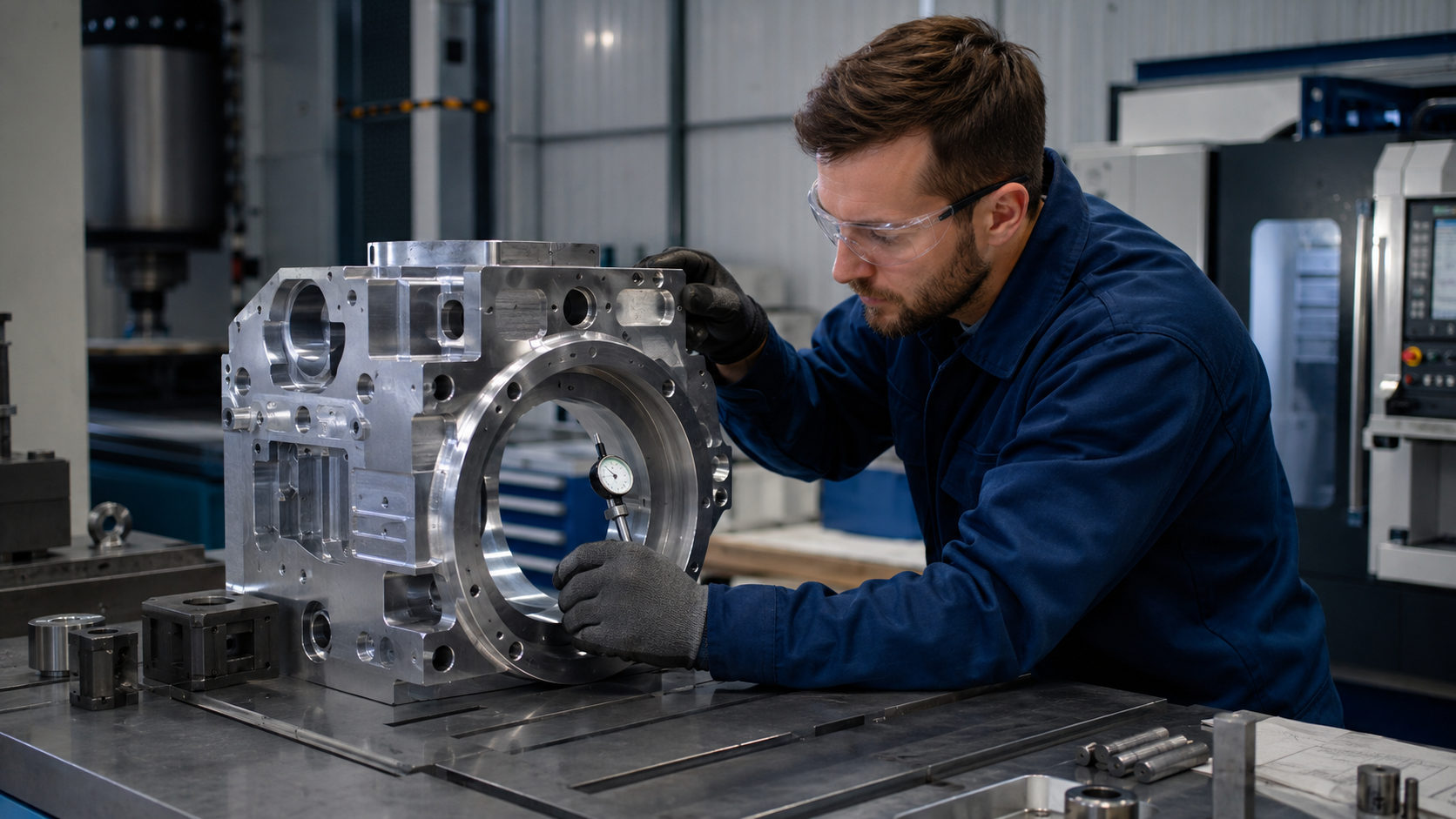
Inspection requirements vary depending on the part and its critical features. Precision CNC machining services identify these features before production begins. This allows inspectors to focus on dimensions that affect fit, assembly, and performance.
Managing Risk Without Overpromising
CNC machining can support component quality, but it cannot independently guarantee that a product will be safe, reliable, or free from failure.
Part performance may also depend on:
- Material grade and condition
- Heat treatment
- Casting or fabrication quality
- Coatings and surface treatments
- Engineering calculations
- Assembly procedures
- Operating loads
- Lubrication and maintenance
- Documentation and traceability
- Industry-specific inspection requirements
Precision machining is one part of a wider manufacturing and quality process. For replacement components, copying a worn or repaired part may produce inaccurate results. A reliable drawing, material specification, functional details, and inspection plan may be needed before production.
Efficiency and Speed Without Sacrificing Process Control
CNC machining can improve throughput through programmed movements, automatic tool changes, and efficient setups. However, not every project can be completed quickly. Lead times still depend on material availability, programming, tooling, machine capacity, finishing, inspection, and shop workload.
Streamlining Production Cycles and Setup
Reducing part repositioning can improve machining efficiency. Each additional setup adds labor and may create alignment or measurement challenges. Completing multiple features in one controlled setup can save time and maintain accurate relationships between them.
However, fewer setups are not automatically better. A complicated fixture or difficult tool approach may create more risk than a carefully planned second setup. The machining strategy should balance access, rigidity, inspection, cycle time, and part quality.
Continuous or unattended operation is also possible in some CNC environments, but it requires more than a verified program. Depending on the operation, extended production may require:
- Automatic material or part handling
- Adequate tool capacity
- Tool-life monitoring
- Broken-tool detection
- Chip management
- Coolant control
- In-process measurement
- Alarm monitoring
- Reliable guarding and safety systems
For many custom or industrial jobs, experienced operator involvement remains more practical than fully unattended production.

Moving From Prototypes to Production
CNC machining allows prototypes to be tested as functional metal parts before full production. If changes are needed, the drawing and program can be updated without creating new hard tooling. This makes design revisions easier for parts with holes, bores, threads, profiles, and mounting features.
The phrase “rapid prototyping” should still be used carefully. A digital revision may be quick, but the updated part must still be programmed, set up, machined, finished, and inspected. Specialized material or tooling can also extend the schedule.
Our custom machining services support multi-axis CNC machining, prototyping, precision grinding, custom component work, and specialized industrial projects. The appropriate route depends on the component’s geometry, material, quantity, and required features.
Once a prototype is approved, the program, setup information, inspection points, and tooling strategy can help support repeat production. These records reduce the need to rebuild the entire process from memory, although the setup must still be verified when the job returns to the machine.
Design Freedom and Material Versatility
CNC machining can produce complex features, but it still has practical limits. Cutting tools need clear access, and the workpiece must be held securely within the machine’s capacity. Deep cavities, narrow slots, thin walls, long overhangs, and difficult undercuts can increase cost and complexity.
Producing Complex Geometries With Multi-Axis Machining
Multi-axis CNC machining allows the cutting tool or workpiece to move through additional directions compared with a basic three-axis setup. This can improve access to angled faces, curved profiles, pockets, holes, and features located on several sides of the component.
Potential advantages include:
- Fewer part repositioning steps
- Better control of relationships between features
- Improved access to angled surfaces
- More efficient machining of complex external geometry
- Reduced need for multiple dedicated fixtures
- The ability to combine several operations in one setup
Multi-axis machining expands design options but does not remove every production limit. Inaccessible cavities, deep features, and blocked tool paths may require specialized processes or design changes. Simple adjustments such as larger corner radii, better tool access, and shallower pockets can reduce machining time and cost.
Matching the Process to the Material
Dews Foundry machines steel, stainless steel, and aluminum, each with different cutting characteristics.
| Material | Machining Considerations |
|---|---|
| Steel | Steel grades vary in strength, hardness, and machinability, so tooling and cutting conditions must match the specific grade. |
| Stainless Steel | Stainless steel can retain heat and work-harden, requiring controlled cutting conditions and appropriate tooling. |
| Aluminum | Aluminum is generally easier to machine but may distort if too much material is removed without proper support. |
The material cannot be selected based on machinability alone. It must also meet the application’s requirements for strength, wear resistance, corrosion resistance, temperature, impact, weight, and service environment.
Strategic Applications of Precision CNC Machining Services
CNC machining is used across many industries, but the most useful examples are not generic claims about aerospace, medical devices, or automotive production. The better question is where machining solves a real dimensional or fit problem.
We serve industrial sectors that include mining and aggregate, recycling, construction, infrastructure and transportation, oil and gas, and manufacturing. Within these environments, machined components may be exposed to heavy loads, abrasive material, vibration, contamination, and demanding operating conditions.
Mining, Aggregate, and Recycling Equipment
Mining and material-processing equipment often depends on large, durable components that must align correctly with adjoining assemblies.
Potential machining requirements may include:
- Bearing bores
- Shaft fits
- Mounting faces
- Bolt patterns
- Bushings and sleeves
- Equipment repair parts
- Machined castings
- Replacement components for older machinery
Not every surface requires tight tolerances. Cast or fabricated parts may need precise control only on critical bores, faces, and mounting points. This reduces unnecessary machining while protecting alignment and movement.
Construction, Infrastructure, and Transportation
Large industrial components often combine fabrication and machining. Welding provides structural strength, while machining finishes critical holes, bores, slots, and mounting surfaces. Machining after fabrication can help correct heat-related distortion and improve final alignment.
This is another reason precision CNC machining services should be involved early. A machining review can help determine which features should be completed before fabrication, which should be left for final machining, and what stock allowance is needed.
Manufacturing, Oil and Gas, and Custom Equipment
Manufacturing facilities frequently need components that are no longer readily available from an original equipment supplier. They may also need a modified part to solve a recurring fit, wear, or maintenance problem.
Custom CNC machining can support:
- Replacement shafts and bushings
- Equipment adapters
- Custom plates and brackets
- Machine components
- Repair parts
- Prototypes
- Modified production components
- Parts produced from drawings or approved specifications
Oil and gas components may require specific materials, documentation, inspection, and corrosion or pressure controls. These requirements must be defined before production rather than assumed by the machining supplier. CNC machining provides the required geometry, but engineering approval, material verification, and applicable codes still apply.
The Future of CNC Machining and Connected Manufacturing
CNC technology continues to advance through improved controls, simulation tools, sensors, machine monitoring, and production software. Connected systems can track machine status, spindle loads, temperature, tool use, alarms, and production progress.
When this data is reliable and reviewed properly, it can support maintenance planning, process improvements, and downtime investigations.
Digital twins and simulations can help test programs, evaluate machine movement, and identify possible collisions before cutting begins, but physical verification is still essential. Artificial intelligence may also support programming, toolpath optimisation, and machine-data analysis. However, any gains in cycle time depend on the part, machine, tooling, software, and efficiency of the original process.
CNC Machining as a Strategic Manufacturing Capability
CNC machining provides manufacturers with a controlled way to produce complex metal components, repeat approved operations, and maintain critical dimensional relationships.
Its most important advantages include:
- Repeatable programmed machine movement
- Controlled production of critical features
- Reduced dependence on manual tool guidance
- Efficient completion of multiple operations
- Support for prototypes, custom parts, and production work
- Compatibility with cast, fabricated, and solid-stock components
- The ability to store and reuse approved programs
- Better opportunities for process monitoring and inspection
CNC machining benefits depend on the quality of the programming, setup, tooling, and inspection process. A machine can repeat a correct process consistently, but it can also repeat errors caused by poor offsets or weak workholding. Precision comes from the entire manufacturing system, not the machine alone.
Manufacturers should choose precision CNC machining services based on more than equipment capacity. The supplier should understand drawings, tolerances, materials, quantities, finishing, inspection, and how the part will perform in service. We provide U.S.-based machining support from Hattiesburg, Mississippi, for industrial components used across mining, construction, manufacturing, recycling, infrastructure, transportation, and oil and gas operations.
For a productive quotation, provide the available drawing or model, material requirements, quantity, critical tolerances, inspection expectations, and intended application. Clear information at the beginning gives the machining team a better chance of recommending a process that protects both component performance and project cost.
Request a Quote for Precision CNC Machining Services
Send Dews Foundry your drawing, model, material requirements, quantity, tolerances, and inspection expectations to start a practical machining review.
Contact us today
