
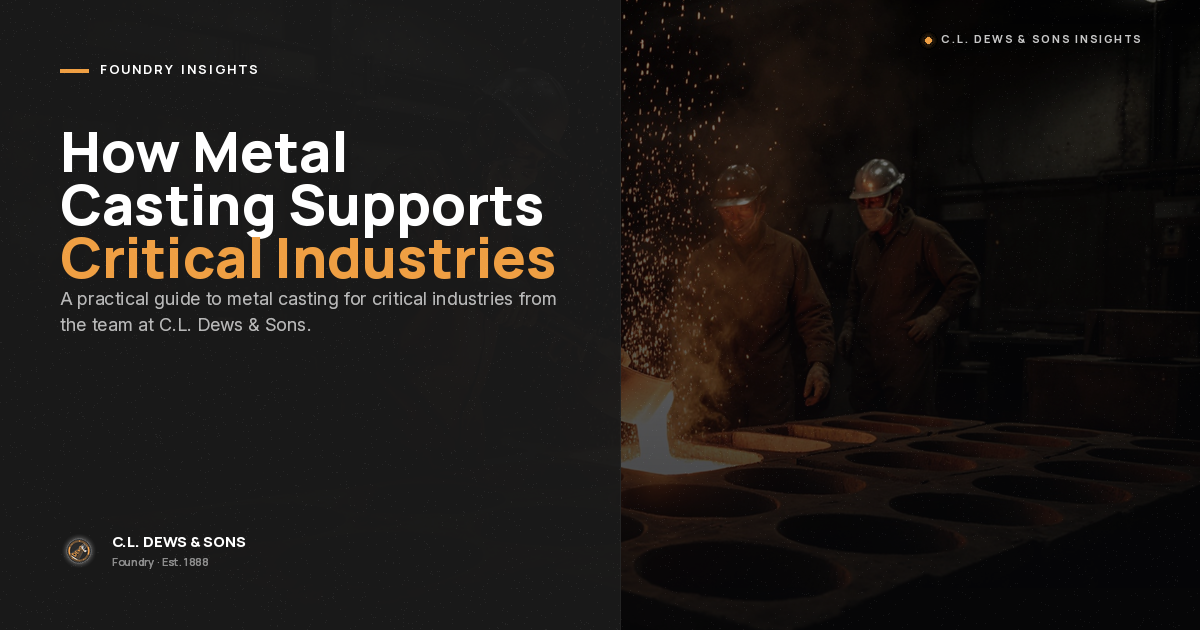
Metal Casting for Critical Industries: Building Parts That Perform Under Pressure
How alloy selection, casting design, heat treatment, inspection, and CNC machining work together to produce reliable industrial components.
A failed casting in a crusher, conveyor, pump, or infrastructure system can bring production to a halt and damage nearby equipment. That is why metal casting for critical industries requires more than simply pouring molten metal into a mold; the alloy, design, heat treatment, inspection, and CNC machining plan must all suit the part’s real operating conditions.
Mining, recycling, construction, energy, transportation, and heavy manufacturing rely on cast components because casting can create strong, complex parts efficiently. At C.L. Dews & Sons Foundry & Machinery, this includes high-chrome wear parts, gray iron castings, replacement components, steel fabrications, and machined parts, all of which must be matched carefully to the demands of the application.

What Is Metal Casting?
Metal casting is a manufacturing process in which metal is melted, poured into a prepared mold, allowed to solidify, and removed as a near-net-shape component. The mold cavity determines the basic shape of the casting, while the alloy and production process influence its hardness, strength, toughness, machinability, wear resistance, and service life.
Casting is especially useful for:
- Complex shapes that would be difficult to fabricate or machine from solid stock
- Heavy components requiring substantial cross-sections
- Internal passages or cavities created using cores
- Industrial replacement parts that are no longer commercially available
- Repeated production of the same part from an established pattern
- Components requiring wear-resistant alloys
- Parts that will receive CNC machining after casting
A near-net-shape casting may closely resemble the finished part, but critical surfaces often still need CNC machining. Features such as bores, threads, keyways, bolt patterns, and mounting faces require tighter tolerances and smoother finishes. Casting forms the main shape, while CNC machining prepares the part for accurate installation and reliable operation.
Common Metal Casting Methods
Different casting methods suit different materials, production volumes, part sizes, geometries, and tolerance requirements. No single method is automatically best for every critical component.
Sand Casting
Sand casting creates a mold by packing prepared sand around a pattern. After the pattern is removed, molten metal is poured into the cavity and allowed to solidify.
The process is widely used for industrial castings because it can accommodate:
- Small or very large components
- Complex external shapes
- Internal cavities formed with cores
- Iron and other high-temperature alloys
- Low-volume custom work
- Replacement components
- Repeat production using permanent patterns
Sand casting can achieve reliable accuracy when the pattern, mold, geometry, shrinkage allowance, and pouring process are properly controlled. Only critical areas need extra machining allowance rather than applying tight tolerances to every surface. CNC machining can then finish bores, faces, holes, and mounting features efficiently.
For a closer explanation of mold preparation, pouring, alloy selection, and inspection, read our guide to the sand metal casting process.
Investment Casting
Investment casting uses a wax pattern covered with ceramic to form the mold. Once the shell hardens, the wax is removed, and molten metal fills the cavity. The process is well suited to small, detailed parts used in aerospace, medical, defense, valve, and precision equipment applications.
Investment casting is part of the wider metal casting industry, but it should not be confused with the heavy sand-casting work commonly used for large wear parts and industrial equipment. Buyers should select a supplier based on the specific casting method, alloy, size range, and inspection requirements their project needs.
Die Casting
Die casting forces molten aluminium, zinc, or magnesium into a reusable steel die under pressure. It is commonly used to produce housings, brackets, covers, electronics components, and automotive parts in large quantities. Because tooling costs are high, the process is most economical for high-volume production.
Although die-cast components can achieve consistent shapes and good surface finishes, some features may still require CNC machining. Drilled holes, threaded ports, bearing seats, gasket faces, or precision interfaces may be machined after casting.
Centrifugal Casting
Centrifugal casting spins the mold as molten metal solidifies, pushing the material toward the outer wall. It is commonly used for cylindrical parts such as sleeves, liners, rings, bushings, and pipes. The process is best suited to components whose shape and material requirements match this casting method.
Again, the rough cast form may require CNC machining to achieve the specified inside diameter, outside diameter, concentricity, face condition, or surface finish.
| Casting Method | Common Strength | Typical Applications |
|---|---|---|
| Sand Casting | Flexible size, alloy, and volume range | Heavy industrial parts, wear components, and replacements |
| Investment Casting | Detailed geometry and fine features | Small precision components |
| Die Casting | Fast, repeatable high-volume production | Housings, covers, brackets, and automotive parts |
| Centrifugal Casting | Well suited to rotationally symmetrical forms | Sleeves, liners, rings, bushings, and pipes |
Why Metal Casting Matters in Critical Industries
A component is considered critical when its failure can cause downtime, safety risks, equipment damage, or costly repairs. It does not need to be highly complex to be essential. Even a simple liner, housing, grate, or bearing support can stop an entire operation if it fails.
Several factors determine whether a casting will perform reliably:
- The correct alloy for the application
- A design that avoids harmful stress concentrations
- Adequate feeding during solidification
- Controlled pouring and mold preparation
- Appropriate heat treatment
- Sufficient machining allowance
- Accurate CNC machining of functional features
- Dimensional and material inspection
- Correct installation and operating practices
Foundries must understand the part’s function, wear conditions, failure history, and fit requirements before selecting the right material.
Metal Casting in Mining and Aggregate Processing
Mining and aggregate equipment handles rock, ore, sand, gravel, and other abrasive materials. Crushers, conveyors, screens, chutes, feeders, and material-handling systems operate under combinations of impact, abrasion, vibration, and heavy loading.
Crusher Wear Parts
Components designed for crushing zones exposed to repeated abrasion and impact.
Blow Bars and Anvils
High-wear parts used in impact crushing and material reduction equipment.
Curtain and Chute Liners
Replaceable surfaces that protect equipment from sliding and impact wear.
Feed Tubes and Rotor Shoes
Parts that manage material flow and withstand concentrated abrasion.
Wear Plates and Impellers
Components used where material movement causes erosion and surface loss.
Custom Replacement Parts
Non-standard components reproduced from drawings, patterns, or worn samples.
High-chrome cast iron is often used for abrasion resistance, but chrome content alone does not determine performance. Service life also depends on geometry, heat treatment, impact exposure, mounting support, and the material being processed. CNC machining then helps ensure bolt holes, bores, slots, and mounting faces fit correctly and reduce the risk of vibration or uneven wear.
Our foundry services focus on high-chrome cast iron parts and industrial wear components for demanding mining, aggregate, and recycling applications. Keeping foundry work and CNC machining coordinated can also reduce the risk of a raw casting reaching the machine shop without enough material in the areas that require final finishing.

Metal Casting in Oil and Gas Operations
Metal castings are used throughout the wider oil and gas sector in pumps, valves, compressors, pipe systems, drilling equipment, and processing machinery. These components may encounter pressure, corrosive media, cyclic loading, temperature changes, erosion, or abrasive particles.
The material and quality requirements can be strict because pressure-containing and process-critical equipment may be governed by specific engineering codes, purchaser specifications, testing requirements, and material standards.
Potential cast components include:
- Pump housings
- Valve bodies
- Impellers
- Compressor components
- Bearing housings
- Equipment bases
- Wear-resistant process parts
CNC machining often follows casting to finish seal faces, flanges, threaded connections, bores, and alignment features. These areas require controlled dimensions and surface finishes for reliable performance. Buyers should also verify that the foundry has the materials, certifications, testing, inspection, and industry experience required for the application.
Our capabilities should be discussed based on the exact part rather than making a blanket claim that every oil and gas casting can be produced in-house.
Metal Casting in Construction and Infrastructure
Construction and public infrastructure rely on a combination of cast components, machined parts, and fabricated steel assemblies. Applications range from drainage and transportation systems to heavy equipment and industrial facilities.
| Application | Possible Component | Manufacturing Consideration |
|---|---|---|
| Drainage | Grates and drainage components | Load capacity, fit, corrosion exposure, and repeatability |
| Industrial Equipment | Machine bases and bearing housings | Rigidity, alignment, damping, and machined interfaces |
| Municipal Systems | Municipal castings and heavy-duty supports | Service environment, loading, and dimensional control |
| Construction Machinery | Equipment and replacement parts | Impact, wear, installation fit, and field serviceability |
Infrastructure projects may require cast parts or fabricated components such as bridge bearings, drainage assemblies, guardrail elements, and structural steelwork. Casting suits complex molded shapes, heavy sections, and repeat production, while steel fabrication is better for parts assembled from plates, tubes, bars, and welded sections. Choosing the right process depends on the component’s design, material, and performance requirements.
Some projects combine both. A cast housing or bearing component may connect to a fabricated support, while CNC machining ensures the mating surfaces align.
Our steel fabrication services support construction and infrastructure requirements involving custom metal components, drainage products, highway items, embedded steel, and related industrial fabrications.
Metal Casting in Aerospace and Automotive Manufacturing
Aerospace and automotive manufacturers use castings extensively, but their materials, processes, tolerances, documentation, and supplier approvals differ significantly from heavy industrial foundry work.
Automotive Castings
Engine blocks, cylinder heads, transmission housings, brake components, suspension parts, electric motor housings, and structural aluminum components.
Aerospace Castings
Turbine and engine components, structural brackets, housings, pump components, and complex air-management parts.
These industries use specialised methods such as sand, investment, permanent mold, and die casting with metals selected for the application. Casting mainly produces mechanical, structural, thermal, and fluid-management components. Aerodynamic performance depends on the engineered shape exposed to airflow, not simply on whether a part was cast.
CNC machining creates the precise bores, sealing surfaces, bearing seats, and connection points these cast components require. However, buyers should choose foundries with proven process control, traceability, and industry-specific quality systems.
Need a Casting Built Around Real Operating Conditions?
Discuss the material, geometry, wear environment, machining requirements, and inspection needs before production begins.
Discuss Your ProjectMetal Casting in Renewable and Conventional Energy
The energy sector uses castings in power generation equipment, pumps, turbines, gear systems, electrical machinery, and material-handling equipment.
Relevant cast parts may include:
- Turbine housings and components
- Pump casings
- Impellers
- Gearbox housings
- Bearing housings
- Generator and motor housings
- Hydro equipment components
- Wear parts for fuel or raw-material handling
Wind turbine blades are generally made from composite materials, while cast metal is used for hubs, housings, bearing supports, and drivetrain components. Solar panel frames and mounting rails are usually extruded or fabricated rather than cast. However, specialised housings, brackets, connectors, and equipment parts may still use cast components.
CNC machining supports energy castings by finishing shafts, bores, mating faces, mounting patterns, seal areas, and alignment features. As with oil and gas components, the required material documentation, testing, and quality controls depend on the application.
Casting Applications in Defense, Agriculture, and Healthcare
Defense, agriculture, and healthcare all use metal castings, but they should not be grouped as though they share identical production requirements.
Defense
Defense equipment may use castings in vehicle systems, machinery, pumps, housings, structural components, and support equipment. Applicable specifications, traceability, cybersecurity obligations, quality systems, and supplier approvals may be extensive.
Agriculture
Agricultural machinery uses cast components in:
- Gear housings
- Pump bodies
- Wheel and drive components
- Bearing housings
- Tillage equipment
- Harvesting machinery
- Heavy equipment replacement parts
Agricultural equipment must withstand abrasion, impact, dust, moisture, and corrosion. A failed part during planting or harvest can cause costly downtime. CNC machining helps finish shaft fits, bearing seats, threaded holes, mounting faces, and alignment points on custom castings.
Healthcare
Medical equipment can contain cast metal housings, frames, instrument components, imaging equipment parts, and support structures. Implantable devices and surgical instruments, however, may require highly specialised materials, clean manufacturing environments, validation, and regulatory controls.
Casting supports many industries, but supplier capabilities vary widely. Dew’s expertise should remain focused on the industrial markets it can verify and serve directly.
How CNC Machining Completes a Critical Casting
The casting process creates the part’s basic form, but CNC machining often turns it into a component that is ready to install.
- Milling mounting faces
- Boring internal diameters
- Drilling bolt patterns
- Cutting threads
- Turning cylindrical features
- Creating keyways and slots
- Finishing sealing surfaces
- Establishing reference datums
- Correcting machining stock to the final dimension
Planning for CNC machining should begin before the metal is poured. The foundry and machine shop need to consider:
- Where machining stock is required
- How the casting will be held during machining
- Which surfaces establish the datum
- Whether the geometry allows tool access
- How casting variation affects setup
- Which dimensions are genuinely critical
- Whether heat treatment occurs before or after rough machining
- How the part will be inspected
Treating CNC machining as an afterthought creates avoidable problems. A casting may not have enough stock on one surface, a fixture may be difficult to design, or a critical feature may be inaccessible to the cutting tool.
Our custom CNC machining and precision machining services include operations such as milling, turning, drilling, boring, and grinding for industrial components. Coordinating casting and CNC machining through one manufacturing workflow can simplify communication when both processes are required.
Quality Control for Critical Industrial Castings
Quality control should reflect how the component will be used. Not every casting needs the same inspection plan, but critical features must be identified before production begins.
| Quality Check | What It Helps Verify |
|---|---|
| Visual Inspection | Surface condition, obvious defects, and workmanship |
| Dimensional Inspection | Critical sizes, locations, alignment, and fit |
| Chemical Composition Verification | Whether the alloy chemistry meets the requirement |
| Hardness Testing | Material response and heat-treatment results |
| Surface Finish Checks | Whether machined or sealing surfaces meet the specified finish |
| Machined Feature Inspection | Bores, holes, threads, faces, slots, and datums |
| Pattern and Mold Verification | Pattern condition, mold accuracy, and process consistency |
| Non-Destructive Testing | Surface or internal discontinuities, depending on the method |
| Material Certification | Traceable documentation for the supplied material |
| First-Article Inspection | Whether the initial production part matches agreed requirements |
| Final Fit Checks | Assembly readiness and compatibility with mating components |
The United States’ National Institute of Standards and Technology provides resources covering manufacturing, measurement, quality assurance, machining, standards, and process control. These disciplines matter because a part cannot be judged by appearance alone. Reliable production requires measurements tied to engineering requirements.
The drawing should clearly distinguish between cast dimensions and machined dimensions. Applying unnecessarily tight tolerances to every surface increases cost without improving performance. The better approach is to control the features that affect fit, alignment, sealing, movement, loading, or safety.
Information to Provide When Requesting a Casting
A foundry can give better recommendations when the buyer provides useful application information instead of only a part name.
Prepare as much of the following as possible:
- A drawing, CAD model, pattern, or sample part
- Required material or known existing alloy
- Part quantity
- Overall dimensions and weight
- Critical dimensions
- Tolerance requirements
- Surface finish requirements
- Required CNC machining operations
- Operating temperature
- Exposure to abrasion, impact, corrosion, or chemicals
- The material handled by the equipment
- Known failure points
- Required testing or documentation
- Delivery schedule
- Expected repeat demand
For a replacement component, photographs and an explanation of how the old part failed can be extremely valuable. Uneven wear, cracking, deformation, movement around bolt holes, or damage at a transition point may reveal a material, geometry, installation, or equipment issue that should be addressed before reproducing the part.
Choosing a Metal Casting Partner
A capable casting supplier should be willing to discuss limitations as clearly as capabilities. Warning signs include a supplier promising the hardest alloy, tightest tolerance, fastest lead time, and lowest price without asking meaningful questions about the application.
Evaluate a potential partner based on:
- Experience with the required material
- Experience with similar part sizes and operating conditions
- Ability to interpret drawings and samples
- Pattern and mold capabilities
- Heat treatment options
- CNC machining capacity
- Inspection and testing procedures
- Communication about tolerance limitations
- Support for replacement and non-standard parts
- Ability to coordinate casting, machining, and fabrication
Metal Casting Built Around the Real Application
Metal casting produces durable, complex components for critical industrial applications. The best results come from coordinating material selection, mold design, heat treatment, CNC machining, and inspection. Since each industry places different demands on its parts, the operating environment should guide every casting decision.
C.L. Dews & Sons Foundry & Machinery supports industrial projects through foundry work, high-chrome wear parts, steel fabrication, custom machining, and CNC machining from its Hattiesburg, Mississippi facility. Whether the need involves a worn component, an obsolete replacement part, a rough casting requiring final machining, or a custom industrial assembly, the strongest starting point is a clear discussion of the application, dimensions, material, failure history, and expected performance.
Start With the Part, the Application, and the Failure History
Share your drawing, sample, dimensions, material requirements, operating conditions, and machining needs with the C.L. Dews & Sons team.
Reach out to us now
