
Carbon Steel vs Stainless Steel: Strength, Cost and Uses
One rusts if you look at it wrong, the other costs several times as much per pound. Here is how they compare, and how to decide which one belongs on your print.
Most material callouts on the drawings we quote come down to one line: carbon steel vs stainless steel. Both are iron with carbon in them, both can be cut, welded, machined, and formed in the same shop, and both show up on everything from bridge hardware to food plant conveyors. Yet picking the wrong one is expensive in either direction. Specify stainless where carbon steel would do and you pay for corrosion resistance the part never uses. Specify carbon steel in a wet, salty, or washdown environment and you buy the same part twice.
Six factors decide the specification: composition, corrosion resistance, strength, weldability, machinability, and total cost.
What Separates the Two: Composition
Carbon steel is iron plus carbon, with modest amounts of manganese and silicon and very little else. Carbon content sets its personality. Low carbon (mild) steels under about 0.30% carbon, like 1018 and A36, are soft, forgiving, and easy to weld. Medium carbon grades such as 1045 respond to heat treatment and make good shafts and gears. High carbon steels above about 0.60% get very hard, which is why they turn up in springs, blades, and wear edges.
Stainless steel is defined by chromium. Once an iron alloy carries at least 10.5% chromium, it forms a thin, invisible chromium oxide film on its surface that heals itself when scratched. That film, not a coating, is what keeps stainless from rusting. Most stainless grades fall into a handful of families:
- Austenitic (304, 316): roughly 18% chromium and 8% or more nickel. The most common, nonmagnetic when annealed, and cannot be hardened by heat treatment. 316 adds molybdenum for better resistance to chlorides.
- Ferritic (430): chromium without much nickel. Cheaper, magnetic, moderate corrosion resistance.
- Martensitic (410, 420, 440C): more carbon, hardenable by heat treatment, used for valve trim, cutlery, and wear components.
- Duplex (2205) and precipitation hardening (17-4 PH): higher strength options for demanding service.
Corrosion Resistance: Where Stainless Earns Its Price
Plain carbon steel has no built-in defense. Exposed to moisture and oxygen, it rusts, and the rust flakes away to expose fresh metal underneath. That is why carbon steel parts are painted, powder coated, or hot-dip galvanized before they go into service. Those coatings work well, but they have to be maintained, and any scratch or weld that breaks the coating becomes the starting point for rust.
Stainless steel carries its protection all the way through the metal. Cut it, grind it, or scuff it and the chromium film re-forms on its own. Grade still matters. Standard 304 handles fresh water, most food products, and general atmospheric exposure. Around salt spray, de-icing chemicals, or chlorinated washdown, 304 can pit, and 316 with its molybdenum is the safer call.
Yes, Stainless Can Still Rust
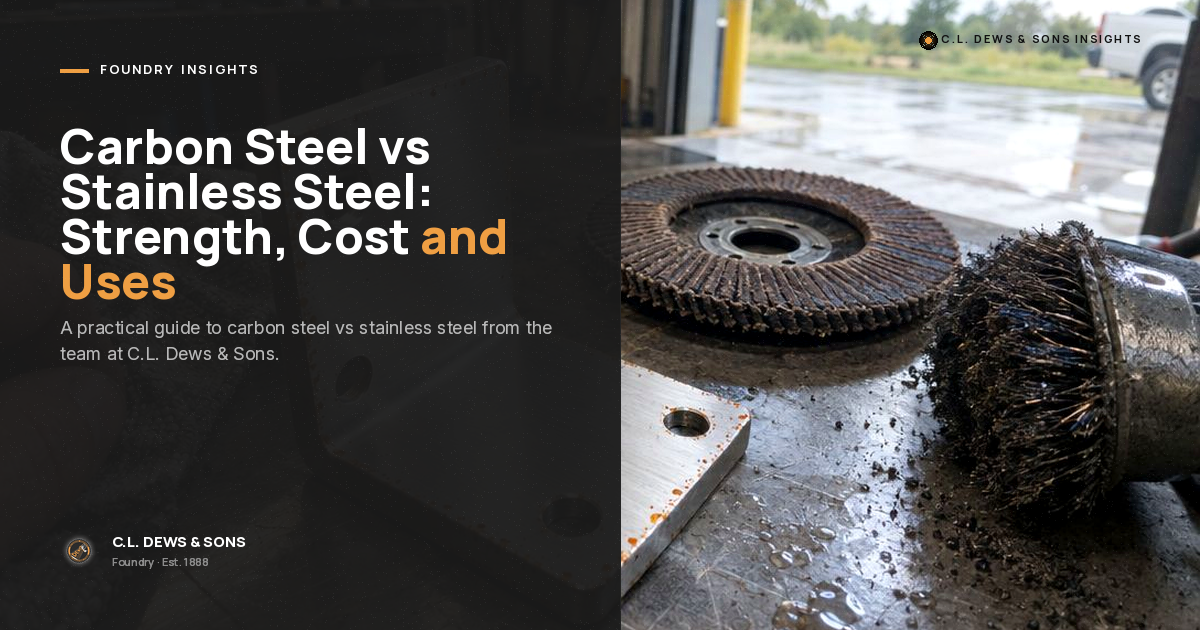
Few failures confuse buyers more than this one. A brand-new 304 stainless bracket ships out looking perfect. Three weeks later it is freckled with orange specks along the edges that were deburred. The stainless did not fail. The shop dressed it with a grinding wheel or wire brush that had already been used on carbon steel, and tiny particles of plain iron got embedded in the surface. In humid South Mississippi air, those particles rust within days and stain the stainless around them.
The fix is discipline on the shop floor: dedicated stainless-only wheels, brushes, and clamps, separate storage racks, and passivation after fabrication when the spec calls for it. If your stainless parts are coming back with rust spots, ask your supplier how they keep the two materials apart.
Strength and Hardness
Stainless is not automatically stronger, despite how often that comes up in the carbon steel vs stainless steel debate. Annealed 304 has a minimum yield strength around 30 ksi, which is actually a little below A36 structural steel at 36 ksi. The real difference is how they behave.
- Carbon steel can be heat treated. Medium and high carbon grades can be quenched and tempered to much higher strength and hardness, which makes them the default for shafts, pins, gears, and wear surfaces.
- Austenitic stainless work hardens instead. It gets stronger as it is cold worked, and it stays tough at very low temperatures where carbon steel can turn brittle.
- High strength stainless exists but costs more. Duplex 2205 has roughly double the yield strength of 304, and 17-4 PH can be aged to well over 150 ksi.
For abrasion, the answer is usually neither standard 304 nor mild steel. A soft austenitic stainless chute liner will wear through quickly under gravel or ore, so wear service calls for hardened carbon and alloy grades. Our guide to choosing abrasion resistant steel for wear parts covers those options in detail.
Weldability: Carbon Steel Is More Forgiving
Low carbon steel is about the easiest metal there is to weld. It tolerates a wide range of procedures, and A36 plate rarely needs preheat in normal thicknesses. As carbon content climbs, so does the risk of hard, crack-prone zones next to the weld, so medium and high carbon grades need preheat and controlled cooling.
Austenitic stainless welds well, but it behaves differently under the arc. It conducts heat at roughly a third of the rate of carbon steel and expands more when heated, so heat stays concentrated near the weld and thin sheet bows and twists more readily. Held too long between roughly 800 and 1,500°F, standard grades can form chromium carbides at the grain boundaries, starving the nearby metal of the chromium it needs to resist corrosion. That is why welded stainless assemblies are usually specified in the low-carbon L grades, 304L and 316L.

Welding fume is another difference. Stainless welding releases hexavalent chromium, which OSHA regulates under its own hexavalent chromium standard, so ventilation and fume extraction matter more than on mild steel. Experienced steel fabrication services account for all of this in their weld procedures, fixturing, and sequencing.
Machinability
On the lathe and mill, carbon steel is generally the easier material. Grades like 1018 cut cleanly, break chips well, and allow faster speeds and longer tool life. Free-machining carbon grades with added sulfur machine even better, because the sulfur forms tiny manganese sulfide inclusions that help chips snap off.
Austenitic stainless is gummy by comparison. It work hardens right at the cutting edge, so a dull tool or a light, rubbing cut makes the next pass even harder. Chips come off long and stringy instead of breaking. On machinability ratings, 304 typically lands well below 1018, which means slower spindle speeds, sharper tooling, and more cycle time per part. Grade 303 adds sulfur to cut faster, but it gives up some corrosion resistance and weldability to get there.

None of this makes stainless a problem part; it just has to be programmed and tooled correctly from the start. Raise it with your custom machining partner before the quote, because it directly affects price and lead time.
Cost: Purchase Price vs Life-Cycle Price
By the pound, stainless commonly runs several times the price of plain carbon steel, and 316 costs more than 304 because of its extra nickel and molybdenum. Add the slower machining and stricter fabrication practices, and a finished stainless part often costs well above its carbon steel twin.
The sticker price leaves out upkeep, though. A carbon steel part also needs a coating, plus recoating and repair over its life, and in a corrosive spot it may need replacing outright. Stainless needs none of that. In a dry indoor setting, carbon steel almost always wins on total cost. In a washdown area or outdoors near salt, stainless often wins even though it costs more on day one.
A simple test: if the part will be painted anyway and stays dry, carbon steel is usually the smart buy. If coating is impractical or the part lives wet, price the stainless option before you rule it out.
Carbon Steel vs Stainless Steel at a Glance
| Factor | Carbon Steel | Stainless Steel |
|---|---|---|
| Key alloying element | Carbon, up to about 2% | Chromium, 10.5% minimum |
| Corrosion resistance | Low, needs coating | High, built in |
| Heat treatable | Yes, medium and high carbon | Martensitic and PH grades only |
| Weldability | Excellent in low carbon grades | Good, but more distortion |
| Machinability | Good to excellent | Fair, work hardens |
| Magnetic | Yes | Austenitic grades no; others yes |
| Material cost | Low | Several times higher |
Which One Should You Specify?
- Structural frames, brackets, and bases that will be painted
- Shafts, pins, and gears that need heat treatment
- Wear edges and abrasion service (hardened grades)
- Large weldments where budget drives the decision
- Dry, indoor, or controlled environments
- Food, beverage, and pharmaceutical contact surfaces
- Washdown and chemical exposure
- Coastal, marine, and de-icing salt environments
- Parts where coatings are impractical or cannot be maintained
- Cryogenic or low temperature service
When a part sits in the gray zone, a mixed approach often works: a carbon steel frame with stainless only where the product or the water touches. Just keep the two from touching each other in wet service, or isolate them, because the contact can speed up corrosion of the carbon steel.
Settle the material at the drawing stage, not after the first parts rust or wear out. Tell your supplier where the part will live, what it touches, and how long it needs to last, and the right grade usually becomes obvious.
Not Sure Which Steel Your Part Needs?
Send us your drawings or a worn sample. Our Hattiesburg team machines and fabricates both carbon and stainless steel under one roof, and we will recommend the grade that fits your service and your budget.
Request a Quote
