
Heat Treating
Tempering Steel: A Complete, Proven Guide to How It Works and Why It Matters
Picture an old-school smith finishing a cold chisel. The tip has just been quenched glass-hard, so the smith rubs a stripe of it bright with a scrap of emery and lets heat from the thick shank creep forward. A band of pale straw slides toward the edge, chased by bronze, then purple, then blue. The instant straw reaches the cutting edge, the whole chisel goes into the water. That is tempering steel in its oldest form, and the logic behind it still runs every heat-treat oven in the country, including ours in Hattiesburg.
A quenched part is at its hardest and its most fragile at the same moment. Tempering is the controlled reheat that trades a little of that hardness for the toughness a part needs to survive real work. The temperature you choose decides how much you trade, and for a part that starts as a casting and ends on a machine tool, the temper is one link in a longer chain.
- Quenching makes steel hard but brittle and full of internal stress. Tempering reheats it below the lower critical temperature to restore toughness.
- Low tempers (roughly 300 to 400°F) keep most of the hardness. High tempers (roughly 800 to 1,200°F) give up hardness for impact resistance.
- Every degree you add costs hardness and buys toughness, so the right temperature depends on how the part is likely to fail.
- Temper colors are a thin oxide film, useful as a rough guide on bright steel but no substitute for a furnace thermocouple and a hardness test.
- Temper promptly after quenching. A hardened part left sitting untempered can crack on its own.
Why Quenched Steel Needs Tempering
To harden steel, you heat it until it turns to austenite, then cool it fast enough that carbon has no time to escape. The result is martensite: a strained, crowded crystal structure that is extremely hard and extremely unforgiving. A fully hardened, untempered file will scratch glass, and it will also snap like glass if you drop it on concrete.
As-quenched martensite carries two problems. The structure itself is brittle, and the quench leaves the part loaded with internal stress because the surface and core cooled and transformed at different times. Very few parts can go into service in that condition. A crusher component, a shaft, or a punch that is all hardness and no toughness will chip, crack, or shatter at the first real shock load. Tempering steel after the quench is not an optional extra.
What Happens Inside the Metal During Tempering
Tempering steel means reheating the hardened part to a set temperature below the lower critical temperature (about 1,340°F, or 727°C, for plain carbon steel), holding it there, and then cooling it. Stay below that line and the steel never turns back into austenite, so you keep the hardened structure while relaxing it. Our guide to the iron carbon phase diagram shows exactly where that boundary sits.
Inside the oven, carbon that was trapped in the martensite begins to come out as extremely fine carbide particles. The strained crystal lattice relaxes, and much of the quench stress bleeds off. The hotter you go, the more carbon precipitates and the coarser those carbides grow, so hardness drops steadily while ductility and impact strength climb. The result is tempered martensite, the working microstructure of most hardened steel parts.
Tempering Steel Temperature Ranges and What They Buy You
There is no single correct tempering temperature. The number depends on the steel grade and the job the part has to do. For carbon and low-alloy steels, the broad map looks like this:
1. Low Temper: About 300 to 400°F (150 to 205°C)
This is mostly stress relief. The part keeps nearly all of its as-quenched hardness, which is what you want for cutting tools, gauges, bearing races, and case-hardened gear teeth where wear resistance is the whole point.
2. Middle Range: About 400 to 700°F (205 to 370°C)
Chisels, punches, knives, and springs often land somewhere in or near this band. One caution: many steels show a dip in impact toughness when tempered around 500 to 700°F, a problem known as tempered martensite embrittlement. Heat treaters usually step around that window for parts that will take repeated shock.
3. High Temper: About 800 to 1,200°F (425 to 650°C)
Shafts, axles, structural bolts, gears that see shock, and quench-and-tempered plate and castings live here. Hardness comes down substantially, but the steel becomes tough enough to bend, absorb impact, and resist cracking. Some alloy steels need a fast cool from this range to avoid a separate form of temper embrittlement.
Time matters too, but less than temperature. A common rule of thumb is about one hour at temperature per inch of section thickness, with a minimum of an hour or two. A slightly higher temperature has roughly the same effect as a much longer soak, so tight furnace control matters.
The Hardness vs. Toughness Trade-Off
Every decision about tempering steel is a bet on how the part is most likely to fail. If it fails by wearing away, you lean toward hardness and a lower temper. If it fails by cracking or chipping under impact, you lean toward toughness and a higher one. You cannot max out both on the same steel.
- Mostly abrasion, little impact: keep hardness high with a low temper. Edge life wins.
- Mixed abrasion and shock: compromise in the middle and verify toughness, not just hardness.
- Heavy impact or bending: temper high, accept a softer surface, and protect the part from cracking.
So the spec on a drawing usually calls out a hardness range, not a temperature. The heat treater picks the temper that lands the part in that range for that grade, then proves it with Brinell or Rockwell readings. Our article on heat treatment and the casting hardness scale covers how those numbers are tested and read.
Reading Temper Colors
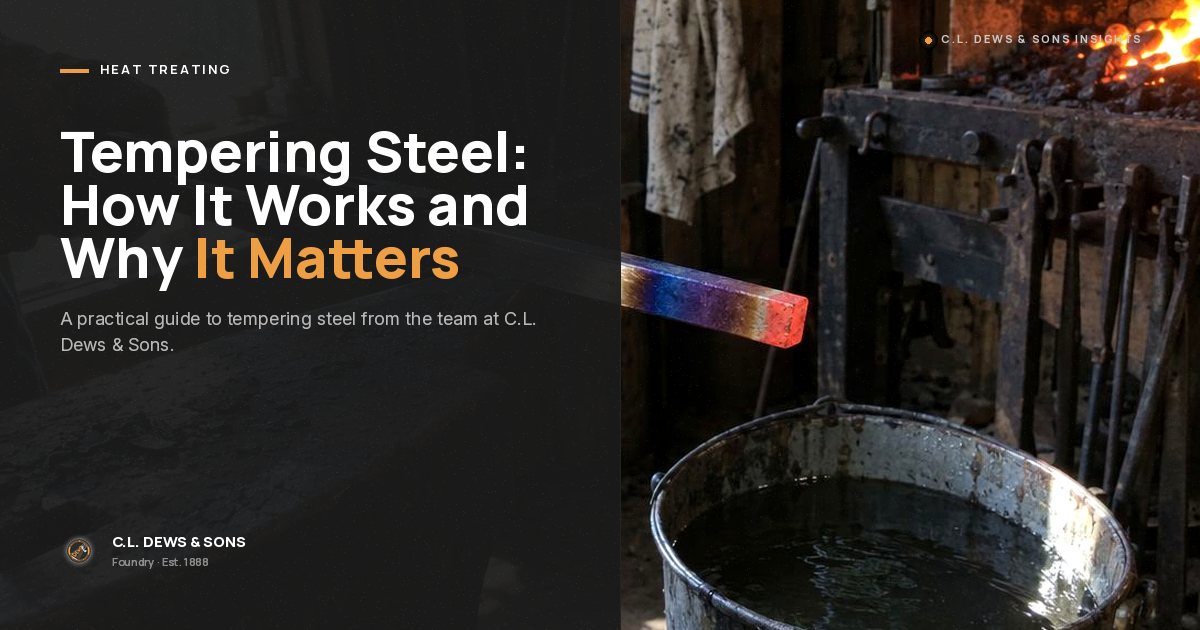
When clean, bright steel is heated in air, a very thin oxide film forms on the surface. As the temperature rises, that film thickens, and its color shifts through a predictable sequence: pale straw, darker straw, brown, purple, dark blue, light blue, and finally gray. Blacksmiths and toolmakers used this sequence for centuries to judge heat when tempering steel by eye. It is the same cue the smith in the opening watched creep toward the chisel edge.
Colors are handy on the shop floor, but they have real limits. The film depends on time as well as temperature, so a part held longer at a lower heat can show a “hotter” color. Alloy content changes the sequence, and scale, oil, or a controlled furnace atmosphere can hide it entirely. Production heat treating relies on calibrated furnaces with thermocouples and confirms the result with a hardness tester. The color tells you roughly where you are. The hardness reading tells you whether the part is right. For more technical background, the encyclopedia entry on tempering in metallurgy is a solid primer.
Timing: Why You Temper Right Away
Every heat treater has a version of this story. A batch of 4140 shafts gets quenched at four o’clock on a Friday. The tempering oven is full, so the shafts sit on the rack over the weekend, still hard and still loaded with quench stress. On Monday morning one of them has a hairline crack running out of the keyway, the sharpest corner on the part. Nothing hit it. The stress alone did the damage.

The standard practice for tempering steel is to start as soon as the part has cooled enough to handle, often while it is still warm to the touch. A few other timing rules follow from the same logic:
- Heat the whole section. Count hold time from when the core reaches temperature, not when the furnace display does.
- Double temper when the steel calls for it. Many tool steels keep some untransformed austenite after the quench. A second temper relaxes the fresh martensite that forms as the first temper cools.
- Cool the way the spec says. Most parts air cool from tempering, but some alloy steels need a faster cool to avoid embrittlement.
Where Tempering Steel Fits in Casting and Machining Work
For a part that starts life in a sand mold, tempering is one step in a longer chain. Cast steels are often normalized and tempered to refine the as-cast grain and relieve casting stress, while higher-strength grades, such as the upper classes of ASTM A148, typically reach their properties through a full quench and temper. The same principle carries over to the high-chrome irons we pour for crusher wear parts. After the hardening cycle, a lower-temperature temper eases internal stress while holding the hardness that abrasion resistance depends on. Our heat treatment ovens take chrome iron castings to the 600 to 700 HB range for exactly that kind of service.
Machining adds a sequencing question. Hardened and tempered steel is slow and expensive to cut, so the usual path is to rough machine, heat treat, and then finish machine or grind. Leaving extra stock covers the small distortion and scale that come with heat treating. When a part only needs moderate hardness, it can sometimes be machined entirely from steel that was already quenched and tempered to a machinable level. Either way, a proper temper relieves the stress that would otherwise make the part move on the machine. Our CNC machining services sit under the same roof as the foundry and ovens, so the casting, heat treat, and final cuts are planned together instead of handed off.
One thing tempering cannot do: fix an unsound casting. Gas porosity, trapped sand, and oxide inclusions stay exactly where they were. Heat treating changes the microstructure, not the soundness, and a defect sitting just under the skin can even be opened up by scale and shot blast afterward. Good tempering starts with a good pour.
Section size matters as well. Thin sections cool quickly in the mold and in the quench, while heavy sections may never harden all the way through. A tempering plan that works for a half-inch bracket will not automatically work for a six-inch-thick wear plate, so the grade, the geometry, and the heat treat cycle need to be chosen together.
Get the Heat Treat Right the First Time
Tempering steel is where hardness becomes usable strength, and small choices in temperature and timing decide whether a part wears out gracefully or cracks early. Our crew in Hattiesburg, Mississippi pours, heat treats, and machines parts under one roof, so the alloy, the temper, and the final dimensions are all planned by the same team.
Send us your drawing or a worn part, and we will tell you how we would cast, treat, and finish it.
Request a QuoteCall 601-582-4427

