
Can You Weld Galvanized Steel? Safety, Methods, and Coating Repair
Learn how galvanized steel can be welded safely, which welding methods may be suitable, how zinc fumes should be controlled, and how corrosion protection is restored after welding.
Yes, you can weld galvanized steel, but you should not treat it exactly like uncoated mild steel. The zinc coating that protects the material from corrosion can interfere with the weld and produce zinc oxide fumes when heated, so the work requires proper preparation, ventilation, process selection, inspection, and coating repair.
The real question is not only, “Can you weld galvanized steel?” It is whether the joint can be completed safely, whether it will meet the project requirements, and how the damaged zinc coating will be restored afterward. This guide explains the main risks, suitable welding methods, preparation steps, safety controls, post-weld checks, and alternatives.
This article provides general information for trained personnel. Project drawings, welding procedure specifications, applicable codes, coating requirements, safety data sheets, employer procedures, and site-specific hazard assessments should always control the work.
What Is Galvanized Steel and What Makes It Difficult to Weld?
Galvanized steel is carbon steel protected by a zinc-based coating. Hot-dip galvanizing forms layers of zinc and zinc-iron alloy on the steel, while sheet products may use continuous galvanizing, electrogalvanizing, or another zinc-coating process. Because the coating type and thickness can vary, the material should be identified before welding begins.
Zinc provides both barrier and sacrificial corrosion protection. Under welding heat, however, zinc near the arc can vaporize, disrupt shielding, increase spatter, and contribute to porosity or incomplete fusion when the joint preparation and welding procedure are unsuitable. The heat also destroys the coating around the joint, leaving an area that must be protected again after welding.
Common welding processes can produce sound joints when the zinc coating is managed correctly. In many industrial applications, the practical sequence is to remove zinc from the specified weld area, prepare and weld the exposed steel, inspect the joint, and then repair the corrosion-protection system.
| Aspect | Galvanized Steel | Uncoated Carbon Steel |
|---|---|---|
| Surface condition | Zinc must be identified and managed. | Rust, oil, paint, and other contaminants still require removal. |
| Additional fume concern | Zinc can add zinc oxide to the welding fumes. | Fume hazards still depend on the metal, filler, process, and surface condition. |
| Weld-quality concern | Zinc may contribute to porosity, spatter, and fusion problems. | Poor fit-up, contamination, or incorrect settings can still cause defects. |
| Post-weld work | Exposed steel and heat-damaged coating require repair. | Finishing depends on the project specification. |
Our steel fabrication services include SMAW, GMAW, and FCAW capabilities supported by certified welding personnel and inspection resources. The selected process should still match the drawing, material, joint, service conditions, and applicable project requirements.
Recognising Zinc Oxide Fumes and Metal Fume Fever
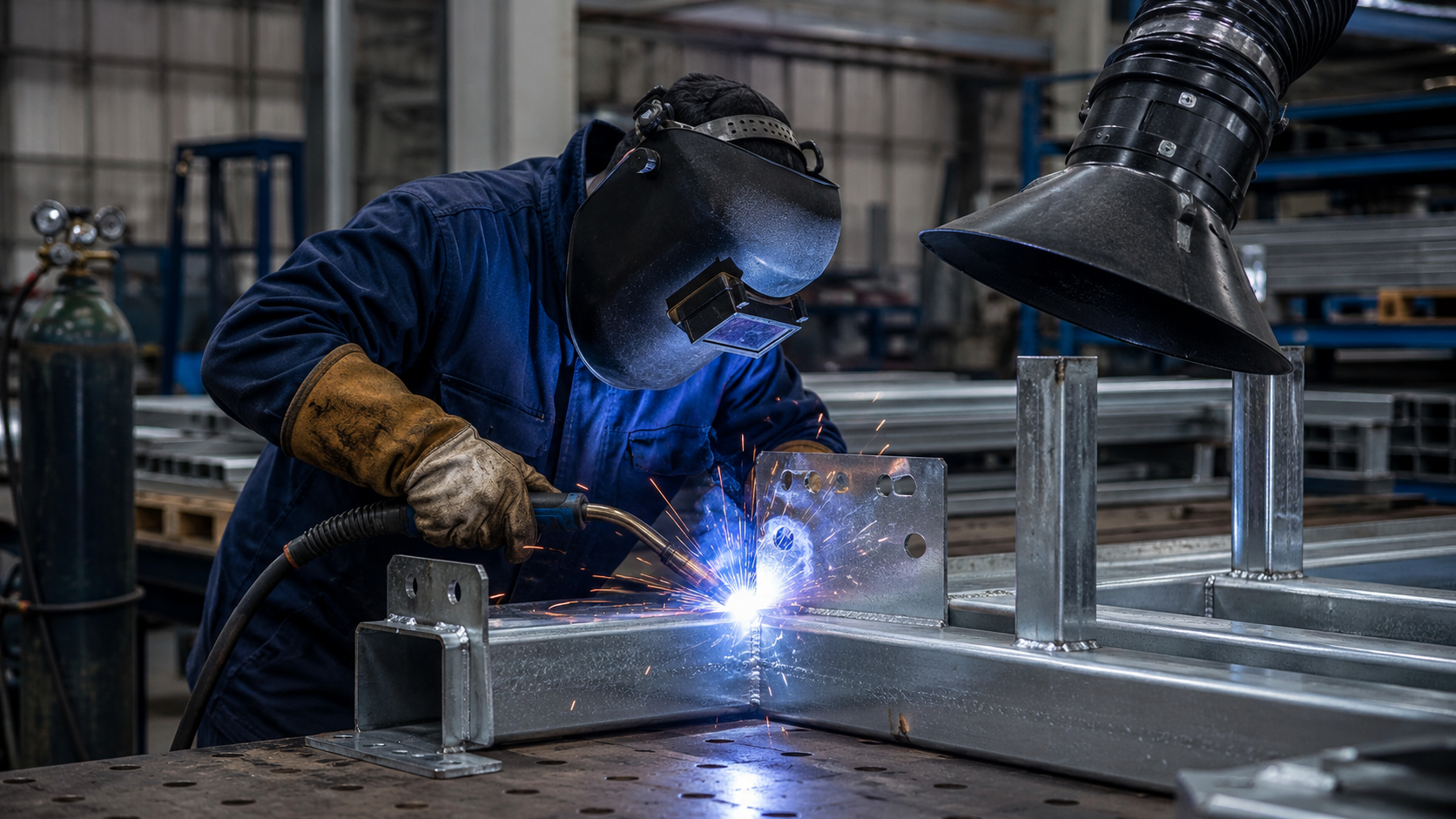
The main health risk when welding galvanized steel is exposure to zinc oxide fumes. These fine airborne particles can enter the welder’s breathing zone, and a light or drifting plume does not necessarily mean exposure is under control.
Zinc oxide exposure can cause metal fume fever, with symptoms such as fever, chills, coughing, nausea, muscle aches, headache, chest tightness, and difficulty breathing. Because welding fumes may also contain contaminants from filler metals, coatings, oils, paint, or previous service, anyone who feels ill after welding galvanized steel should stop work, report the exposure, and seek medical advice.
The correct response is to follow the hierarchy of controls, not rely on a single item of personal protective equipment. When practical, the work should first eliminate or reduce the hazard through planning and design. Options may include:
- Completing the welding before galvanizing
- Selecting a bolted or mechanical connection
- Removing zinc from the weld area
- Isolating the welding operation
- Using effective local exhaust ventilation
- Restricting access to the work zone
Personal protective equipment and respiratory protection support these controls. They should not replace proper preparation and engineering controls.
The Occupational Safety and Health Administration’s welding, cutting, and brazing guidance addresses metal fumes, gases, ultraviolet radiation, burns, eye injuries, electric shock, fire prevention, hot work, and confined-space hazards. Employers must apply the rules relevant to their industry, location, and specific work conditions.
Pre-Weld Preparation: Removing Zinc and Cleaning the Joint
If the question is, “Can you weld galvanized steel without grinding it?” the honest answer is that specialised procedures can weld certain zinc-coated products without completely removing the coating. That does not mean welding directly through zinc should be the default approach for structural or industrial work.
American Galvanizers Association guidance explains that welds on galvanized steel should generally be made on zinc-free areas. The exact preparation width should be determined by the welding procedure, coating type, joint design, project specifications, and applicable welding code.
Before removing the coating, confirm the following:
- Base-metal grade
- Zinc-coating type
- Coating thickness
- Drawing requirements
- Weld symbols
- Joint configuration
- Applicable welding procedure
- Inspection and acceptance criteria
Inspect both sides of the component. Zinc on the back side may still be heated and create fumes or contamination, especially on thin steel or full-penetration joints.
Mechanical Grinding
Mechanical grinding is one of the most common methods for removing zinc from a localised weld area. Use an abrasive suitable for the steel and remove enough coating to expose clean base metal without gouging the surface or changing the required bevel.
Grinding creates its own hazards, including sparks, noise, flying debris, and zinc-containing dust. Workers may require:
- Local dust extraction
- Safety glasses
- Face protection
- Hearing protection
- Gloves
- Flame-resistant clothing
- Proper housekeeping and fire prevention
Abrasive Blasting
Abrasive blasting may be appropriate for larger areas, complex shapes, or components that are difficult to prepare with a grinder. The blasting media, containment system, dust collection, surface profile, and waste-disposal method should all be controlled.
Chemical Stripping
Chemical stripping should only be completed under an approved procedure because acids and other stripping agents can cause burns, damage nearby coatings, leave hazardous residues, and create waste that requires proper handling.
After removing the zinc, clean away oil, grease, moisture, paint, rust, abrasive particles, and loose debris with a welding-compatible, non-chlorinated cleaner, then allow the surface to dry completely.
Preheat should only be used when required by the welding procedure, base-metal grade, thickness, hydrogen-control plan, joint restraint, or applicable code. It should not be treated as a general method for reducing zinc fumes, and unnecessary heating may damage more of the coating.
Choosing the Right Welding Technique

There is no universal answer to, “Can you weld galvanized steel with MIG, stick, flux-core, or TIG?” All four processes may be suitable, but the correct choice depends on:
- Material thickness
- Joint design
- Welding position
- Worksite conditions
- Required mechanical properties
- Production requirements
- Inspection criteria
- Approved welding procedures
For more background on welding arcs, electrodes, shielding, filler metals, and common processes, review our guide explaining what welding is and how it works .
Shielded Metal Arc Welding
Shielded Metal Arc Welding, or SMAW, uses a consumable flux-coated electrode and does not require an external shielding-gas cylinder, making it practical for many field applications. It can be suitable for galvanized structural steel, repairs, and outdoor work when the coating is properly prepared and the correct electrode is selected under the welding procedure.
Slag should be removed between passes and before the final inspection. Stick welding does not make zinc fumes harmless, so local exhaust ventilation and other exposure controls may still be necessary.
Gas Metal Arc Welding
Gas Metal Arc Welding, commonly called GMAW or MIG welding, feeds a continuous solid wire through the welding gun and uses externally supplied shielding gas. Can you weld galvanized steel with MIG? Yes. GMAW can provide productive and repeatable welds on clean, properly prepared, and correctly fitted material.
Zinc left in the weld zone may:
- Make the arc less stable
- Increase spatter
- Cause porosity
- Interfere with fusion
- Add zinc oxide to the welding fumes
Wind can also disturb the shielding gas, so MIG welding is not automatically the best process for outdoor or exposed work.
Flux-Cored Arc Welding
Flux-Cored Arc Welding uses a continuously fed tubular electrode containing flux. FCAW includes both gas-shielded and self-shielded processes. It is incorrect to describe every flux-cored welding process as requiring external shielding gas.
Depending on the electrode and procedure, FCAW can provide:
- High deposition rates
- Good positional capability
- Strong performance on structural fabrication
- Greater field flexibility with self-shielded wire
However, FCAW can also produce significant amounts of welding fumes. The presence of flux does not neutralise zinc oxide or remove the need for ventilation and exposure controls.
Gas Tungsten Arc Welding
Gas Tungsten Arc Welding, commonly called GTAW or TIG welding, uses a nonconsumable tungsten electrode and separate filler metal when required. TIG welding offers precise control of the arc and weld pool, which may make it suitable for thin material, detailed fabrication, or applications requiring a clean weld profile.
However, TIG generally requires very clean surfaces and thorough removal of zinc from the joint. It is also slower than most wire-fed processes. Lower spatter does not eliminate the hazards created by heating a zinc coating.
Resistance Welding
Resistance spot welding, seam welding, and projection welding are commonly used for zinc-coated sheet metal. Some qualified procedures weld coated sheet without removing the zinc first.
Successful resistance welding requires control of:
- Coating weight
- Sheet thickness
- Electrode force
- Current
- Weld time
- Electrode shape
- Electrode wear
Settings developed for uncoated steel should not be copied directly without testing.
Welding parameters and filler-metal selection should come from a qualified or approved welding procedure, not a generic online chart. A test coupon, mock-up, production trial, or formal procedure qualification may be necessary before completing critical or repetitive work.
Essential Safety Precautions
Safe welding requires control of the entire operation, not just the welding arc. The work plan should address:
Material and Process
Identify the coating, base material, welding process, work duration, and approved welding procedure.
Work Environment
Evaluate the work location, nearby workers, work at height, weather, ventilation, and confined-space conditions.
Exposure Controls
Plan local exhaust ventilation, respiratory protection, restricted access, and safe worker positioning.
Hot-Work Hazards
Control electrical hazards, combustible materials, sparks, hot slag, gas cylinders, and fire-watch requirements.
Capture Fumes Near the Source
Position local exhaust ventilation close to the weld so it captures fumes without disrupting shielding gas or pulling the plume through the welder’s breathing zone. A high ceiling or large room does not guarantee safe exposure levels. General ventilation may help, but fumes should still be controlled at the source.
Keep the Welder Out of the Plume
Arrange the worker, component, exhaust hood, and welding position so fumes move away from the welder’s face. Portable fans are not always effective and can push fumes through the breathing zone or towards nearby workers. Poor fan placement may also disrupt shielding gas and increase weld defects.
Treat Confined Spaces Separately
Welding inside a tank, vessel, pit, utility space, or other enclosed area requires an approved confined-space and hot-work procedure. Depending on the hazard assessment, controls may include mechanical ventilation, atmospheric testing, entry permits, communication, an attendant, rescue planning, supplied-air respiratory protection, and isolation of hazardous energy or materials.
Use Respirators Through a Proper Program
Respiratory protection may be necessary when engineering and work-practice controls cannot adequately limit exposure. The correct respirator depends on the contaminants present, exposure level, oxygen concentration, welding process, work duration, and location. Respirator selection should follow the site’s hazard assessment and respiratory-protection program.
When workplace respirator use is required, the employer’s respiratory-protection program should include medical evaluations, fit testing, employee training, and proper filter or cartridge selection. It should also cover respirator inspection, maintenance, storage, and cleaning. A disposable mask chosen without an exposure assessment may not provide adequate protection.
Wear Complete Welding PPE
Typical PPE may include a welding helmet with the correct filter shade, safety glasses with side shields, flame-resistant clothing, welding gloves, protective footwear, and hearing protection. Additional face protection may be required for grinding or similar tasks. PPE should match the job and support, not replace, ventilation and other engineering controls.
Control Fire and Nearby Exposure
Remove or shield combustible materials, control sparks and hot slag, inspect concealed areas, and assign a fire watch when required. Protect nearby workers with welding curtains, restricted access, local exhaust ventilation, clear signage, and safe working distances.
Post-Welding Inspection and Coating Repair
Finishing the weld bead does not complete the job. Welding removes or damages the zinc around the joint, leaving exposed steel and heat-affected coating that require inspection, cleaning, and repair.
Visual Weld Inspection
Begin with visual inspection after removing slag, spatter, soot, and residue. The inspector should check the weld against the applicable acceptance criteria, including:
- Weld size
- Weld profile
- Cracks
- Craters
- Visible porosity
- Undercut
- Overlap
- Arc strikes
- Dimensional accuracy
- Distortion
Visual inspection is not something used only after other testing fails. It is normally the starting point of a weld-inspection program.
Additional Nondestructive Testing
Additional nondestructive testing may be required by the drawings, contract, welding code, engineer, or inspection plan. Available methods may include:
- Liquid penetrant testing
- Magnetic particle testing
- Ultrasonic testing
- Radiographic testing
The correct method depends on the base material, joint design, thickness, expected discontinuities, service conditions, and inspection access. Specifying ultrasonic or radiographic testing for every galvanized weld would be unnecessary and technically unjustified.
Post-weld heat treatment is also not automatically required. It should only be performed when specified by the material standard, welding procedure, engineering design, service requirements, or governing code. Unnecessary heating may damage additional coating or affect the completed component.
Repairing the Galvanized Coating
After the weld passes inspection, the exposed steel and damaged zinc coating should be prepared for repair. ASTM A780/A780M recognizes three common methods for repairing damaged hot-dip galvanized coatings:
- Zinc-rich paint
- Zinc-based solder
- Zinc-spray metallizing
The selected repair system should meet the project’s requirements for:
- Surface preparation
- Zinc content
- Coating thickness
- Application conditions
- Curing
- Adhesion
- Inspection
The phrase “cold galvanizing” commonly refers to zinc-rich paint, but zinc-rich paint is not identical to hot-dip galvanizing. The repair specification should identify the actual coating system rather than relying on vague terminology.
Hot-dip galvanizing is an industrial immersion process. It is not a routine brush-on repair method.
When practical, completing all welding before hot-dip galvanizing can provide continuous protection over the finished assembly. However, field welds, modifications, oversized structures, and certain installation conditions may still require welding after galvanizing, followed by localized coating repair.
Some welded components also require final bores, mounting faces, bolt holes, slots, or other precision features. Our custom machining services can support components that require machining after fabrication when the welding, machining, and coating requirements are planned together.
Any zinc coating damaged during machining should also be included in the final repair plan.
Final Thoughts
Can you weld galvanized steel? Yes, but a reliable result depends on planning the entire operation rather than focusing only on the weld bead.
Identify the coating, prepare the joint, follow the approved welding procedure, capture fumes near the source, inspect the completed weld, and restore the damaged corrosion protection.
The weak approach is to weld through an unknown coating and hope that cleanup solves the problems. The professional approach treats worker safety, weld quality, inspection, and coating repair as one connected process.
Frequently Asked Questions
Can you weld galvanized steel safely?
Yes. Trained workers can weld galvanized steel when the coating is identified, zinc is removed where required, fumes are controlled, the welding procedure is followed, hot-work hazards are managed, and suitable PPE is used. Simply opening a door and wearing a respirator is not an adequate safety plan.
Do you have to grind galvanized steel before welding?
Grinding is a common way to expose clean steel around the weld area. The preparation width should follow the welding procedure, coating type, joint design, project specification, and applicable welding code. Both sides of the component may require preparation.
Can you weld galvanized steel with MIG?
Yes. MIG welding can produce efficient and repeatable welds on properly prepared galvanized steel. Zinc left in the joint may increase spatter, porosity, arc instability, and fusion problems, so ventilation and weld inspection are still required.
What can happen if the zinc is not removed?
Leaving zinc in the weld area may increase fumes, spatter, porosity, incomplete fusion, and arc instability. Some specialised procedures can weld coated sheet directly, but industrial welding should not be improvised without testing and an approved procedure.
How is corrosion protection restored after welding?
After the weld passes inspection, clean and repair the exposed area according to the coating specification. Hot-dip galvanized coatings may be repaired with zinc-rich paint, zinc-based solder, or zinc-spray metallizing in accordance with ASTM A780/A780M.

