
Welding & Fabrication
Porosity in Welding: A Complete Guide to Causes, Types and Proven Prevention
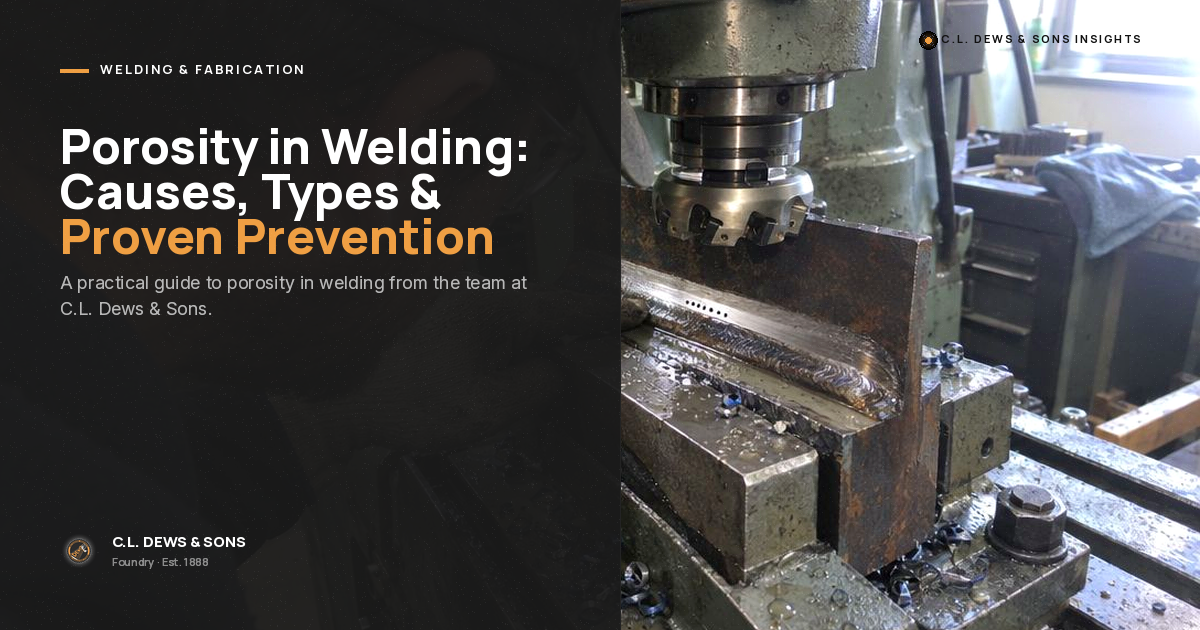
A fillet weld can look perfect on the fabrication floor: smooth ripples, even toes, no undercut. Then the weldment goes to the mill, the first facing cut skims a sixteenth of an inch off the bead, and a row of pinholes opens up across the shiny new surface. That is porosity in welding, and it is one of the most common reasons a weld that passed a glance fails a real inspection. The gas was trapped all along, just under the skin.
Porosity is gas that got caught in the weld metal as it froze. The good news is that it almost always has a traceable cause, and nearly every cause is something a disciplined shop controls before the arc ever strikes.
- Porosity forms when gas dissolved in the molten puddle comes out of solution as the weld freezes and cannot escape in time.
- The three big cause families are contamination on the joint or filler, shielding gas problems, and welding technique.
- The size, shape, and pattern of the pores point to the cause: scattered pores, clusters, aligned rows, and elongated wormholes each tell a different story.
- Surface pores show up in a visual check, but subsurface porosity usually takes radiography or a machining cut to find.
- Small amounts of scattered porosity may be acceptable under code, while aligned porosity and wormholes are far more damaging, especially under fatigue loading.
What Causes Porosity in Welding?
Molten steel can hold far more gas in solution than solid steel can. While the puddle is liquid it soaks up hydrogen, nitrogen, and oxygen from whatever is around it. As the metal freezes, that dissolved gas gets pushed out ahead of the solidifying front and concentrates in the last liquid to freeze. If the gas forms bubbles and they float out before the surface skins over, no harm done. If the weld freezes faster than the bubbles can rise, they are locked in place.
So every porosity problem comes down to two questions: where did the extra gas come from, and why couldn’t it get out? The answers fall into three families.
1. Contamination
Anything on the joint that burns or boils in the arc becomes gas. The usual suspects are oil and cutting fluid, paint and shop primer, rust and heavy mill scale, galvanizing, and plain moisture, including the condensation that forms on cold plate brought in from outside on a humid morning. Hydrocarbons and water break down into hydrogen in the arc, and that hydrogen, along with nitrogen from poor shielding, is one of the main sources of pores in steel.
Filler metal counts too. Low-hydrogen stick electrodes pick up moisture from the air once the can is opened, which is why they belong in a heated rod oven, not on a bench. Spools of solid wire left uncovered collect dust and surface rust that feed straight into the puddle.
2. Shielding Gas Problems
The shielding gas exists to keep air away from the molten metal. When that blanket fails, nitrogen and oxygen from the atmosphere rush in, and nitrogen in particular produces porosity fast. Common failures include:
- Too little flow, often from a nearly empty cylinder or a regulator bumped out of adjustment.
- Too much flow, which creates turbulence that actually pulls air into the gas stream.
- Leaks in hoses, fittings, or a cracked gas diffuser, which can draw in air like a venturi.
- A spatter-clogged nozzle that breaks the gas column into an uneven, swirling cone.
- Drafts from open bay doors, exhaust fans, or a cooling fan aimed at the welder.
That last one catches a lot of shops. In a Mississippi summer, a welder sets a box fan on the floor to blow across the booth and keep cool. The fan feels great and strips the shielding gas right off the puddle. The welds that day come out peppered with pores, and the cause is sitting six feet away humming. Gas-shielded processes need still air at the arc, which is why screens go up for outdoor work and why self-shielded flux-cored wire is often the choice in the field. Our comparison of MIG vs FCA welding covers how each process holds up in wind.

3. Technique
Even with clean steel and good gas, the welder’s hands matter. Holding the gun too far from the work stretches the gas coverage thin. A steep drag angle can pull air in behind the nozzle. Traveling too fast freezes the puddle before gas escapes, and jerking the gun away the instant the trigger is released robs the crater of post-flow protection. With stick welding, a long arc lets air into the arc column. All of these are habits, and habits can be trained.
Types of Weld Porosity and What Each One Tells You
Inspectors do not just note that porosity is present. They describe its shape and pattern, because the pattern is a clue to the cause. Pore size and spacing work a bit like fingerprints.
Scattered (Uniform) Porosity
Small, round pores spread fairly evenly through the weld. This pattern usually points to gas absorbed across the whole weld: consistently poor shielding, damp filler metal, or contamination along the full joint.
Cluster Porosity
A tight group of pores in one spot, often at an arc start, a restart, or the crater at the end of a bead. Clusters point to a local event: a momentary loss of gas at arc initiation, a spot of grease on one area of the plate, or poor crater technique.
Linear (Aligned) Porosity
Pores lined up in a row, typically along the root of the weld or along a fusion line. Aligned pores suggest a contaminant that runs the length of the joint, like oil wicked into the gap of a tight fit-up or primer left on the faying surfaces. Because a row of holes behaves a lot like a crack, codes treat it more harshly than scattered pores.
Wormholes and Surface Pores
Wormholes, also called piping or elongated porosity, are tube-shaped cavities that stretch through the weld in the direction it froze. They form when a steady gas supply keeps feeding a bubble as the solidification front advances, so instead of a round pore you get a tunnel. Wormholes are common with heavy contamination and with flux-cored wire that has absorbed moisture. When a pore or wormhole reaches the face of the weld it becomes a surface pore, the one form of porosity you can see without equipment.
How Inspectors Find Porosity
The right way to find porosity in welding depends on where the pores sit and how critical the joint is.
- Visual inspection catches surface pores and wormhole openings. It is the first and cheapest check, and it misses everything below the surface.
- Radiographic testing (X-ray or gamma) is the classic tool for subsurface porosity. Gas pores show up as dark, rounded spots on the image because there is less metal to absorb the radiation, and the pattern is easy to classify as scattered, clustered, or aligned.
- Ultrasonic testing is excellent for planar flaws like cracks and lack of fusion. Rounded pores scatter sound rather than reflect it cleanly, so small scattered porosity can be harder to characterize with UT alone.
- Destructive tests such as macro-etch cross sections and fillet break tests are used during welding procedure and welder qualification, where cutting a sample apart is acceptable.
And then there is the accidental inspection from our opening example: the machining cut. Subsurface pores that sit just under the bead are often first discovered when a weld is faced, bored, or ground flush. For weldments that will become custom machined parts, that is the worst possible time to find them, because the part already has hours of fabrication and setup in it.
How Porosity Affects Weld Strength
How much porosity in welding hurts a joint depends on the amount, the shape, and the load. A few small, scattered pores remove very little cross-section, and static tensile strength often drops only slightly. That is why welding codes allow limited porosity in many joints. The American Welding Society publishes the structural welding codes most U.S. fabricators work to, and they set limits on how much porosity is acceptable based on pore size, spacing, and the type of loading the connection sees.
The damage climbs quickly from there. Aligned porosity and wormholes act as stress concentrators and can link up into a crack path. Under fatigue loading (the repeated cycling in equipment frames, conveyor supports, crusher components, and vibrating screens), even modest porosity can become the site where a crack starts. Porosity also reduces ductility and toughness, creates leak paths in tanks and pressure parts, and leaves surface pits that trap moisture and undermine coatings. On anything cyclically loaded or pressure-tight, the tolerance for porosity is low for good reason.
Repair rule of thumb: porosity cannot be welded over. Capping a porous bead only buries the gas pockets under fresh metal. The defective area has to be ground or gouged out to sound metal, and the cause fixed before the joint is rewelded.
Shop Practices That Prevent Porosity in Welding
Prevention is far cheaper than repair, and most of it comes down to discipline, not equipment. These habits keep porosity in welding rare in our shop:
- Clean to bright metal. Grind or wire brush the joint and roughly an inch on each side to remove mill scale, rust, paint, and primer. Wipe oil and cutting fluid off with a solvent that evaporates clean.
- Keep everything dry. Store low-hydrogen electrodes in a heated oven, cover wire spools, and warm cold or damp plate before welding so condensation is driven off.
- Set and verify gas flow. Use the flow rate recommended for the process, nozzle size, and gas mix, and check it at the nozzle, not just at the regulator.
- Inspect the gas path. Look for cracked hoses, loose fittings, and worn diffusers, and clean spatter out of the nozzle throughout the shift.
- Control the air around the arc. Keep fans and open doors from blowing across the work, and set up screens for any outdoor gas-shielded welding.
- Train the technique. Hold a consistent contact-tip-to-work distance, use a moderate gun angle, travel at a speed that lets the puddle degas, and keep the gun over the crater through post-flow.
- Inspect early. Check the first passes on a new job before the joint is buried under fill and cap passes, so a problem gets caught after one bead instead of ten.

None of these steps are exotic. What separates a shop that rarely sees porosity from one that fights it weekly is whether those habits hold on a busy Friday afternoon as well as a slow Monday morning. For a refresher on the fundamentals, our guide to how welding works covers the arc, the puddle, and the role of shielding.
Sound Welds From a Shop That Machines Them Too
At C.L. Dews & Sons Foundry, our welders and machinists work under the same roof in Hattiesburg, Mississippi, and that matters for porosity. When a weldment is going to be faced or bored later, we know it, and we weld it clean enough to survive the cut. Our structural steel fabrication work runs on the shop practices above, and our in-house machining means a hidden pore gets caught by our own people instead of yours.
Need Welds That Hold Up to the Cut?
Send us your drawings. Four generations into fabricating, casting, and machining metal, we build weldments that are clean on the outside and sound on the inside, and we quote them honestly.
Request a Quote
