
Global Steel Supply Chains: Navigating Disruption, Sustainability, and Demand Shifts
Learn how steel buyers can assess supply disruption, supplier capability, quality control, sustainability claims, demand shifts, and total landed cost.
Global steel supply chains determine whether manufacturers, fabricators, contractors, and infrastructure owners can secure the right material at the right time and with the required documentation. A delay at a mine, mill, port, service center, or freight corridor can quickly become a missed production window, an idle crew, or a project cost increase.
World crude steel production reached about 1.849 billion metric tons in 2025. China produced 960.8 million metric tons, India produced 164.9 million, and the United States produced 81.9 million, while finished and semifinished steel exports totaled 456.5 million metric tons.
This guide explains how steel buyers can assess disruption risk, supplier capability, quality controls, sustainability claims, demand shifts, and total landed cost without turning procurement into a guessing game.
The Critical Role of Global Steel Supply Chains
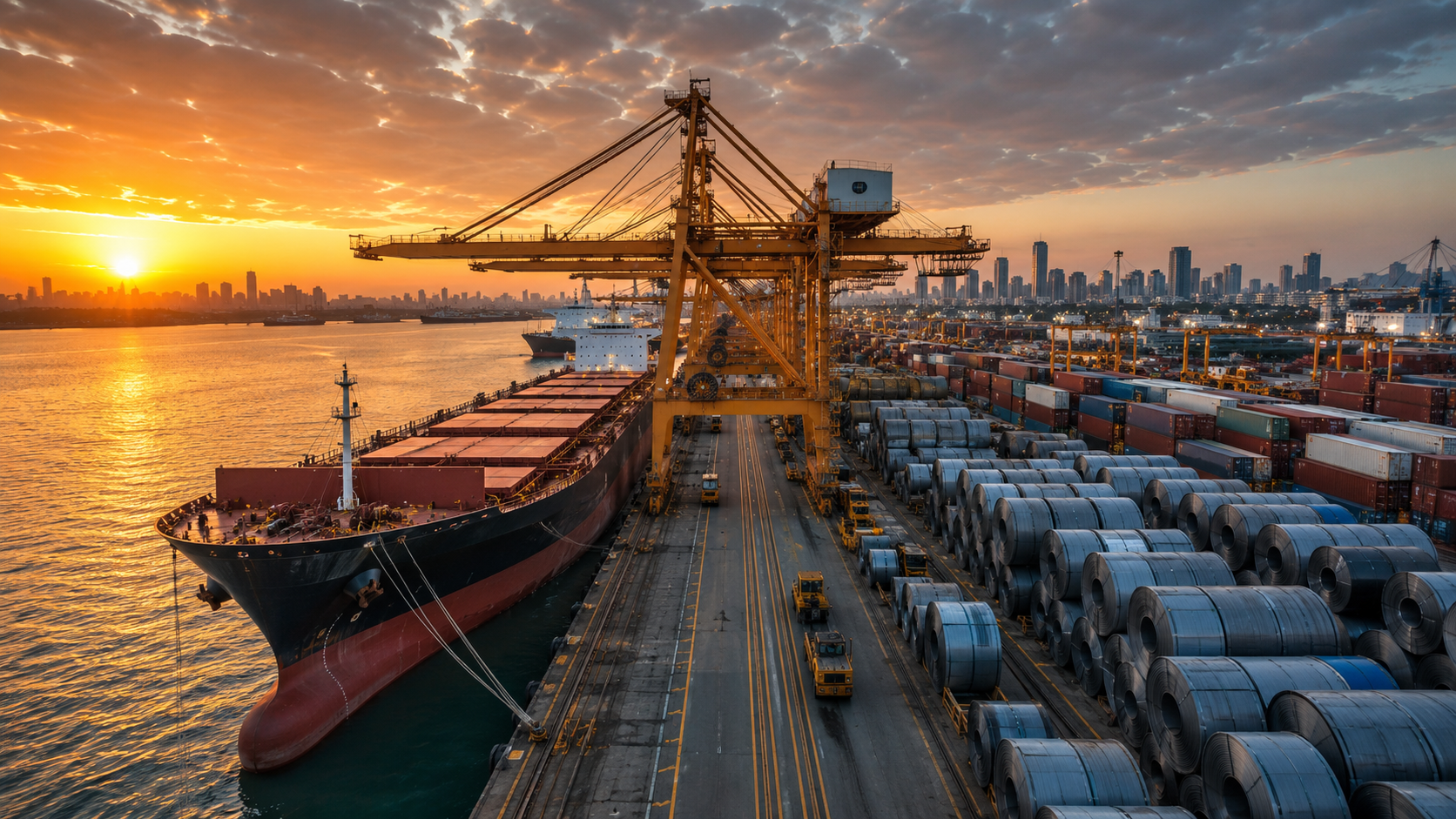
A steel supply chain begins long before a coil, plate, bar, casting, or fabricated component reaches the buyer. Each upstream and downstream stage can affect material availability, documentation, price, and delivery.
Global steel supply chains can include iron ore, ferrous scrap, metallurgical coal, alloying elements, energy, steelmaking, casting and rolling, heat treatment, coating, service-center processing, machining, fabrication, inspection, warehousing, and transportation.
Weakness at any stage can affect availability. A mill may lack a particular alloying input, a distributor may not hold the exact grade or certification package, and a shipment can still be delayed after reaching port because of inland freight, customs, weather, or documentation problems.
Production and raw-material flows are also concentrated. In 2024, Australia exported about 901.6 million metric tons of iron ore and Brazil exported 389.2 million, while China imported roughly 1.238 billion metric tons.
That concentration does not mean a disruption in one country will stop the entire market. However, weather, port congestion, energy constraints, policy changes, and freight problems in a few major locations can influence global steel supply chains far beyond their borders.
Understanding the Stakes: Availability, Price Stability, and Traceability
Steel buyers usually focus on price per pound or ton, but that is only one part of the actual cost.
From our perspective, the most expensive steel is often the material that arrives late, lacks the required test report, cannot be traced to the specified heat, or forces production to wait. A higher purchase price can be the better decision when it reduces schedule, quality, and replacement risk.
Three outcomes deserve equal attention:
- Availability: Can the supplier provide the required product form, grade, dimensions, quantity, and delivery date?
- Price stability: Does the quote explain freight, surcharges, escalation terms, duties, processing, testing, and minimum-order costs?
- Traceability: Can the supplier connect the delivered material to reliable records, including the mill, heat number, chemical composition, mechanical properties, and required inspections?
The U.S. market shows why these issues matter across multiple sectors. According to the 2026 U.S. Geological Survey summary for iron and steel, construction accounted for an estimated 31% of U.S. steel net shipments by market classification in 2025.
Steel service centers and distributors represented 26%, automotive represented 15%, and converting and processing represented 11%. One supply problem can therefore reach job sites, equipment manufacturers, transportation networks, and downstream processors at the same time.
Defining Material and Project Needs: The First Step to Resilience
A resilient sourcing plan starts with a precise material requirement. “Steel plate,” “structural steel,” or “wear-resistant material” is not a complete specification. Define what the component must do, how it will be manufactured, which standard applies, and what evidence must accompany delivery.
1. What Steel Are You Buying?
Start with the grade, product form, dimensions, tolerances, surface condition, and required quantity. Then identify the properties that are critical to manufacturing and service.
Depending on the application, the specification may need to address:
- Chemical composition
- Yield and tensile strength
- Elongation
- Hardness
- Impact toughness at a stated temperature
- Weldability or carbon-equivalent limits
- Heat treatment condition
- Corrosion resistance
- Abrasion resistance
- Flatness, straightness, or dimensional tolerances
- Coating type and thickness
- Required testing and certification
These requirements should come from the engineering drawing, purchase specification, applicable code, or qualified technical review. Buyers should not substitute a supposedly similar grade based only on a sales description because materials with comparable strength can behave differently during welding, machining, forming, heat treatment, or service.
Steel must also be distinguished from cast iron and other ferrous alloys. A high-chromium white iron casting is not interchangeable with rolled abrasion-resistant steel plate, so material selection must follow the component design and actual service conditions.
2. Map the Production Route and Raw Materials
The production route can influence cost, available product forms, reported emissions, scrap demand, and exposure to raw-material disruptions. Blast furnace and basic oxygen furnace production depends heavily on iron ore, coke or other reducing inputs, while electric arc furnaces commonly melt scrap and direct reduced iron using electricity.
In 2025, about 69.4% of global crude steel came from oxygen-based steelmaking and 30.3% from electric furnaces, although the mix varied widely by country. Buyers should focus less on which route is generally considered better and more on whether the mill can meet the required grade, properties, traceability, delivery schedule, recycled-content targets, and emissions-reporting requirements.
3. Plan Around Standards, Trade Rules, and Documentation
Global steel supply chains operate under different technical standards, commercial terms, and regulatory requirements. Before requesting quotes, buyers should identify the applicable ASTM, AASHTO, AWS, ASME, API, military, or customer-specific standards, along with country-of-origin rules, approved supplier lists, inspection hold points, and record-retention requirements.
A mill test report is important, but it does not prove complete compliance unless it covers the required specification, tests, product form, and traceability details. For imported steel, buyers should also clarify responsibility for duties, customs documents, insurance, port charges, inland freight, and damage claims because a low ex-mill price can still result in a much higher landed cost.
4. Choose Domestic, Regional, or Offshore Supply Deliberately
Domestic sourcing can reduce communication delays and ocean-freight exposure, while offshore suppliers may offer specialized products, larger production runs, or lower prices. Regional service centers can also support supply through local stocking, processing, testing, and scheduled deliveries.
Domestic Supply
May shorten communication lines, reduce ocean-freight exposure, and provide easier access to local technical or delivery support.
Offshore Supply
May provide specialized products, larger mill campaigns, competitive pricing, or access to capacity unavailable locally.
Regional Service Centers
Can support buyers through local inventory, cutting, processing, testing, scheduled releases, and shorter delivery windows.
Dual-Sourcing Strategies
Can reduce exposure when critical grades, long lead times, limited mills, or disruption costs make a single source too risky.
The best option depends on volume, lead time, availability, certification needs, and disruption risk. Critical or long-lead materials may justify dual sourcing, safety stock, or a domestic backup, while common products available from several qualified distributors may not.
Downstream capability matters too. A supplier may deliver suitable plate or structural shapes, but the project may still require cutting, forming, welding, machining, inspection, and assembly.
Working with an experienced provider of steel fabrication services can reduce handoffs when the job involves bridge, infrastructure, mining, manufacturing, or custom industrial components.
Need Steel Fabrication Support?
Discuss your material requirements, fabrication scope, drawings, tolerances, and production schedule with the Dews Foundry team.
Discuss Your ProjectVerifying Supplier and Mill Capabilities
A supplier should be qualified for the exact product, application, and risk level. Previous experience selling steel does not automatically prove capability for every grade, process, specification, or project.
Review the mill, distributor, processor, and fabricator separately because each controls a different part of material quality and delivery.
Confirm that the mill regularly produces the required grade and dimensions, the service center has suitable handling and processing equipment, and the fabricator can work to the required drawings, procedures, tolerances, and inspection plan.
Ask about committed capacity, planned outages, single-sourced inputs, production constraints, and backup facilities. A confident delivery promise is not the same as a documented contingency plan.
The imbalance between steelmaking capacity and demand remains another significant risk. The OECD Steel Outlook 2026 projects global excess capacity to reach approximately 745 million metric tons by 2028, with up to 138.8 million metric tons of additional capacity planned through 2028.
Global capacity utilization could fall from approximately 76% in 2025 to 74% or lower in 2028. Excess capacity may temporarily pressure steel prices, but it can also weaken producers, redirect exports, trigger trade measures, encourage plant closures, and reduce investment in modernization and decarbonization.

A practical supplier review should cover:
- Financial stability and ownership
- Production locations and backup facilities
- Normal product range and minimum order quantities
- Historical on-time delivery
- Relevant quality certifications
- Traceability, inspection, and corrective-action controls
- Freight routes and alternate carriers
- Business-continuity plans
- Trade and origin-compliance controls
- References from comparable customers
Certifications can support confidence, but they are not magic. Verify the certification scope, covered facility, expiration date, and relevance because a certificate for one location or process does not automatically cover every product, employee, or operation.
Assessing Quality Control and Traceability
Quality control in global steel supply chains begins before the purchase order. Buyers, suppliers, processors, and fabricators need a shared and documented definition of acceptance.
The purchase order should specify the applicable standard and revision, grade, dimensions, tolerances, quantity, certification, inspection, marking, packaging, delivery schedule, substitution rules, and mill test report requirements.
Traceability must also continue through downstream processing. Heat-number transfers, controlled identification, job travelers, digital records, and material-segregation procedures help preserve the connection between a finished component and its original heat or lot.
Inspection methods should match the risk and acceptance criteria. Visual, chemical, dimensional, mechanical, hardness, impact, ultrasonic, magnetic particle, liquid penetrant, or radiographic testing may be appropriate depending on the applicable specification.
No inspection method proves that material is completely defect-free. Each method has limitations, and acceptance must be based on the applicable specification, sampling plan, and acceptance criteria.
More testing is not automatically better if the selected method is unsuitable or the results are not tied to a clear requirement.
For cast components, control extends beyond incoming metallics. Pattern condition, molding, melt chemistry, pouring practice, heat treatment, cleaning, inspection, and final machining can all affect the delivered part.
Our foundry services include custom castings, in-house pattern work, controlled heat treatment, grinding, and high-chrome scrap recovery for eligible materials. Keeping related operations coordinated can make traceability and corrective action easier than splitting every stage among unrelated vendors.
A supplier scorecard should measure more than unit price. Useful performance measures include:
| Measure | What It Reveals |
|---|---|
| On-Time Delivery | Whether promised production and delivery dates are reliable |
| Complete Documentation Rate | Whether test reports, certificates, and required records arrive correctly |
| Nonconformance Rate | How often material fails the applicable specification or inspection criteria |
| Corrective-Action Closure Time | How quickly root causes are investigated, corrected, and documented |
| Premium Freight Incidents | Whether planning or production failures are creating hidden transportation costs |
| Lot and Heat Traceability | Whether records remain connected to the material after cutting and processing |
| Forecast Accuracy | Whether planned demand and actual order releases remain reasonably aligned |
| Total Landed Cost | Whether the quoted price reflects the complete cost of obtaining and using the material |
Evaluating Technology, Sustainability, and Capacity
Technology can improve control, but equipment age or software alone does not prove quality. A modern system used poorly is still a weak system, while older equipment that is suitable, maintained, calibrated, and operated under controlled procedures may remain fully capable.
Digital Visibility and Production Technology
Useful technology should solve a clear supply-chain problem. Examples include electronic test reports, barcode or RFID identification, real-time inventory records, shipment tracking, production scheduling, automated alerts, and shared demand forecasts.
Ask what data the supplier can actually provide. A useful system should show inventory by grade and heat, connect documents to delivered lots, track production and shipment status, and flag delays before the final ship date.
Automated cutting, robotic welding, CNC machining, process monitoring, and advanced inspection can improve repeatability when supported by qualified procedures, trained personnel, maintenance, and calibrated instruments. They are not proof that every part will be correct.
Sustainability Is Becoming a Sourcing Requirement
Sustainability is changing global steel supply chains through customer reporting, public procurement, investor expectations, emissions targets, energy costs, scrap competition, and the development of lower-emissions production routes.
Using 2024 activity data, World Steel in Figures 2026 reported a production-weighted average carbon dioxide intensity of 1.92 metric tons of CO2 per metric ton of crude steel and an average greenhouse-gas intensity of 2.18 metric tons of CO2 equivalent.
Worldsteel’s CO2 methodology includes Scope 1, Scope 2, and some Scope 3 emissions, although some upstream Scope 3 sources are excluded from its default calculation. These figures are useful industry indicators, but they should not be treated as the verified carbon footprint of every mill or steel product.
Electric arc furnaces can use high levels of recycled steel, but EAF production does not automatically mean zero-carbon steel. Results still depend on the electricity source, metallic inputs, material yield, alloy additions, transportation, and reporting boundaries.
Buyers should ask suppliers to explain:
- The product-level or facility-level emissions boundary
- The reporting standard and calculation method
- Scope 1, Scope 2, and relevant Scope 3 treatment
- The recycled-content calculation methodology
- Electricity sourcing
- The use of environmental product declarations
- Whether renewable-energy certificates or carbon offsets are included
- Chain-of-custody controls supporting lower-emissions claims
- How the underlying data was reviewed or independently verified
Vague claims such as “green steel,” “eco-friendly,” or “sustainable material” are not enough. A credible claim needs a defined product, baseline, reporting boundary, time period, methodology, and supporting data.
Circularity also requires practical controls. Scrap must be identified, sorted, prepared, and matched to the production process because mixed or contaminated scrap can create chemistry and quality problems.
Demand Shifts Are Redrawing the Market
Global demand is not moving in one direction. Worldsteel’s April 2026 outlook forecast global steel demand of 1.724 billion metric tons in 2026, an increase of only 0.3%, followed by 2.2% growth to 1.762 billion metric tons in 2027.
The forecast was based on information available in mid-March 2026 and remains subject to economic, geopolitical, energy, and trade risks.
Regional differences are much sharper. China’s finished-steel demand was estimated at 796.0 million metric tons in 2025 and forecast at 784.1 million in 2026.
India was forecast to increase from 159.8 million metric tons in 2025 to 171.6 million in 2026 and 187.4 million in 2027. U.S. demand was forecast to increase from 90.9 million metric tons in 2025 to 92.4 million in 2026 and 94.3 million in 2027.
These shifts influence investment, freight demand, raw-material contracts, scrap flows, export pressure, and mill maintenance. A buyer watching only the local spot price may miss a much larger upstream change.
Communication, Pricing, and Project Management
Reliable global steel supply chains depend on clear technical and commercial communication. Problems become more expensive when suppliers wait until the promised delivery date to disclose them.
Suppliers should communicate delays in rolling, testing, documentation, customs clearance, or freight as soon as those issues become known.
A complete steel quotation should define:
- Material grade, specification, and revision
- Dimensions, tolerances, and delivery condition
- Quantity and permitted overrun or underrun
- Unit price and price-validity period
- Alloy, energy, scrap, or freight surcharges
- Testing, inspection, processing, and packaging costs
- Delivery terms and named destination
- Estimated production and transit time
- Taxes, duties, and customs responsibilities
- Payment terms
- Cancellation and change-order rules
- Warranty and claim procedures
- Required documents
- Force majeure and allocation terms
For long projects, consider a price-adjustment mechanism tied to a transparent index or clearly defined input. The contract should explain the formula, reference date, adjustment frequency, cap, floor, and exclusions.
Buyers should share realistic forecasts so mills and service centers can reserve capacity or inventory. Suppliers should report constraints early and clearly distinguish confirmed orders from tentative demand.
Red Flags to Watch For
Watch for these warning signs when evaluating global steel supply chains and individual suppliers:
- Quotes that omit freight, testing, duties, surcharges, or processing
- Refusal to identify the producing mill or country of origin when required
- Test reports that cannot be connected to the delivered heat or lot
- Frequent substitutions presented after the material has already shipped
- Delivery promises made without confirmed capacity or production dates
- Unusually low prices that do not match the specification or market
- Poor handling, storage, marking, or segregation practices
- Certifications that are expired, irrelevant, or issued for another facility
- No written corrective-action process
- Sustainability claims without a method, boundary, or supporting data
- Reliance on one port, mill, carrier, or raw-material source with no backup
- Equipment that is unsuitable, poorly maintained, or not calibrated when required
- Contracts with vague acceptance, warranty, or responsibility terms
- Communication that becomes evasive as soon as a problem appears
Do not reject a supplier simply because some equipment is older. Reject suppliers that cannot demonstrate process control, capability, maintenance, traceability, and compliance.
The same rule applies to technology claims. New software and automated equipment are useful only when the underlying production and quality systems are disciplined.
Conclusion: Building Stronger Global Steel Supply Chains
Global steel supply chains will continue to face uneven demand, excess capacity, trade pressure, freight risk, energy constraints, and greater scrutiny of environmental claims.
Buyers can reduce exposure by defining material requirements, qualifying suppliers, preserving traceability, comparing total landed cost, and preparing alternate sources before a disruption occurs.
A strong steel sourcing plan should:
- Define the exact grade, form, properties, tolerances, and documentation
- Understand the mill route and critical raw-material dependencies
- Evaluate domestic, regional, and offshore options by total risk and cost
- Verify mill, distributor, processor, and fabricator capabilities separately
- Maintain heat and lot traceability through cutting and manufacturing
- Match inspection methods to the applicable acceptance criteria
- Validate sustainability claims with transparent data
- Track regional demand, capacity, trade, and logistics signals
- Use realistic forecasts and written escalation procedures
- Maintain contingency plans for critical materials and components
For heavy industrial applications, supply-chain resilience also depends on how effectively raw material becomes a finished component. Our guide to mining equipment manufacturing and critical fabrication challenges explains how alloy selection, casting, fabrication, machining, and wear conditions come together in demanding equipment.
The goal is not to predict every market swing. It is to build global steel supply chains that can absorb disruption without sacrificing compliance, quality, or schedule.
Discuss Your Industrial Casting or Fabrication Requirements
Contact Dews Foundry to discuss your drawings, material requirements, production challenges, inspection needs, and project schedule.
Contact us today
