
Steel Fabrication Explained: What Does a Steel Fabricator Actually Do?
Steel fabricators turn raw steel into accurate, usable components through controlled cutting, forming, fitting, welding, assembly, finishing, and inspection.
Steel fabricators turn steel plate, sheet, bar, pipe, and structural sections into components that match a defined drawing or specification. If you are asking what does a steel fabricator do, the practical answer is that they measure, cut, form, fit, weld, finish, and inspect steel so it can be installed or assembled into a larger product.
That work supports buildings, bridges, highways, industrial equipment, drainage systems, mining operations, manufacturing plants, and many other applications. The fabricator’s job is not simply to make metal look like the drawing. The finished component must have the correct material, dimensions, connection details, weld quality, surface condition, and documentation for its intended use.
What Is Steel Fabrication?
Steel fabrication is the controlled process of converting steel stock into usable parts and assemblies according to approved drawings, specifications, material requirements, and production procedures.
A project may start with structural shapes supplied by a steel mill, flat plate, tubing, pipe, or an existing component that must be repaired or reproduced. The fabrication team then follows controlled project information to create the finished work.
Definition and Fundamentals
Most fabrication projects combine several operations rather than relying on one machine or trade. A plate may be CNC cut, drilled, bent, fitted to another component, welded, ground, inspected, and coated before it leaves the shop. A structural assembly may also require bolted connections, machined surfaces, or dimensional checks at several production stages.
This distinction matters because fabrication is different from steel production. Steel mills manufacture plate, sheet, bar, and rolled structural sections such as beams and channels. A fabrication shop receives those materials and turns them into project-specific items such as brackets, frames, base plates, bridge components, handrails, guards, drainage grates, or machinery assemblies.
Modern fabrication also relies on information control. Drawings must show the necessary dimensions, material grades, weld symbols, tolerances, finishes, and revision status. Fabricators may identify constructability problems and raise questions, but design responsibility normally remains with the engineer or other qualified designer responsible for the project.
Our steel fabrication services combine custom fabrication, structural steel work, welding, CNC plasma cutting, oxy-fuel cutting, and supporting machining for industrial and infrastructure applications.
How Steel Fabrication Developed
Modern steel fabrication developed through industrial steel production, mechanized cutting, electric welding, standardized drawings, and repeatable quality systems. Shops gradually moved from manual layouts and physical templates to CAD files, CNC equipment, and digital production records.
Traditional skills still matter. Fabricators must understand how steel behaves during cutting, forming, heating, and welding because software cannot correct a wrong material grade, poor fit-up, outdated drawing, or unsuitable procedure. The central goal remains simple: produce a component that fits, functions, and meets the specification.
What Does a Steel Fabricator Do?
A steel fabricator reads production information, prepares the material, performs or supports fabrication operations, and checks the work as it moves through the shop.
The exact duties vary by company and project. A structural fabrication shop, a sheet-metal operation, and a heavy-equipment repair facility will not have identical workflows.
Key Responsibilities
Common responsibilities include:
- Reviewing shop drawings, material lists, weld symbols, tolerances, and revision notes
- Confirming that the correct steel grade, thickness, and section have been issued
- Measuring, marking, and laying out material before cutting or forming
- Operating or supporting saws, drills, punches, presses, rollers, plasma cutters, and oxy-fuel equipment
- Preparing edges and joint surfaces for welding
- Positioning, aligning, clamping, and tack-welding parts during fit-up
- Welding components with the specified process and procedure
- Grinding, cleaning, straightening, and preparing surfaces as required
- Checking dimensions, hole locations, alignment, squareness, and assembly fit
- Reporting discrepancies rather than guessing when drawings or materials do not agree
- Moving completed work through inspection, coating, packing, and shipment
These tasks show why describing fabricators as “engineers” is inaccurate. Fabricators bring essential trade knowledge and often provide valuable feedback about access, weld sequence, handling, and assembly. However, they typically manufacture to engineering and project requirements rather than independently approving structural calculations or changing critical design details.
The best answer to what does a steel fabricator do is therefore broader than “cut and weld metal.” A capable fabricator manages the practical transition from a controlled drawing to a physical component while protecting material traceability, dimensional accuracy, weld quality, and safe production.
A Typical Day in a Fabrication Shop
A shift may begin with a production meeting, safety review, drawing check, and confirmation of priorities. The fabricator gathers the correct material, verifies its identification, checks the equipment, and prepares the work area. Repeat jobs may use approved programs and fixtures, while custom work often needs more layout, trial fitting, and coordination.
A fabricator may cut brackets, fit a frame, complete welds, and check dimensions before the assembly moves to finishing. The job also includes material handling, housekeeping, equipment checks, and production records.
One practical insight matters more than the sparks shown in fabrication photos: expensive errors often begin quietly. A missed revision or wrong hole location can ruin an assembly, so good fabricators stop when something does not make sense instead of guessing.
Which Techniques Are Used in Steel Fabrication?
Steel fabrication methods depend on the material, thickness, geometry, tolerance, quantity, and final use. No single process is best for every component.
Cutting
Steel fabrication often begins by cutting raw material to the required dimensions and profile using methods such as sawing, shearing, plasma cutting, oxy-fuel cutting, laser cutting, or waterjet cutting. The most suitable process depends on the material type, thickness, accuracy, edge quality, production volume, and the steps that follow. CNC plasma cutting is commonly used for conductive metals because it can produce repeatable profiles for brackets, gussets, base plates, guards, and other components prepared for further fabrication.
However, CNC equipment does not guarantee a flawless part. Programming accuracy, consumable condition, torch height, machine calibration, material flatness, heat input, and final inspection can all affect the result. Our guide to the best CNC plasma cutter for metal fabrication explains why proper fit-up and cleanup remain just as important as cutting speed.
Oxy-fuel cutting is generally suited to carbon steel and heavier plate, while sawing works well for bar, tube, pipe, beams, and channels. The correct method should be selected according to the material and required finish, not simply because one machine appears more advanced.
Shaping
Shaping operations refine the steel after cutting so the component matches the required dimensions, contours, holes, edges, and connection details. Depending on the project, this may involve drilling, punching, grinding, beveling, machining, or trimming. These processes prepare components for accurate fit-up, welding, fastening, or final assembly.
Shaping is particularly important where parts must align with existing equipment or connect to other fabricated components. Even a correctly cut plate may still require hole preparation, edge finishing, or machining before it is ready for installation.
Forming
Forming changes the shape of steel without removing most of the material. It allows flat plate, sheet, or structural sections to be bent or curved into the geometry required by the drawing. Press-brake bending is commonly used to create angles, channels, flanges, and other profiles in plate or sheet. Plate and section rolling can form cylinders, rings, cones, curved beams, and similar components.
Fabrication-shop rolling should not be confused with mill rolling. Steel mills use rolling processes to manufacture standard beams, channels, plate, and other sections before the material reaches the fabrication facility. Fabricators then bend or roll those supplied materials into project-specific shapes.
Wire or tube drawing is a different manufacturing process that pulls material through a die to reduce its cross-section. It is specialized work and is not a routine responsibility in most structural fabrication shops. For that reason, it should not be presented as a primary answer to what does a steel fabricator do unless the facility specifically manufactures drawn products.

Fitting
Fitting, or fit-up, is the stage where steel components are positioned and aligned before final joining. Fabricators use clamps, jigs, fixtures, squares, levels, and measuring tools to keep each part within the required dimensions and geometry. Accurate fit-up is essential because gaps, misaligned edges, or incorrect angles can affect weld quality, assembly accuracy, and installation.
Tack welds are often used to hold parts temporarily in position. Although they may appear minor, their placement and quality still matter. Tack welds can become part of the final weld or affect penetration, alignment, and distortion if they are applied incorrectly.
Welding
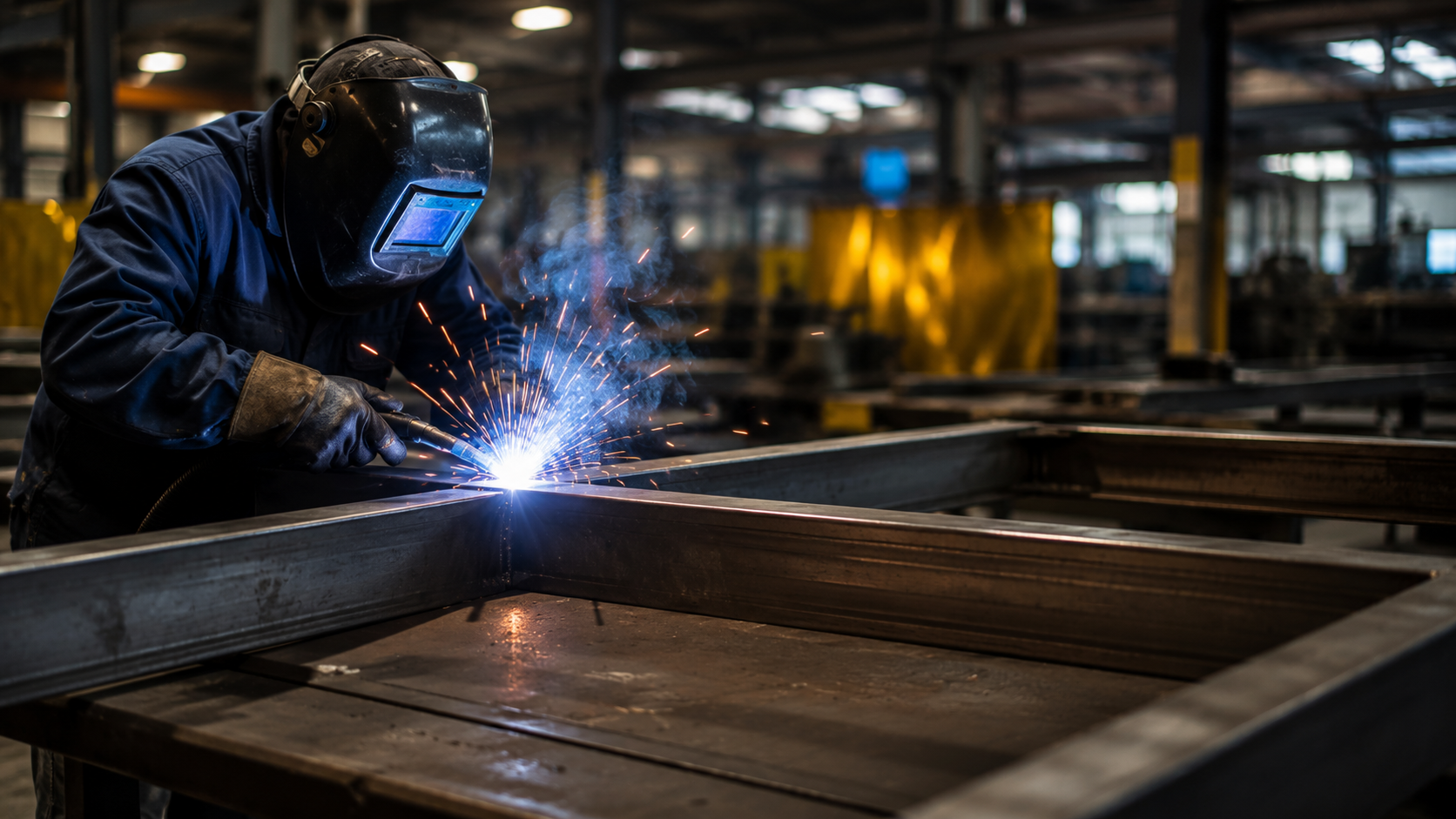
Welding permanently joins fitted steel components using heat, pressure, or a combination of both. Common arc-welding processes used in structural and industrial fabrication include:
- Shielded metal arc welding, or SMAW
- Flux-cored arc welding, or FCAW
- Gas metal arc welding, or GMAW
- Submerged arc welding, or SAW, for suitable applications
The appropriate welding process depends on the steel grade, material thickness, joint design, welding position, production environment, deposition requirements, and governing specification. Resistance welding is common in high-volume sheet-metal production but is not the primary method for every structural or heavy fabrication project. Because welding heat can cause distortion and residual stress, fabricators control these effects through proper joint preparation, approved procedures, planned weld sequences, balanced heat input, restraint, and fixturing.
Dimensional checks help identify distortion or nonconformance, but inspection alone does not remove residual stress. Effective control must begin before and during welding rather than after the assembly has already moved out of tolerance.
Assembly
Assembly brings fabricated components together into a complete structure, frame, machine part, or subassembly using welds, bolts, pins, threaded fasteners, machined fits, or a combination of methods. Fabricators then check alignment, squareness, hole locations, overall dimensions, and connection fit. Trial assembly may also be required to confirm that components match existing equipment or will connect correctly during installation.
Some welded components need machining after assembly so critical faces, bores, shafts, or mounting features meet their final tolerances. In these cases, fabrication and machine shop services must work from the same datum structure, drawings, and revision-controlled information.
This coordination is especially important because welding can slightly change the geometry of a component. Completing precision machining after welding allows critical features to be finished in relation to the final assembled condition.
Need Fabrication and Machining Support?
Send Dews Foundry your drawings, material requirements, and project details so our team can review the fabrication and machining work involved.
Discuss your project with usWhat Skills and Safety Practices Do Steel Fabricators Need?
The trade requires more than physical strength or comfort around machinery. Fabricators combine drawing interpretation, measurement, process knowledge, coordination, and disciplined quality checks.
Technical Skills and Personal Traits
Important technical skills include:
Drawing Interpretation
Read shop drawings, dimensions, notes, tolerances, and weld symbols accurately.
Measurement and Inspection
Use tape measures, squares, levels, calipers, gauges, and other inspection tools.
Material Control
Understand material identification, steel grades, thicknesses, and traceability requirements.
Equipment Setup
Set up cutting, forming, drilling, fitting, and welding operations correctly.
Heat and Distortion Control
Recognize how joint preparation, weld sequence, heat input, and restraint affect geometry.
Procedure Compliance
Follow welding procedure specifications, production instructions, and inspection requirements.
Material Handling
Use cranes, hoists, forklifts, and rigging within training and authorization limits.
Documentation
Record work accurately and escalate nonconforming conditions before they become larger problems.
Attention to detail is essential because small errors can compound. A plate cut slightly short may prevent fit-up. A hole pattern referenced from the wrong edge may make a component unusable. A welding sequence that ignores shrinkage can pull an otherwise accurate frame out of square.
Problem-solving also matters, but it needs boundaries. A fabricator should solve practical production problems without casually changing an engineered design. When information conflicts, the professional response is to stop, document the issue, and obtain clarification.
Clear communication protects quality and schedule. Fabricators coordinate with supervisors, inspectors, welders, machinists, project managers, and engineering personnel. The strongest shop culture makes it normal to raise a concern before steel is cut.
Safety Practices and Regulations
Fabrication shops contain hot work, sharp edges, moving machinery, fumes, electrical equipment, compressed gases, heavy loads, noise, and vehicle traffic. PPE may include safety glasses, welding helmets, face shields, gloves, hearing protection, protective clothing, and safety footwear. The required protection depends on the specific task and hazard assessment.
Ventilation and fume control are particularly important during welding and thermal cutting. Coatings, contaminants, consumables, base metals, and the work environment can change the exposure. OSHA’s welding, cutting, and brazing guidance identifies hazards including metal fumes, ultraviolet radiation, burns, eye damage, electric shock, cuts, and crushing injuries.
Other controls include machine guarding, lockout and tagout, fire prevention, hot-work procedures, safe cylinder handling, lifting plans, correct rigging, housekeeping, and equipment-specific training. Automation can reduce a worker’s direct exposure to some repetitive or hazardous tasks, but automated equipment introduces its own risks. Robots, CNC tables, and material-handling systems still require controlled access, guarding, maintenance procedures, and trained operators.
Which Tools and Technologies Do Steel Fabricators Use?
Equipment depends on the shop’s market. Bridge-component work may need heavy cutting and welding capacity, while sheet-metal production may rely on lasers, punches, and press brakes.
Hand Tools, Shop Machinery, and CNC Systems
Hand tools remain necessary for setup, adjustment, cleaning, verification, and finishing. Common examples include grinders, drills, magnetic drills, clamps, hammers, squares, levels, scribes, punches, and measuring equipment.
| Equipment Category | Common Examples |
|---|---|
| Cutting | Band saws, cold saws, CNC plasma tables, and oxy-fuel cutting tables |
| Hole Preparation | Ironworkers, punches, drill presses, radial drills, and magnetic drills |
| Forming | Press brakes, hydraulic presses, and plate or section rollers |
| Welding and Positioning | Welding power sources, positioners, turning rolls, clamps, jigs, and fixtures |
| Finishing | Grinders, blasting equipment, cleaning tools, and coating preparation systems |
| Material Handling | Cranes, hoists, forklifts, lifting devices, and rigging equipment |
CNC means computer numerical control. A CNC controller directs a machine along programmed axes to follow a defined toolpath. CNC cutting improves repeatability and can reduce layout time on suitable parts, but it remains dependent on correct data, setup, maintenance, material condition, and inspection.
Industrial robots are separate programmable systems, although they may be integrated into cutting or welding cells. A welding robot repeats a programmed path, while a CNC plasma table guides a torch through a plate program. Treating every automated machine as a robot obscures how the equipment is controlled and where human oversight is needed.
Automation works best on stable, repeatable work. Custom assemblies, repairs, limited access, and inconsistent incoming material may still require manual fitting and welding. Technology should support process control, not replace it.
What Training and Certification Apply to Steel Fabrication?
There is no single certificate that proves a person or company is qualified for every steel fabrication project. Requirements depend on the work, contract documents, jurisdiction, customer, and applicable code or standard.
Individual Qualifications and Facility Certification
Welder qualification normally demonstrates that an individual can produce an acceptable test weld using defined variables such as process, material group, position, thickness, and joint type. A welder qualified for one procedure is not automatically qualified for every process or application.
Welding inspectors, welding supervisors, engineers, and other personnel may hold separate credentials with different scopes. Those credentials should not be lumped together as a generic “steel fabricator certification.”
Facility certification is different again. A certified fabrication facility operates a documented quality management system covering areas such as procedures, personnel responsibilities, document control, purchasing, material identification, welding, inspection, calibration, nonconformance, and recordkeeping. It evaluates the organization’s system rather than replacing the qualifications required for individual workers.
At Dews Foundry, our structural steel facility is AISC certified, our team includes AWS-certified welders, and welding work is supervised by onsite Certified Welding Inspectors. These are distinct quality credentials rather than interchangeable labels.
Training and Apprenticeships
Fabricators may enter the trade through apprenticeships, technical schools, employer training, military experience, or related metalworking roles. Effective training combines classroom knowledge with supervised practice because drawing interpretation, fit-up, welding, rigging, and machinery setup cannot be learned from theory alone.
Training continues after entry. New equipment, revised codes, different materials, customer requirements, and updated safety procedures may require additional instruction or qualification. Experienced workers also benefit from refreshers because habit is not the same as compliance.
Which Industries Rely on Steel Fabrication?
Steel fabrication supports industries that need strong, repairable, weldable, and project-specific components. Material selection must still consider loads, weight, corrosion, temperature, wear, service life, fabrication method, and cost.
Construction, Infrastructure, and Manufacturing
Fabricated steel is used across construction, manufacturing, heavy industry, transport, energy, agriculture, and material-handling operations. Common applications include:
Construction and Infrastructure
Structural frames, connection plates, stairs, platforms, handrails, bridge components, drainage systems, guardrails, embedded items, supports, and utility structures.
Manufacturing
Machine bases, guards, frames, hoppers, chutes, tanks, brackets, conveyors, platforms, and production equipment.
Mining, Aggregate, and Recycling
Equipment frames, wear components, guards, chutes, repair parts, supports, and replacement assemblies.
Oil, Gas, Transport, Agriculture, and Utilities
Custom brackets, service platforms, equipment supports, protective structures, and specialized components.
Fabricators produce each component according to approved drawings, material specifications, dimensions, and connection requirements. Some assemblies also need precision machining to align critical features such as bores, bearing seats, and mounting surfaces. Final performance depends on proper design, material selection, fabrication, installation, corrosion protection, inspection, and maintenance.
Across every industry, the answer to what does a steel fabricator do depends on the final application. The fabricator converts controlled project requirements into usable parts and assemblies that can be installed, repaired, or integrated into larger systems.
What Challenges and Future Trends Are Shaping Steel Fabrication?
Steel fabrication shops must manage operational pressures that can affect cost, quality, productivity, and delivery times.
- Material availability and pricing: Changes in steel supply, lead times, and costs can disrupt estimates and production schedules.
- Drawing and specification errors: Late revisions, missing details, or conflicting information can cause delays, rework, and material waste.
- Skilled labour requirements: Automated equipment still depends on experienced workers who understand setup, welding, inspection, maintenance, and troubleshooting.
- Traceability and quality control: Fabricators must maintain accurate records for materials, drawings, procedures, inspections, and completed work.
- Equipment investment: CNC machines, robotic welding systems, and digital inspection tools require significant investment, training, and maintenance.
Future developments will focus on improving consistency, productivity, and material use. Digital drawings, nesting software, CNC cutting, automated welding, production tracking, and inspection technology can help reduce scrap, handling, variation, and rework.
However, automation does not eliminate mistakes. Machines can repeatedly produce incorrect parts when the drawing, program, material, or setup is wrong, so human oversight and quality checks remain essential.
Sustainability will continue to influence fabrication practices through:
- More efficient material nesting
- Better scrap separation and recycling
- Reduced rework and material waste
- Energy-efficient equipment and maintenance practices
- Durable finishes suited to the service environment
The future of steel fabrication will combine skilled tradespeople with better digital systems and automation rather than replacing human expertise entirely.
Why Skilled Steel Fabrication Still Matters
So, what does a steel fabricator do? A steel fabricator turns approved drawings and raw steel into accurate, usable components through cutting, shaping, forming, fitting, welding, assembly, finishing, and inspection. The work demands practical trade skills, controlled procedures, suitable equipment, and close attention to dimensions, materials, and connection details.
Modern technology can improve productivity and repeatability, but it cannot replace sound judgment. CNC machinery, digital drawings, automated welding, and inspection tools still depend on correct information, qualified operators, and effective quality control.
Choosing the right fabrication partner is therefore about more than finding a shop that can cut and weld steel. It means working with a team that understands your specifications, maintains proper documentation, identifies problems early, and produces components suited to their final application.
Need a Reliable Steel Fabrication Partner?
Talk to Dews Foundry about custom steel components, structural fabrications, bridge and highway items, handrails, drainage systems, guards, embedded items, and supporting machining.
Request a quote now
