
How Outsourcing Metal Fabrication Can Reduce Lead Times and Ease Production Bottlenecks
Learn how qualified fabrication and machining support can relieve production constraints, add specialized capacity, and help protect manufacturing schedules.
A machining queue does not need to stop an entire project to become expensive. If one part waits for cutting, grinding, welding, inspection, or machine time, every operation that depends on it can fall behind. Outsourcing metal fabrication can relieve these constraints by adding qualified capacity and specialized capabilities without immediately expanding the customer’s facility.
Outsourcing does not automatically make every order faster or cheaper. Supplier workload, material availability, tooling, inspection, logistics, and the quality of the technical package still affect the schedule. The advantage comes from placing the right work with a partner whose equipment, experience, and available capacity fit the job.
Understanding Bottlenecks in Metal Fabrication and Machining
A bottleneck is the stage that limits how much work the overall production system can complete. It may be obvious, such as a single machine with a long backlog, or it may be hidden inside scheduling, inspection, material handling, or repeated rework.
A bottleneck is not simply an operation that feels slow. It is the constraint controlling the flow around it. Speeding up a non-critical step may only create more work-in-process inventory.
What a Manufacturing Bottleneck Actually Looks Like
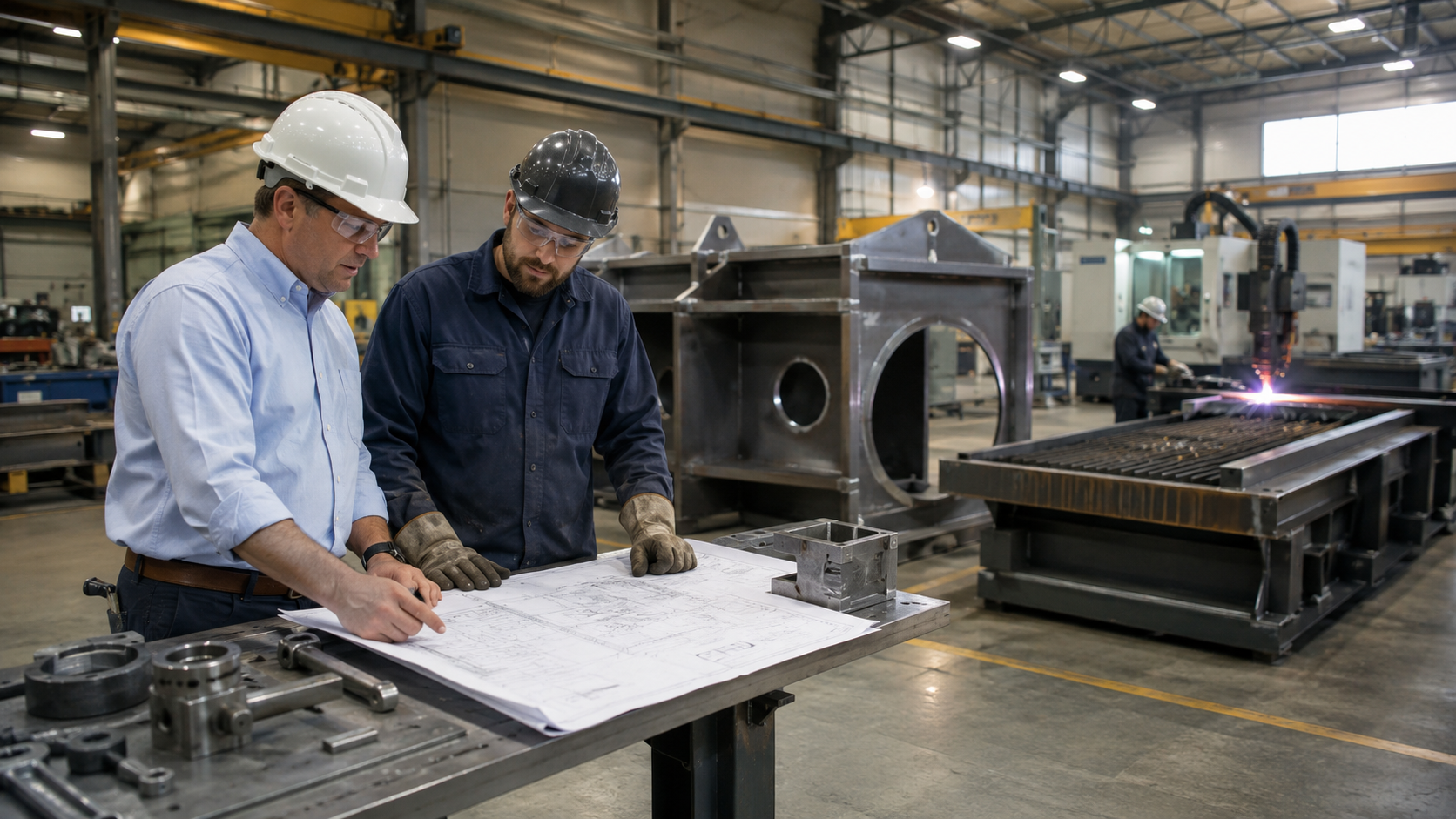
Consider a fabricated assembly that requires plate cutting, machining, welding, grinding, inspection, and coating. If cutting and welding can support ten assemblies per week but machining can complete only six, machining sets the practical output of the whole workflow.
Producing more cut blanks will not solve the problem. It will create a larger queue in front of the machine shop.
Capable equipment can also become a constraint when maintenance, changeovers, tooling shortages, operator availability, first-article approval, or inspection reduce its effective capacity.
Waiting is also recognized as a form of manufacturing waste. In a working fabrication or machine shop, that waiting may take several forms.
- Material sitting beside a machine until an operator is available
- Weldments waiting for machining or stress relief
- Finished parts waiting for inspection records
- Assemblies held because one purchased component is late
- Operators waiting for drawings, approvals, fixtures, or tooling
- Completed work waiting for transportation to another supplier
These delays tie up material, labor, floor space, and working capital while making the production schedule less reliable.
Common In-House Constraints
A manufacturer may have enough general-purpose equipment for routine work but lack the right machine size, axis capability, cutting process, grinding capacity, or welding setup for a specific component. The shop may also have the correct equipment but no available machine hours during a large order, shutdown, or demand peak.
Precision grinding, heat treatment, coating, nondestructive testing, and other secondary operations can become constraints when they require outside expertise. Workflow failures matter just as much.
Poor sequencing, incomplete drawings, missing certifications, unrealistic tolerances, late design changes, and slow approvals create delays that no new machine will fix.
How Outsourcing Metal Fabrication Can Reduce Lead Times
Outsourcing metal fabrication can improve lead time when the external supplier has the right capability, an achievable production window, and complete technical information.
It gives the manufacturer another route through production instead of forcing every component through the same internal resources.
The effect is usually strongest when the outsourced work can run in parallel with internal operations. While the supplier cuts, fabricates, or machines one group of components, the customer can continue assembly preparation, procurement, engineering, or other production tasks.
Access to Additional Capacity and Suitable Equipment
The clearest advantage is access to production capacity that already exists. Buying and commissioning equipment can require capital approval, facility changes, tooling, training, hiring, and process development. Outsourcing may address a capacity gap without waiting for that expansion.
The equipment still needs to match the component. Large weldments, tight-tolerance parts, thick plate, complex geometries, and difficult materials place different demands on a supplier.
Buyers should verify machine travels, weight limits, cutting capacity, achievable tolerances, inspection resources, welding processes, and material experience before issuing the order.
Our steel fabrication services include structural steel fabrication, SMAW, FCAW, and GMAW welding, plus CNC plasma and oxy-fuel cutting for steel, stainless steel, and aluminum.
For more specialized parts, our custom machining capabilities include multi-axis CNC machining, prototyping, small-batch production, precision surface and Blanchard grinding, finishing, and assembly.
Documented capabilities are more useful than vague promises because they help buyers determine whether the supplier can perform the required operations.
Specialized Expertise and More Efficient Process Planning
Equipment alone does not guarantee a better schedule. A capable supplier also brings programmers, machinists, welders, inspectors, and production planners who regularly work with the relevant processes.
That experience can reduce unnecessary setups, improve tooling and weld sequencing, plan machining allowances, and expose drawing issues before production. A specialist may already have a workable process for jobs that are unusual for the customer.
Early communication matters. A supplier should review the drawing, model, material, quantity, tolerance, finish, inspection requirements, and required delivery date before committing to the work.
Ambiguous requests create padded quotes and unstable schedules because the supplier has to plan for unknown conditions.
Our related guide on CNC machining cost factors explains how geometry, material, tolerance, setup, machine time, volume, and secondary operations influence a machining quote.
The same variables affect lead time. A difficult tolerance may require slower cutting, additional setups, specialized inspection, or rework when the requirement is poorly defined.
Integrated Services and Better-Coordinated Deliveries
Consolidating compatible operations with one supplier can reduce the number of handoffs between shops. For example, a partner that can cut, weld, machine, grind, inspect, and assemble a component may be able to manage the sequence internally instead of sending the work through several unrelated vendors.
This does not eliminate transportation or delay risk, but it can reduce external transfers and create one primary point of coordination.
Some manufacturers also use scheduled releases, blanket orders, Kanban, or just-in-time arrangements to align component deliveries more closely with assembly demand.
These systems can reduce excess work-in-process and finished inventory, but they depend on accurate forecasts, stable communication, supplier reliability, and realistic safety-stock decisions.
JIT does not guarantee that every part will arrive at the exact required moment. Material shortages, carrier delays, downtime, and rejected parts can still disrupt the plan. The defensible goal is lower unnecessary inventory with suitable protection against disruption.
Is an Overloaded Process Affecting Your Schedule?
Send Dews Foundry your drawings, material requirements, quantities, and target delivery date so our team can assess whether our fabrication or machining capabilities fit the project.
Discuss Your ProjectEasing Bottlenecks Through a Strategic Partnership
A useful outsourcing relationship makes the supplier part of the production plan, with agreed responsibilities for capacity, quality, communication, and delivery.
Outsourcing can ease a constraint, but every shop remains limited by labor, machine hours, material, tooling, inspection resources, and existing commitments.
Flexible Capacity Without the “Infinite Scalability” Myth
One of the strongest reasons for outsourcing metal fabrication is the ability to add qualified capacity during demand peaks. A manufacturer may need temporary support for a large order, a shutdown, a product launch, or an internal equipment outage. Sending an appropriate portion of the work to another facility can help protect the schedule without permanently expanding internal overhead.
The correct phrase is additional capacity, not infinite scalability. A responsible supplier should be able to explain:
- Which operations it can perform
- How much capacity is currently available
- What material or tooling must be secured
- Which approvals are needed before production
- What lead time is realistic
- Which factors could change the committed date
This transparency is more valuable than a promise to “scale on demand.” The customer should also compare setup, minimum quantities, material, tooling, freight, and inspection against overtime, internal disruption, equipment investment, and the cost of delaying other work.
Offloading Specialized and Secondary Operations
Specialized operations are practical outsourcing candidates when they are required often enough to affect production but not often enough to justify dedicated internal equipment and staffing.
Precision grinding is a good example. A company may machine most features internally but lack the grinding equipment or experience needed to achieve a required flatness, parallelism, or surface condition.
Outsourcing that operation can be sensible if the supplier’s capacity and inspection process support the schedule.
The same logic applies to heavy cutting, complex weldments, unusual machining envelopes, prototypes, small batches, finishing, and assembly.
The outside operation remains on the critical path if later work depends on it. Good planning must still include procurement, production, outside processing, inspection, packaging, shipping, and possible corrective action.
Quality Controls That Reduce Rework Risk
Nonconforming parts can create one of the most damaging bottlenecks because they consume material and capacity without producing usable output.
Rework can interrupt planned jobs, while scrap may force the entire production cycle to restart.
A qualified supplier should have documented procedures appropriate to the work. Buyers may need to review certifications, welding qualifications, inspection equipment, calibration, material traceability, first-article processes, and nonconformance controls.
Certification should be verified rather than assumed. ISO 9001, AS9100, AISC, AWS qualifications, and customer-specific approvals do not mean the same thing, and each has a defined scope.
Dews Foundry identifies an AISC-certified fabrication facility, AWS-certified welders, and onsite Certified Welding Inspectors for its steel fabrication work.
A strong quality system cannot guarantee zero defects. It reduces risk by standardizing requirement review, production, inspection, and corrective action.
Using Design for Manufacturability Before Production
Design for Manufacturability, or DFM, is most useful before the drawing is frozen.
A supplier may identify features that require unnecessary setups, tolerances that are tighter than the function needs, inaccessible welds, difficult inspection points, or stock sizes that create excessive material removal.
Early manufacturability assessment can reduce later design changes and support a shorter development schedule.
That does not mean the supplier should change the design without approval. Any recommendation that affects fit, strength, safety, service life, or regulatory compliance must be reviewed and validated by the responsible engineering team.
DFM provides manufacturing input while there is still time to act. A drawing revision before material is ordered is easier to manage than a stoppage after a failed first article.
Keeping Internal Teams Focused on Core Work
Outsourcing metal fabrication can free internal machinists, welders, engineers, and supervisors from work that competes with higher-priority production.
That may allow the company to protect critical customer orders, preventive maintenance, product development, final assembly, or proprietary processes.
High-volume core processes with stable demand may remain more economical in-house. Work involving sensitive intellectual property, frequent design changes, or constant coordination may also be a poor candidate.
The objective is to outsource selectively, not indiscriminately.
Strategic Benefits Beyond Speed
Lead time is often the reason a company first considers outsourcing metal fabrication, but the broader value may involve capital allocation, production flexibility, market responsiveness, and supply-chain resilience.
These benefits need actual numbers. A lower unit quote does not automatically mean a lower total cost, and a domestic supplier does not automatically mean a shorter schedule.
Capital Avoidance and Total Cost of Ownership
Outsourcing may help a company avoid or delay investment in machines, building space, utilities, tooling, maintenance, software, inspection equipment, and specialized labor.
It can turn some internal fixed costs into purchased services tied more closely to demand. However, the full comparison must include more than the supplier’s price per part.
| Cost Category | Factors to Evaluate |
|---|---|
| Management | Engineering time, supplier coordination, purchasing, and schedule management |
| Production Setup | Tooling, fixtures, programming, qualification, and setup charges |
| Materials | Raw material commitments, availability, lead time, and minimum quantities |
| Logistics | Packaging, freight, insurance, receiving, customs, and transportation risk |
| Quality | Inspection reports, testing, material records, and customer documentation |
| Inventory | Safety stock and work-in-process held to protect against disruption |
| Failure Costs | Rework, scrap, rejected shipments, warranty exposure, and corrective action |
| Schedule Risk | Expediting, missed production windows, downtime, and customer delivery delays |
Total cost of ownership matters. A nearby supplier with a higher piece price may still provide better overall value by reducing freight, inventory, communication delay, and disruption risk.
Offshore supply may remain competitive for stable, high-volume work with long planning horizons.
The right answer depends on the component, volume, production plan, and supply chain. It cannot be determined from the quoted unit price alone.
Faster Response and Greater Supply-Chain Resilience
When a supplier has available capacity and the correct capability, outsourcing can help a manufacturer respond faster to demand changes, prototype requirements, maintenance needs, or temporary production constraints.
It may shorten a selected stage of the schedule and allow internal and external work to proceed in parallel.
The improvement may be substantial, modest, or nonexistent. It depends on the bottleneck and whether the outsourced route is genuinely faster.
Adding a qualified external supplier can also reduce dependence on one internal machine or process. That creates another production option during equipment failure, labor shortages, facility disruption, or demand spikes.
It does not guarantee continuity. The outside supplier can face its own material, labor, equipment, and transportation problems.
Resilience is stronger with current drawings, approved materials, clear quality requirements, backup sources where justified, and realistic contingency plans.
The NIST Manufacturing Extension Partnership’s supply-chain guidance also emphasizes supplier performance, critical-path lead time, quality systems, forecasting, and coordination.

Choosing the Right Metal Fabrication and Machining Partner
The success of outsourcing metal fabrication depends on supplier fit. The lowest quote is worthless if the shop lacks capacity, misunderstands the requirements, or cannot provide the required documentation.
Start with the technical package. A supplier cannot quote or schedule accurately from a vague description.
Provide the latest drawing or model, material grade, quantity, tolerances, finish, welding requirements, inspection needs, certification requirements, packaging instructions, and requested delivery date.
Then evaluate the supplier against the actual risk of the job.
Key Selection Criteria
Technical Capability
Confirm suitable machines, process knowledge, material experience, size and weight capacity, welding processes, grinding capability, and inspection equipment.
Available Capacity
Ask whether the quoted lead time reflects current workload, material availability, planned maintenance, and outside processing.
Quality Controls
Review relevant certifications, qualifications, calibration, traceability, inspection plans, documentation, and nonconformance handling.
Communication
Agree on who will manage technical questions, schedule updates, drawing revisions, approvals, and delivery issues.
Relevant Track Record
Look for experience with comparable materials, component sizes, tolerances, industries, and production volumes.
Commercial Clarity
Make sure the quote identifies assumptions, exclusions, tooling, freight, inspection, outside processes, and change-order procedures.
Contingency Planning
Ask how the supplier would respond to equipment failure, material delays, failed inspection, or another schedule disruption.
Pilot or First-Article Order
Use an initial order to test communication, documentation, quality, packaging, and delivery before making a larger commitment.
Domestic, Nearshore, and Offshore Options
Location affects logistics, communication, inventory, transportation time, and risk, but it does not determine performance by itself.
Domestic Suppliers
Domestic sourcing may offer shorter shipping routes, easier site visits, fewer time-zone barriers, and faster communication.
Nearshore Suppliers
Nearshore options may provide geographic or time-zone advantages while still requiring careful evaluation of logistics, quality, and total cost.
Offshore Suppliers
Offshore sourcing may remain competitive for stable production with clear specifications, sufficient volume, and longer planning horizons.
Total Landed Cost
Compare unit price with freight, customs, inventory, currency exposure, quality oversight, communication, and recovery time.
Domestic suppliers can be especially useful for prototypes, repair parts, engineered components, smaller batches, and work that requires regular collaboration.
Nearshore and offshore suppliers may be competitive for other types of work, particularly stable production with clear specifications and enough planning time.
Their total cost should include longer transportation routes, customs, inventory, currency exposure, communication, quality oversight, and recovery time if a shipment is rejected.
Compare total landed cost, demonstrated capacity, quality, communication, lead-time reliability, and the consequences of failure.
Unlocking Manufacturing Potential Through Better Sourcing
Outsourcing metal fabrication is not a cure for every production problem. It will not fix incomplete drawings, unstable demand, poor scheduling, or unrealistic tolerances. It also cannot create unlimited capacity or guarantee perfect quality.
What it can do is give manufacturers access to additional equipment, specialized knowledge, and qualified production capacity. When the outsourced work targets a genuine constraint, it may reduce queues, support parallel production, protect internal priorities, and avoid an immediate capital expansion.
Strong outsourcing decisions begin with data. Identify where work waits, measure the constraint, calculate internal and external costs, and select a partner based on capability, available capacity, quality controls, communication, and realistic scheduling.
Key Takeaways
- Outsourcing metal fabrication can reduce selected lead-time constraints, but results depend on supplier capacity, materials, technical fit, and planning.
- Bottlenecks may come from equipment, labor, workflow, inspection, material, approvals, or rework.
- Additional supplier capacity is valuable, but it is never infinite.
- Integrated fabrication and machining may reduce handoffs, although outside processes and logistics still require planning.
- Quality systems reduce risk but do not guarantee zero defects.
- Early DFM input can help prevent avoidable production problems, subject to engineering review and approval.
- Total cost of ownership is more useful than comparing unit prices alone.
- Domestic, nearshore, and offshore suppliers should be judged on capability, total landed cost, reliability, communication, and risk.
Need Additional Fabrication or Machining Capacity?
Send Dews Foundry your drawings, materials, quantities, quality requirements, and target delivery date for a realistic project review.
Get in touch with us
