
Blanchard Grinding for Castings: Achieving Unmatched Flatness
The premier solution for delivering exceptional precision on critical casting surfaces across demanding industries
Introduction: The Quest for Precision in Casting Manufacturing
In the realm of modern manufacturing, the integrity and performance of components often hinge on the precision of their foundational elements. Castings, due to their inherent versatility and cost-effectiveness, form the bedrock of countless products across diverse industries. However, achieving the exacting dimensional accuracy and critical flatness demanded by high-performance applications from cast surfaces presents a significant manufacturing challenge. This is where Blanchard grinding emerges not merely as a solution, but as the premier method for delivering unmatched precision on these vital components.
The Foundational Role of Castings in Modern Industry
Castings are indispensable. From the intricate housings of aerospace components to the robust blocks of automotive engines, and the precision bases of machine tools, cast metal parts are ubiquitous. Their ability to be formed into complex shapes directly from molten metal offers significant advantages in design flexibility and material utilization. This process allows for the creation of integral components that would be difficult or prohibitively expensive to fabricate through other manufacturing methods like machining from solid stock or fabrication. The inherent strength and durability of many cast metals, such as cast iron and various aluminum alloys, further solidify their position as critical elements in product design.
The Inherent Challenges of Achieving Critical Flatness and Dimensional Accuracy on Cast Surfaces

While castings offer numerous benefits, their raw surfaces are rarely, if ever, perfectly flat or dimensionally precise. The casting process itself introduces complexities. Variations in cooling rates can lead to internal stresses and distortions. Surface irregularities, such as rough textures, parting line flash, and blowholes, are common. Furthermore, the presence of these internal stresses can manifest as warping or movement once material is removed during subsequent machining operations. Achieving critical flatness and parallelism on these inherently imperfect surfaces, especially for mating components or load-bearing interfaces, requires a specialized approach that standard machining or grinding methods often struggle to provide efficiently or effectively.
Introducing Blanchard Grinding: The Premier Solution for High-Precision Casting Needs
To meet the demand for precision on cast components, manufacturers turn to specialized processes. Blanchard grinding, a form of vertical spindle rotary surface grinding, stands out as the most effective method for achieving exceptional flatness and dimensional accuracy on a wide range of castings. It addresses the fundamental challenges presented by cast surfaces head-on, delivering results that are often unattainable with other grinding techniques. This article will delve into why Blanchard grinding is the ideal choice for critical casting applications.
Understanding Castings: Why They Demand Specialized Grinding Solutions
The inherent nature of castings dictates that they require a unique approach to surface finishing when precision is paramount. Understanding the materials and typical characteristics of raw cast surfaces is key to appreciating the necessity of a specialized solution like Blanchard grinding.
Common Casting Materials: Properties of Cast Iron, Aluminum, and Other Alloys
Castings are produced from a variety of metals, each with distinct properties that influence their machinability and grinding behavior. Cast iron, a workhorse in many industries, offers excellent wear resistance and vibration damping but can be brittle. Aluminum alloys are lightweight and possess good thermal conductivity, making them suitable for engine components, but they can be softer and more prone to distortion. Other common alloys include ductile iron, bronze, and various steel castings, each presenting unique challenges related to hardness, toughness, and thermal expansion. The ability of a grinding process to handle these diverse material properties without compromising the workpiece is crucial.
Typical Characteristics of Raw Cast Surfaces: Unevenness, Internal Stresses, and Surface Irregularities
Raw castings are characterized by a non-uniform surface profile. This can include significant variations in thickness, rough textures from the mold, and the presence of residual internal stresses locked in during the cooling phase. These stresses, if not managed, can lead to warping and dimensional instability once material is removed. Surface irregularities like porosity, scale, and imperfections from the pouring process are also common. These characteristics make it challenging to establish a true datum plane for subsequent operations, often requiring aggressive material removal to achieve the desired flatness.
The Impact of Casting Imperfections on Downstream Machining, Assembly, and Product Performance
When castings are not properly finished to achieve critical flatness and dimensional accuracy, the consequences can be severe. Poorly surfaced mating parts may result in leaks in hydraulic systems or engine blocks, leading to component failure. Misaligned components can cause increased friction, premature wear, and reduced operational efficiency. For critical assemblies, a lack of parallelism can prevent proper seating, compromise structural integrity, and necessitate costly rework or scrap. Ultimately, these imperfections cascade down the manufacturing chain, impacting the reliability, performance, and longevity of the final product.
Casting imperfections don't stay isolated—they cascade through manufacturing, causing leaks, misalignment, premature wear, and costly rework that impacts the reliability and longevity of the final product.
What is Blanchard Grinding? Principles of Vertical Spindle Rotary Surface Grinding
Blanchard grinding is a specific, highly effective form of surface grinding that utilizes a unique machine configuration to tackle challenging workpiece geometries, particularly those found in castings. Understanding its mechanics reveals why it excels where other methods fall short.
Defining Blanchard Grinding: A High-Efficiency Rotary Surface Grinding Process
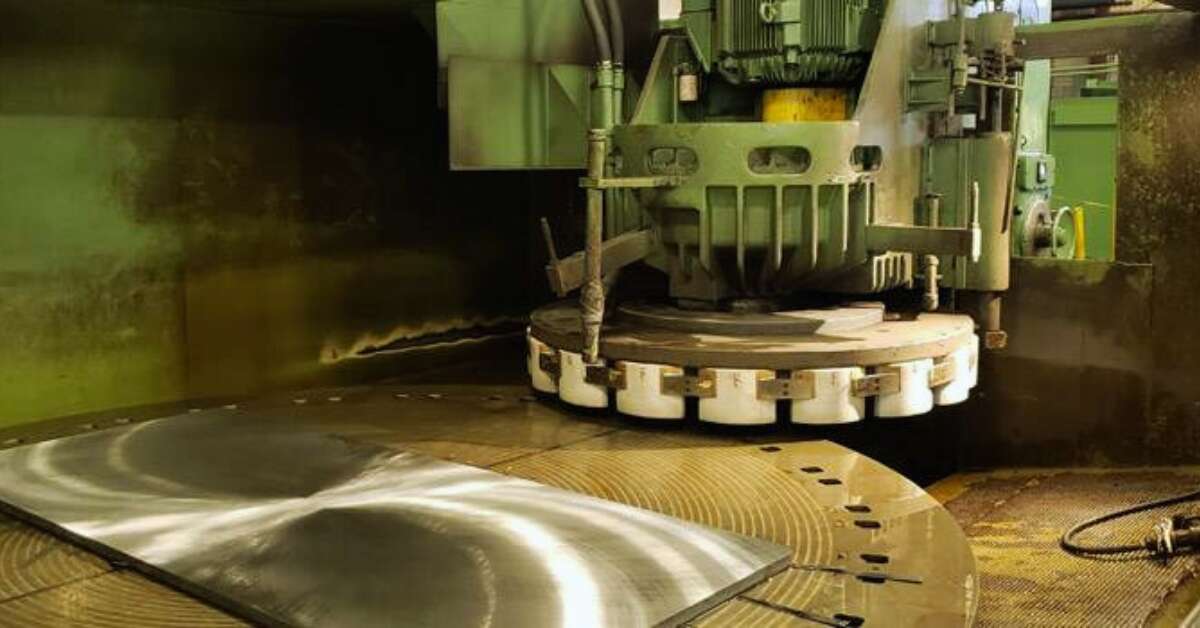
Blanchard grinding is a method of rotary surface grinding where the workpiece is placed on a rotating table, and the grinding wheel, mounted on a vertical spindle, is lowered onto it. This configuration allows for the simultaneous grinding of the entire surface of the workpiece. It is renowned for its high stock removal rates, ability to produce flat surfaces, and its characteristic cross-hatch grind pattern, which can enhance lubrication and chip evacuation in certain applications. It is a robust process well-suited for rough castings that require significant material removal.
How a Blanchard Grinder Works: The Vertical Spindle, Segmented Abrasive Wheel, and Magnetic Chuck
The core of a Blanchard grinder is its vertical spindle motor, which drives a large, typically segmented abrasive wheel. The workpiece is held securely on a powerful electromagnetic rotary chuck. As the chuck rotates the workpiece, the vertical spindle brings the grinding wheel down onto the surface. The dual rotation—of the workpiece table and the grinding wheel—creates the distinctive cross-hatch pattern and ensures efficient, uniform material removal across the entire surface. The magnetic chuck provides immense holding power while allowing for quick loading and unloading of parts, enhancing productivity.
Drives the segmented abrasive wheel downward onto the workpiece for aggressive, controlled material removal.
Large diameter wheel with abrasive segments for high stock removal and efficient chip evacuation.
Powerful electromagnetic rotary chuck secures workpieces without clamps, enabling quick load/unload cycles.
Key Advantages of the Blanchard Grinding Process for Castings
Blanchard grinding offers several distinct advantages that make it particularly well-suited for processing castings. Its ability to handle large, heavy, and irregularly shaped workpieces is paramount. The powerful magnetic chuck can securely hold ferrous castings of substantial weight. The aggressive stock removal capability means that even castings with significant surface irregularities or distortion can be quickly brought to a flat plane. Furthermore, the process naturally relieves surface stresses as material is removed uniformly, minimizing the potential for subsequent warping.
Achieves exceptional flatness across the entire surface, critical for mating components and sealing applications.
Rapidly removes significant material from rough castings, dramatically reducing processing time.
Produces parallel surfaces essential for components that must interface with other precision parts.
Uniform material removal naturally relieves surface stresses, minimizing potential for subsequent warping.
Handles large, heavy, and irregularly shaped castings that other grinding methods cannot accommodate.
Characteristic surface pattern enhances lubrication retention and chip evacuation in functional applications.
The "Unmatched" Factor: Precision Outcomes for Critical Casting Surfaces
The advantages of Blanchard grinding translate directly into superior outcomes for critical casting surfaces, ensuring that these foundational components meet the rigorous demands of modern manufacturing.
Consistently delivers castings that adhere to tight tolerances for flatness, parallelism, and dimensional accuracy.
Creates ideal surfaces ensuring proper contact, effective sealing, and optimal mechanical fit.
Establishes a true datum for subsequent machining, reducing iterative adjustments and errors.
Components that fit perfectly and maintain dimensional integrity experience less wear over time.
Meeting Rigorous Industry Specifications and Tight Tolerances
Many industries, including aerospace, automotive, and defense, have extremely demanding specifications for their components. Blanchard grinding is capable of meeting these rigorous requirements, consistently delivering castings that adhere to tight tolerances for flatness, parallelism, and dimensional accuracy. This reliability ensures that parts will function as intended and meet all performance criteria.
Ensuring Optimal Mating Surfaces, Sealing Integrity, and Mechanical Fit
For castings that form the interface between components, such as engine blocks, pump housings, or valve bodies, a perfectly flat and parallel surface is paramount. Blanchard grinding creates these ideal mating surfaces, ensuring proper contact, effective sealing, and optimal mechanical fit. This prevents leaks, reduces vibration, and guarantees the integrity of the assembled product.
Preparing Castings for Subsequent Machining and Finishing Operations
Achieving a precise, flat surface with Blanchard grinding serves as an excellent foundation for subsequent machining or finishing operations. It establishes a true datum that allows for more accurate machining of other features, reducing the need for iterative adjustments and improving the overall efficiency of the manufacturing process. It provides a predictable starting point, minimizing the risk of errors in downstream operations.
Enhancing Product Performance, Reliability, and Longevity Through Precision Grinding
Ultimately, the precision achieved through Blanchard grinding contributes directly to the enhanced performance, reliability, and longevity of the final product. Components that fit together perfectly, seal effectively, and maintain their dimensional integrity under stress will operate more efficiently and experience less wear. This translates to higher quality end products and greater customer satisfaction.
Applications and Industries Benefiting from Blanchard Ground Castings
The exceptional capabilities of Blanchard grinding lend themselves to a wide array of applications across numerous demanding industries where precision on cast components is non-negotiable.
Housings, structural components, mounting bases for mission-critical systems
Engine blocks, cylinder heads, transmission cases, brake system parts
Bases, platens, fixtures, precision mounting surfaces
Pump housings, valve bodies, mold plates for automotive panels
Precision components requiring highly accurate, flat surfaces
Aerospace and Defense Components: High-Precision, Mission-Critical Parts
In aerospace and defense, where component failure can have severe consequences, the precision of every part is critical. Blanchard grinding is used for housings, structural components, and mounting bases where absolute flatness and dimensional accuracy are required for the integrity and function of complex systems.
Automotive Components: Engine Blocks, Transmission Cases, Brake Systems
The automotive industry relies heavily on castings for components like engine blocks, cylinder heads, transmission cases, and brake system parts. Blanchard grinding ensures that the critical mating surfaces of these components are perfectly flat and parallel, crucial for sealing, efficient operation, and the overall performance and reliability of vehicles.
Machine Tool Equipment: Bases, Platens, Fixtures, and Precision Mounting Surfaces
The accuracy of machine tools themselves depends on the precision of their components. Blanchard grinding is extensively used for machine tool bases, platens, and fixture mounting surfaces. This ensures a stable, vibration-free platform for high-precision machining operations.
Industrial Applications: Pump Housings, Valve Bodies, Mold Plates
Many industrial machinery components, such as pump housings, valve bodies, and the large mold plates used for creating automotive panels, benefit from the precision offered by Blanchard grinding. These parts often require excellent sealing and precise fits for efficient operation.
Medical Devices and Other High-Precision Manufacturing Sectors
Even in sectors like medical devices, where materials and requirements can differ, Blanchard grinding is employed for precision components that may originate as castings. Any manufacturing sector demanding highly accurate, flat surfaces on cast metal parts can benefit.
Blanchard Grinding vs. Other Precision Grinding Methods for Castings
While various grinding methods exist, Blanchard grinding offers a unique combination of attributes that makes it the superior choice for many casting applications, particularly when compared to traditional surface grinding or double-disc grinding.
| Method | Stock Removal | Large Parts | Rough Castings | Best For |
|---|---|---|---|---|
| Blanchard Grinding | ✓ Excellent | ✓ Excellent | ✓ Ideal | Heavy castings, aggressive removal |
| Horizontal Surface Grinding | Moderate | Limited | Challenging | Precision finishing, smaller parts |
| Double Disc Grinding | Good | Limited | Not suitable | Parallel faces, simple geometries |
| Centerless Grinding | Good | N/A | N/A | Cylindrical parts only |
Standard Surface Grinding (Horizontal Spindle)
Traditional horizontal spindle surface grinders are excellent for producing flat surfaces but are often slower for heavy stock removal on large, rough castings compared to Blanchard grinding. The traversed motion can also lead to slight variations across a large workpiece. Blanchard's rotary action and vertical spindle generally offer faster material removal and more uniform results on the challenging surfaces of castings.
Double Disc Grinding
Double disc grinding is highly effective for producing parallel surfaces on smaller, simpler parts. However, it is typically limited to parts that can be fed between two opposing grinding wheels. Many castings, due to their size, shape, or the need to achieve flatness on a single primary surface rather than parallel faces, are not suitable for double disc grinding.
Other Methods
Other grinding methods like centerless grinding are designed for cylindrical parts. Methods that rely on delicate fixturing can struggle with the inherent stresses and potential distortions present in castings. Blanchard grinding's robust magnetic chuck system and aggressive, yet controlled, grinding action provide a more direct and efficient solution for the majority of flat-surface requirements on cast metal components.
Conclusion
Achieving unmatched flatness and dimensional accuracy on castings is not merely a desirable outcome; it is a critical requirement for the performance and reliability of countless products. The inherent challenges presented by raw cast surfaces—unevenness, internal stresses, and dimensional variability—demand a specialized approach. Blanchard grinding, with its vertical spindle rotary configuration, high stock removal capabilities, and ability to deliver exceptional flatness and parallelism, stands as the premier solution.
From the demanding environments of aerospace and automotive manufacturing to the precision requirements of machine tools and industrial equipment, Blanchard grinding ensures that critical casting surfaces are prepared to exact specifications. It provides the foundational precision necessary for optimal mating surfaces, effective sealing, and robust mechanical fit.
By selecting Blanchard grinding for your casting needs, you are investing in enhanced product performance, greater reliability, and ultimately, a superior end product. For manufacturers seeking to overcome the limitations of cast surfaces and achieve the highest levels of precision, Blanchard grinding offers an unparalleled path forward.

