
Abrasion Resistant Castings: How High-Chrome Iron Extends Equipment Life
Learn how high-chromium white cast iron, controlled heat treatment, balanced alloy chemistry, and application-specific casting design can extend wear-part life in demanding industrial equipment.
Abrasion resistant castings are engineered for equipment that repeatedly handles rock, sand, ore, clinker, coal, scrap, and other materials that grind away ordinary metal. The right casting can slow material loss, preserve the working profile of a wear part, and reduce how often crews must stop equipment for changeouts.
High-chromium white cast iron is one of the most important materials in this category, but it is not a universal answer for every severe-duty application. Its performance depends on alloy chemistry, carbide structure, heat treatment, casting quality, component geometry, and the balance between abrasion and impact in the actual machine.
This guide explains how high-chrome abrasion resistant castings work, where they provide value, and where a tougher material may be the better choice.
The Challenge of Industrial Wear and the Role of Abrasion Resistant Castings
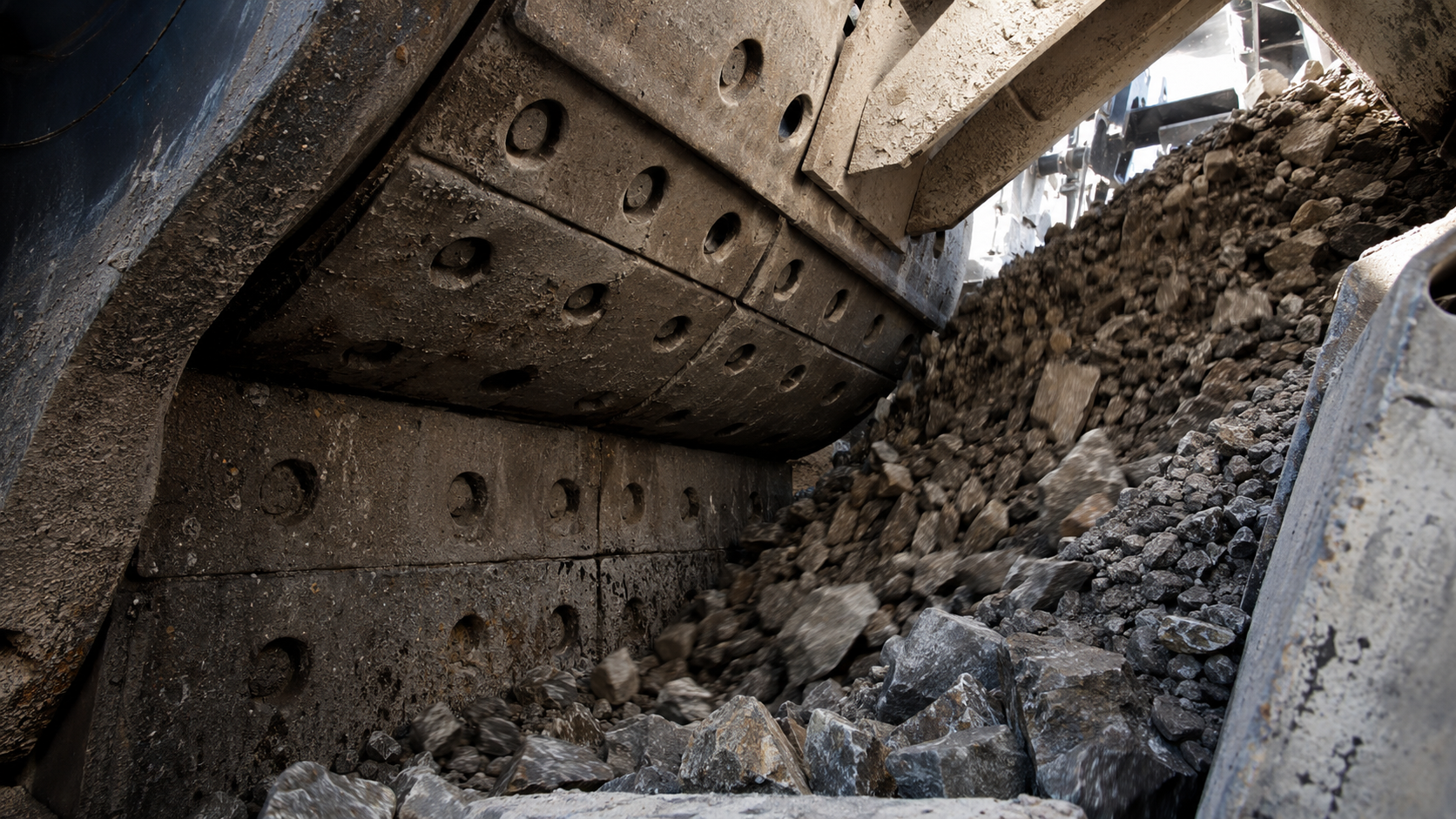
Industrial wear can occur in several ways, and the cause is not always obvious from the surface damage alone. Different components may experience very different wear conditions, even when they operate in the same plant.
Common Wear Conditions
Sliding Abrasion
Chute liners can gradually lose material as rock, sand, or ore moves continuously across the surface.
Abrasion and Impact
Crusher components may experience both cutting wear and repeated shock during operation.
Erosion and Corrosion
Slurry-handling parts can be damaged by suspended particles, fluid velocity, moisture, and corrosive materials.
Combined Wear Mechanisms
A single component may face several types of wear at the same time.
This is why hardness alone is not enough when selecting a wear material. A very hard casting may resist scratching but crack under heavy impact, while a tougher steel may absorb shock but wear quickly in a fine abrasive stream.
Abrasion resistant castings perform best when the alloy, component geometry, heat treatment, and production method are matched to the dominant wear conditions.
What Are Abrasion Resistant Castings?
Abrasion resistant castings are metal components made from specialised alloys that reduce wear caused by rubbing, cutting, gouging, and particle erosion.
Their cast shape makes them suitable for thick sections, complex profiles, internal features, bolt patterns, and replacement parts that would be difficult or wasteful to fabricate from plate.
Depending on the application, they may be produced from high-chromium white cast iron, manganese steel, alloy steel, gray iron, other white irons, or composite materials selected according to particle hardness, impact, temperature, corrosion, mounting, and expected failure mode.
For high-chrome work, ASTM International’s ASTM A532/A532M specification for abrasion-resistant cast irons is an important reference. It covers alloyed white cast irons intended for abrasive service in mining, milling, earth-handling, and manufacturing.
The specification also recognises that their microstructures may include carbides with martensite, bainite, austenite, or combinations of these phases. It distinguishes different casting and heat-treatment conditions rather than treating every high-chrome iron as the same material.
The real operational cost of wear is broader than the price of a replacement part. It can include maintenance labor, lifting and installation time, lost production, emergency freight, damage to nearby components, and inconsistent machine output as the wear profile changes.
Those costs vary too much by plant and asset to reduce them to one universal dollar figure, but the purchasing lesson is straightforward: the cheapest part is not always the lowest-cost part to run.
Understanding High-Chromium White Cast Iron
High-chromium white cast iron, often shortened to high-chrome iron, is a family of cast alloys developed for severe abrasive wear. Unlike gray cast iron, where much of the carbon appears as graphite, high-chrome white iron is designed so that carbon combines with chromium and iron to form hard carbide phases.
These carbides provide much of the alloy’s resistance to cutting and plowing. A surrounding metallic matrix supports them and influences hardness, crack resistance, and the way the part responds to impact.
This two-part structure is why a chemical analysis alone does not fully describe performance. Two castings with similar chromium percentages can behave differently if their carbon level, cooling rate, section thickness, heat treatment, or final microstructure is different.
Similar chromium percentages do not guarantee similar performance. Chemistry, cooling rate, section thickness, heat treatment, and final microstructure all matter.
Dews Foundry produces 15%, 25%, and 28% chrome iron wear parts and uses controlled heat treatment for components intended for high-abrasion service. Our foundry services include high-chrome castings, pattern work, heat treatment, grinding, and related capabilities for industrial replacement parts.
We report hardness levels of approximately 600 to 700 HB for selected high-abrasion parts, but hardness still has to be evaluated alongside application conditions and part design.
How Chromium, Carbon, Nickel, and Molybdenum Affect Performance
High-chrome iron relies on a controlled combination of alloying elements, carbide structure, and matrix development to resist abrasive wear. The final chemistry must be selected for the service conditions rather than judged by chromium content alone.
| Alloying Element or Factor | Primary Role | Key Considerations |
|---|---|---|
| Chromium | Promotes the formation of hard chromium-rich carbides, commonly M7C3 carbides, that help protect the surface from abrasive particles. | More chromium does not automatically produce better wear resistance. Performance also depends on carbon content, carbide distribution, solidification rate, and heat treatment. |
| Metallic Matrix | Supports the carbide structure and may contain martensite, retained austenite, bainite, or a mixture of these phases. | A matrix that is too soft may wear away and expose the carbides, while an overly brittle structure may increase cracking risk. |
| Carbon | Encourages carbide formation and can improve resistance to cutting and particle abrasion. | Higher carbon may reduce toughness and make the casting less tolerant of impact, bending, or stress concentrations. |
| Nickel | Helps control hardenability and stabilises austenite during cooling and heat treatment. | Its effect depends on the overall alloy composition and processing route. It does not automatically create both a harder and tougher matrix. |
| Molybdenum | Improves hardenability and can help thicker casting sections develop more consistent properties through the cross-section. | It may also contribute to carbide formation, but it does not guarantee improved corrosion resistance or high-temperature performance. |
| Other Alloying Elements | May support deoxidation, hardenability, carbide control, and casting behaviour. | Unnecessary alloy additions can create new problems, including excessive brittleness, poor heat-treatment response, or inconsistent properties. |
| Processing Conditions | Solidification rate, section thickness, cooling method, and heat treatment determine the final carbide and matrix structure. | Similar chemical compositions can produce different results if the castings are processed differently. |
The most effective high-chrome iron composition balances hardness, carbide support, toughness, and heat-treatment response. The alloy should be developed around the component geometry, expected impact level, section thickness, and operating environment rather than simply using the highest available chromium or carbon percentage.
The Metallurgical Edge Behind High-Chrome Wear Resistance
High-chrome abrasion resistant castings work because hard carbide phases and a controlled supporting matrix share the load. The carbides resist penetration and cutting, while the matrix supports the carbides and absorbs part of the stress placed on the surface.
That relationship is more useful than a simple “harder is better” explanation. If the matrix wears too quickly, carbides can become exposed and break away. If the matrix and carbide network are too brittle for the impact level, cracks can spread through the casting.
Good wear performance comes from a balanced microstructure that is suitable for the actual contact conditions, not from chasing the highest possible hardness number.
How Heat Treatment Changes the Matrix
The as-cast structure of high-chromium white iron varies with composition, section thickness, cooling rate, and alloy additions. It should not automatically be described as a soft mixture that always requires the same quench.
ASTM A532 recognises multiple delivery conditions, including as-cast, stress-relieved, hardened, hardened and stress-relieved, and softened for machining.
For many grades and applications, destabilisation heat treatment is used to modify the austenitic matrix. During controlled heating, secondary carbides can precipitate from the austenite.
The reduced alloy content of the remaining austenite can then make it more capable of transforming during cooling, often producing a harder martensitic matrix with some retained austenite. A subsequent stress-relief or tempering step may be used when required by the alloy and specification.
Time, temperature, cooling method, furnace loading, and section thickness all affect the result. An aggressive treatment that raises hardness is not automatically successful if it also creates excessive residual stress or cracking risk.
Heat treatment must be developed around the grade, casting geometry, and target properties.
How Wear Still Occurs
High-chrome iron does not make a surface immune to abrasion. It slows material loss under suitable conditions. Abrasive particles may still remove matrix material, score the surface, crack carbides, cause local spalling, or loosen carbides until they pull away.
Wear can accelerate when the part experiences:
- Oversized or unusually hard feed
- Tramp metal or unpredictable impact
- Poor alignment or uneven loading
- Localised stress around bolt holes or sharp transitions
- Incorrect clearances or installation
- Corrosive slurry conditions
- Excessive operating temperature
- A heat-treatment or chemistry mismatch
- Casting defects or insufficient section support
The practical advantage of high-chrome iron is that its carbide-rich structure can reduce cutting and plowing when abrasion is the dominant problem. It is less convincing when the part must bend, absorb extreme shock, or survive frequent high-energy impact.
From Raw Material to a Reliable High-Chrome Casting
Producing dependable abrasion resistant castings requires control from the drawing review through final inspection. A foundry cannot reliably select a wear alloy from the part name alone.
The process begins by defining the part’s dimensions, alloy requirements, service conditions, machining allowance, mounting features, and acceptance criteria.
Charge materials and ferroalloys are selected to reach the required composition. The melt must be controlled for chemistry, temperature, cleanliness, and pouring behaviour.
The mould, gating, and risering system must then deliver metal to the casting without creating avoidable shrinkage, misruns, inclusions, or hot spots.
Cooling behaviour is especially important in high-chrome iron because section thickness and solidification rate influence carbide formation and the as-cast matrix. A thick section and a thin edge do not necessarily cool or respond to heat treatment in the same way.
Pattern design, machining stock, fillets, transitions, and feeding strategy all contribute to the final result.

Casting, Heat Treatment, and Finishing
Once the metal has solidified, the casting is removed from the mould and cleaned. Gates, risers, and excess material are removed before the part moves through any required heat treatment, grinding, or machining operations.
High-chrome iron is difficult to machine after hardening, so the production sequence matters. Some castings may require softened-for-machining conditions, carefully planned machining allowance, grinding, or the use of cast-in features that reduce later material removal.
The drawing should identify which dimensions are critical and which surfaces can remain as-cast.
We support custom patterns, high-chrome casting, controlled heat treatment, Blanchard grinding, and machining for industrial components. Keeping these operations coordinated can reduce handoffs and help the finished part maintain the dimensions, hardness, and fit required by the equipment.
Quality Control Must Match the Specification
Quality control is not a fixed battery of tests performed identically on every casting. The inspection plan should be based on the drawing, customer requirements, alloy, geometry, defect risk, and service criticality.
Common Quality Controls
- Chemical analysis to verify alloy composition
- Hardness testing after heat treatment
- Visual inspection for surface defects
- Dimensional inspection against the drawing or pattern
- Verification of bolt holes, mounting faces, bores, or critical profiles
- Magnetic particle, liquid penetrant, ultrasonic, or radiographic examination when appropriate
- Metallographic evaluation for qualification, troubleshooting, or process validation
- Documentation of heat-treatment and inspection results when required
Visual inspection cannot confirm hidden internal soundness, and ultrasonic testing is not automatically suitable for every casting geometry or microstructure. The method must be chosen for the defect type that needs to be detected.
The goal is not to claim that every part is flawless. It is to confirm that the casting meets the agreed material, dimensional, and acceptance requirements.
Need a High-Chrome Casting Evaluated?
Send Dews Foundry your drawing, sample, equipment model, or wear history so the alloy, casting process, heat treatment, and finishing requirements can be reviewed.
Discuss Your Casting RequirementsThe Operational Value of Abrasion Resistant Castings
The main benefit of abrasion resistant castings is not an impressive hardness number. It is useful wear life in the machine.
A well-matched component can hold its profile longer, reduce replacement frequency, and help the equipment maintain more consistent performance between maintenance intervals.
That can create value in several ways:
- Fewer planned or unplanned wear-part changeouts
- Less labor spent removing and installing components
- Lower exposure to lifting, confined-space, and maintenance hazards
- Reduced emergency freight and rush-order pressure
- More predictable maintenance scheduling
- Better dimensional stability at critical wear surfaces
- Lower cost per processed ton when service life improves enough to offset the purchase price
These outcomes are possible, not automatic. A high-chrome component that cracks early because the impact level was underestimated may cost more than a lower-hardness but tougher alternative.
Total cost should be judged using service hours, tons processed, replacement labor, downtime, collateral damage, and consistency of output.
The hardest alloy on a quote sheet is not automatically the smartest purchase. A technically honest supplier should be willing to say when high-chrome iron is a poor fit.
High-chrome parts can be particularly effective where sliding, grinding, or particle abrasion dominates and impact is moderate and controlled.
Manganese steel may be more appropriate where repeated impact and gouging are severe enough to activate work hardening. Abrasion-resistant steel plate can make more sense when a component must be formed, welded, repaired in place, or incorporated into a larger fabricated structure.
For a broader comparison of these options, see our guide to abrasion resistant steel for industrial wear parts .
Where High-Chrome Abrasion Resistant Castings Are Used
High-chrome abrasion resistant castings are widely associated with mining, aggregate, recycling, cement, mineral processing, and bulk material handling.
However, the application list should remain specific. Saying that high-chrome iron suits every crusher, mill, pump, or ground-engaging tool ignores differences in impact, stress, and equipment design.
Mining, Aggregate, Recycling, and Other Industrial Uses
In aggregate and mineral processing, high-chrome parts are often suited to selected impact-crusher and material-flow components that face severe abrasion with manageable impact.
Our aggregate and mining crusher wear parts include parts for vertical shaft impactors and horizontal shaft impactors, such as anvils, impellers, table liners, feed components, blow bars, curtain liners, side liners, and rotor shoes.
The company also produces sand-washer paddles, log-washer flights, and chute liners.
Crusher and Impact Components
Selected anvils, impellers, table liners, feed components, blow bars, curtain liners, side liners, and rotor shoes.
Material Transfer Systems
Chute liners, transfer-point liners, wear blocks, guides, and protective cast sections.
Slurry and Separation Equipment
Selected pump casings, impellers, throat components, classifiers, and separator wear parts designed for the alloy.
Washing and Recycling Equipment
Sand-washer paddles, log-washer flights, and selected shredder or impact parts with controlled loading.
These are stronger examples than treating high-chrome iron as the standard material for every jaw plate or mill liner. Conventional jaw crusher plates commonly require the toughness and work-hardening behaviour of manganese steel.
Mill liners may be made from alloy steel, rubber, composites, or high-chrome materials depending on impact energy, mill design, ore characteristics, and operating conditions.
Other Components That May Use High-Chrome Castings
- Chute and transfer-point liners
- Selected hammer and impact components
- Slurry pump casings, impellers, or throat components designed for the alloy
- Classifier and separator wear parts
- Sand and log washer components
- Recycling shredder or impact parts with controlled loading
- Replaceable wear blocks and protective cast sections
The correct high-chrome grade should be selected using operating data rather than copied from another application. Feed size, moisture, silica content, contaminants, speed, throughput, and past failure patterns can all affect performance.
Cement, mineral-processing, coal, and ash systems may use high-chrome castings in selected crushers, grinders, conveyors, pulverisers, pipes, nozzles, and liners where abrasion or erosion is the main concern.
Abrasion resistant castings are also used in brick and clay processing, steel production, recycling, and other manufacturing operations for components such as augers, paddles, rolls, guides, and transfer parts.
Oil, gas, and slurry-handling applications require closer review because pressure, corrosion, suspended solids, and erosion may act together. Chemical compatibility, impact, mounting stress, and fracture risk should always be assessed before selecting high-chrome iron.
When Another Wear Material Is Better
High-chrome iron offers strong abrasive-wear resistance, but its limited tolerance for bending, welding, and severe unpredictable impact makes it the wrong choice for some components.
High-chrome iron may be the wrong choice when the component must:
- Absorb severe or unpredictable impact
- Bend or flex during service
- Be welded into an assembly
- Be formed from plate
- Tolerate large stress concentrations
- Be repaired repeatedly by welding
- Survive major thermal shock
- Provide structural toughness rather than primarily resist surface wear
- Operate in a corrosive environment not supported by the selected alloy
Manganese steel, alloy steel, abrasion-resistant plate, hardfacing, rubber, ceramics, or composite wear materials may offer a better balance in those conditions.
In some equipment, the strongest solution combines materials, using a tough backing structure with a hard replaceable wear surface.
Choosing Abrasion Resistant Castings for Long-Term Performance
Abrasion resistant castings can extend service life and make maintenance more predictable when the alloy and part design suit the operating environment.
High-chromium white cast iron performs through the combined effect of hard chromium-rich carbides and a controlled metallic matrix, not hardness or chromium content alone.
Selection should consider wear type, impact, geometry, temperature, corrosion, machining, and replacement cost, with success measured by service hours, tons processed, profile retention, or cost per ton.
Dews Foundry manufactures high-chrome abrasion resistant castings for crusher, aggregate, recycling, and industrial applications, supported by pattern work, heat treatment, grinding, fabrication, and machining capabilities.
The goal is not to specify the hardest possible casting. It is to produce a wear part that fits correctly, survives the expected loading, wears predictably, and delivers better value over its service life.
Find the Right Wear Material for Your Equipment
Send us a drawing, sample, equipment model, or description of your wear problem so the material and production route can be evaluated against the real operating conditions.
Contact our team now
