
Jaw Crusher Wear Parts Explained: What They Are and Why They Matter
Learn how jaw dies, cheek plates, material selection, feed conditions, and maintenance practices affect crusher performance and wear life.
Jaw crusher wear parts directly affect how well a crusher grips feed, maintains its crushing chamber profile, and produces material at the required size. When jaw plates or cheek plates wear unevenly, an operation may see lower output, inconsistent gradation, more plugging, and avoidable maintenance work.
This guide covers the main jaw crusher wear parts, their functions, common materials, signs of wear, and practical ways to extend service life. It also separates direct wear indicators from broader symptoms that require diagnosis.
What Are Jaw Crusher Wear Parts?
A jaw crusher reduces rock, ore, recycled concrete, and other hard materials by compressing them between two jaw dies. One jaw is fixed, while the other moves toward and away from it. Together, they form a V-shaped crushing chamber that narrows toward the discharge opening.
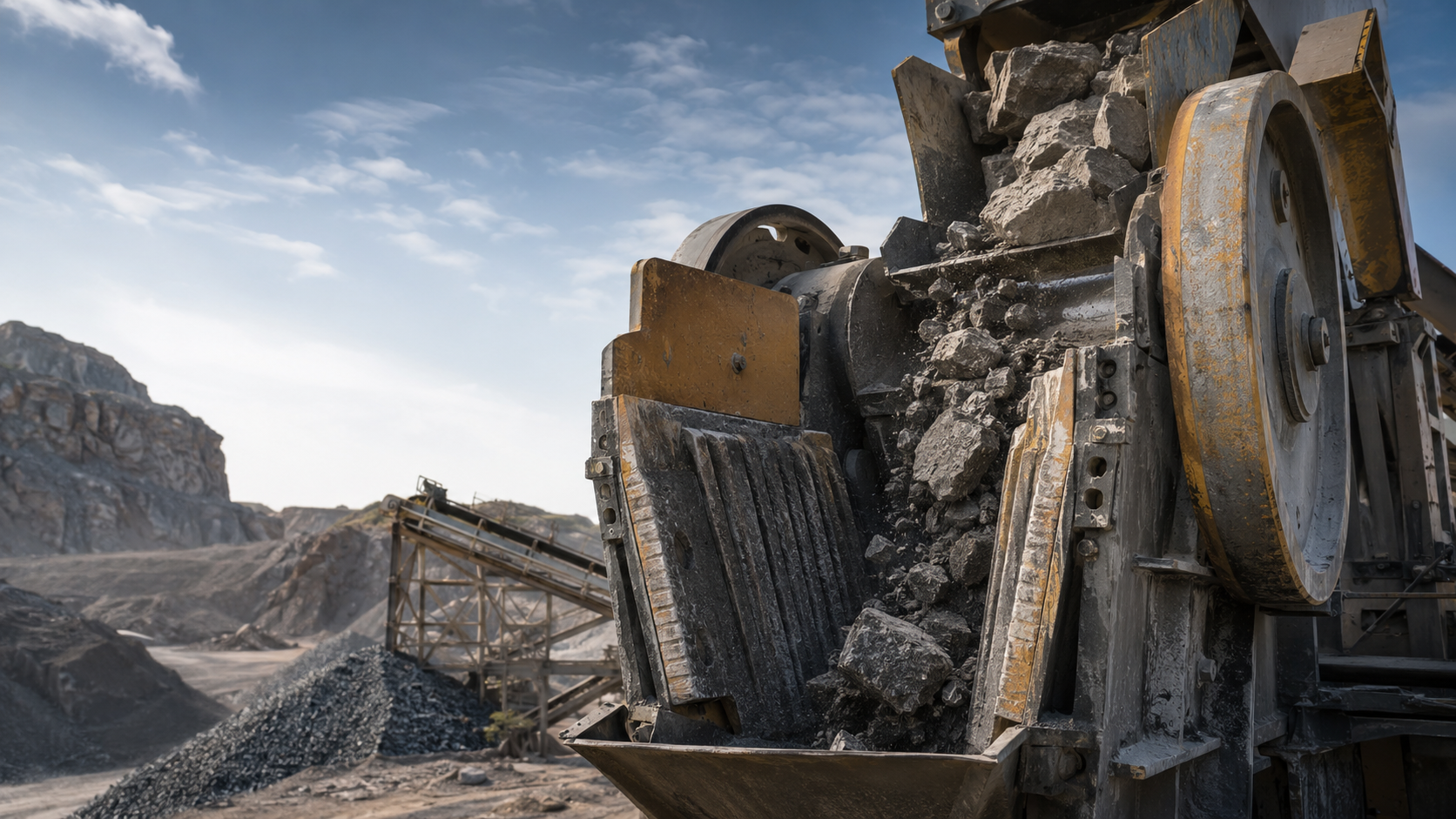
Jaw crusher wear parts are the replaceable components exposed to repeated contact with the feed material. The main material-contact parts are the fixed jaw die, moving jaw die, and cheek plates. Their jobs are not identical because the jaw dies perform the crushing, while the cheek plates protect the sides of the chamber from abrasion.
These parts gradually lose thickness and profile during service. Normal wear is expected, but cracking, looseness, rapid profile loss, or heavy wear on only one side requires investigation.
The toggle plate is often discussed alongside jaw crusher wear parts, but it should be classified more carefully. It transfers force within the crusher mechanism and may serve as an overload-protection component on certain designs. It is not one of the principal surfaces that crushes or contains the feed material.
Its exact function, inspection limits, and replacement procedure depend on the crusher model.
A replaceable wear part should not be operated until it breaks. Excessive wear can damage seating surfaces, fasteners, backing components, or structural areas.
Primary Jaw Crusher Wear Parts and Their Functions
The exact assembly varies by manufacturer and model, but most jaw crushers rely on several primary wear and retaining components.
| Component | Main Function | What to Inspect |
|---|---|---|
| Fixed jaw die | Provides the stationary crushing surface. | Tooth or corrugation loss, cracks, thinning, uneven wear, looseness, and damaged seating areas. |
| Moving jaw die | Compresses feed against the fixed jaw and helps move material through the chamber. | Worn profiles, deformation, cracks, excessive lower-chamber wear, loose wedges, and abnormal wear patterns. |
| Cheek plates | Protect the side walls of the crushing chamber. | Thinning, gouging, cracks, loose hardware, exposed protected surfaces, and uneven side wear. |
| Wedges, bolts, and retaining hardware | Hold jaw dies in their intended position. | Looseness, deformation, damaged threads, poor seating, and movement marks. |
| Backing or protection plates | Protect selected surfaces behind or around the primary wear components. | Distortion, cracking, wear-through, debris buildup, and fit problems. |
| Toggle-system components | Transfer motion and force and may provide overload protection, depending on the design. | Wear at contact points, cracks, incorrect seating, and condition limits stated in the OEM manual. |
Jaw dies, also called jaw plates, are the most important jaw crusher wear parts because their profile grips and compresses the feed. The fixed and moving jaw dies work as a pair, so their geometry affects how material enters, breaks, and exits the chamber.
A jaw die may still look substantial after its working profile has become ineffective. Rounded teeth reduce grip, lower-section wear changes the chamber shape, and uneven wear can leave part of the plate underused. Visual checks should be supported by measurements and earlier inspection records.
Jaw dies may be manufactured as one-piece or multi-piece assemblies. Some are reversible or rotatable, while others are not.
Cheek Plates Protect the Chamber SidesCheek plates line the sides of the crushing chamber and protect machine surfaces from abrasive feed. Uneven wear, especially on one side, can indicate off-center feeding, material segregation, chamber-loading problems, or poor component fit. Replacing the plate without correcting the cause may lead to the same wear pattern again.
Toggle Plates Require Model-Specific GuidanceOn many traditional jaw crusher designs, the toggle plate helps transfer crushing force and may be designed to fail or release under certain overload conditions. Other machines use hydraulic relief, chamber-clearing systems, or different protection arrangements.
The toggle plate should not be described as a universal sacrificial wear liner. Operators should follow the specific crusher manual for inspection, adjustment, and replacement because a procedure that is correct for one jaw crusher may be wrong or unsafe for another.
Why Jaw Crusher Wear Parts Matter
Jaw crusher wear parts influence more than the date of the next maintenance shutdown. They affect chamber geometry, feed grip, product size, equipment protection, and the cost of producing each ton.
Productivity and Crushing Consistency
Jaw crushers rely on the correct chamber shape to grip and reduce feed efficiently. Worn jaw profiles can lower throughput, increase oversized material, and cause more plugging. Replacing worn parts helps restore chamber geometry, but performance also depends on feed conditions, crusher settings, and equipment condition.
If production falls after a feed-source change, replacing parts without checking the material may waste money. If feed, settings, and operating conditions remain stable, wear becomes a stronger suspect.
Machine Protection and Service Reliability
Jaw dies crush material while protecting the surfaces behind them. Cheek plates and backing plates shield other areas from abrasive contact. Excessive wear or loose hardware can damage the crusher and create unsafe operating conditions.
We support demanding aggregate applications through its aggregate and mineral crusher parts capabilities, including wear components for abrasive and high-impact crushing environments. The correct part still has to match the crusher type, application, and dominant wear mechanism.
Maintenance Cost and Cost Per Ton
Purchase price is only one part of wear-part cost. A cheaper jaw plate may be poor value if it wears rapidly, requires extra shutdowns, creates inconsistent output, or damages related components. A more expensive plate is not automatically better either. It still needs the correct alloy, profile, dimensions, and installation.
Our view is simple: judge jaw crusher wear parts by safe service life and cost per ton, not by the invoice alone. That means tracking operating hours, tons processed, changeout labour, downtime, product quality, and the reason each part was removed.
Specific records also improve supplier discussions. “The lower moving jaw lost its profile after a recorded tonnage while the fixed jaw showed lighter wear” is more useful than “the plate did not last.”
Materials Used for Jaw Crusher Wear Parts
Material selection should balance abrasion resistance, toughness, work-hardening behavior, feed conditions, and crusher design. The hardest available material is not automatically the best choice.
Austenitic Manganese Steel
Austenitic manganese steel is common for jaw dies because it is tough and hardens under repeated impact. This makes it suitable for primary crushing with large, irregular feed. However, low-impact applications may not provide enough loading for the material to harden effectively.
Manganese grade alone does not determine wear life. Jaw profile, casting quality, heat treatment, fit, feed distribution, abrasiveness, and crusher settings also influence performance.
Alloy Steel and Composite Designs
Alloy steel can be used where crusher parts need a different balance of hardness, strength, and toughness. The exact grade and heat treatment must match the operating load and failure risk. Composite jaws may add harder inserts to high-wear areas, but they are application-specific rather than universal replacements for manganese steel.
Harder materials can resist abrasion more effectively, but greater hardness may reduce tolerance for severe shock. Material selection should therefore begin with the feed conditions and failure history, not a hardness number alone.
How to Select the Right MaterialBefore ordering jaw crusher wear parts, review the following operating and equipment factors:
- Rock or ore type
- Abrasiveness and silica content
- Feed top size and gradation
- Impact severity
- Moisture and clay content
- Closed-side setting
- Desired product size
- Existing wear pattern
- History of cracking, deformation, or rapid profile loss
- Crusher make, model, and chamber design
- Required fit, dimensions, and fastening arrangement
Our foundry services include pattern work, controlled heat treatment, grinding, and wear-part manufacturing capabilities for mining, aggregate, recycling, and other heavy industries.

Signs It Is Time to Replace Jaw Crusher Wear Parts
Replacement decisions should be based on component condition, measured wear, manufacturer limits, and operating data. One symptom by itself does not always prove that the jaw plates are the cause.
Direct signs that jaw crusher wear parts need immediate review include:
- Cracks, broken sections, or missing material
- Loose jaw dies, cheek plates, wedges, or fasteners
- Jaw teeth or corrugations worn close to the base profile
- Plate thickness approaching the OEM or supplier limit
- Severe scalloping, gouging, or deformation
- Wear-through that begins exposing protected areas
- Uneven wear that significantly changes chamber geometry
- Damaged seating surfaces or evidence that the plate has moved
Some operating symptoms can be related to worn jaw crusher wear parts but also have other causes:
- Lower tons per hour
- Oversized or inconsistent discharge
- Increased recirculating load
- More frequent chamber plugging
- Higher power draw
- New vibration or abnormal noise
- Difficulty maintaining the intended closed-side setting
Treat these symptoms as diagnostic triggers, not automatic proof. Wet or sticky feed can cause plugging, oversized feed can block the opening, and a feeder can load one side of the chamber. Mechanical faults can also create vibration, while incorrect crusher settings may change product size even when the jaw plates remain usable.
Compare component condition with feed changes, operating hours, power, gradation, and crusher settings. Our crusher wear parts inspection guide explains how to connect visible wear with output and maintenance data.
Any cracked, loose, displaced, or severely damaged part should be handled according to the site’s safety procedures and the equipment manufacturer’s instructions.
Need Help Evaluating Crusher Wear?
Discuss your crusher model, feed conditions, wear patterns, and replacement requirements with the Dews Foundry team.
Contact us todayHow to Maximize Jaw Crusher Wear Part Life
Longer service life usually comes from controlling the entire crushing process, not from buying a harder plate and hoping for the best.
Inspect and Measure on a Consistent Schedule
Create an inspection interval based on operating hours, material abrasiveness, duty cycle, and the rate at which the parts have worn in the past. High-wear applications may need more frequent checks than operations processing less abrasive feed.
Record the condition of the fixed jaw, moving jaw, cheek plates, wedges, bolts, backing components, and seating areas. Take photographs from consistent positions and measure the same reference points to establish a usable wear rate.
Do not rely only on a calendar. A crusher processing a new deposit, harder rock, or more abrasive feed may wear faster even when operating hours remain the same.
Control Feed Size and Distribution
Poor feeding can waste usable jaw material. Oversized rock may bridge across the opening, while excessive fines can pack the chamber or pass through without contributing useful crushing work. Off-center feed can also wear one side faster than the other.
McLanahan’s best practices for feeding jaw crushers recommend aligning the feeder with the crusher opening, removing oversize and unnecessary fines, maintaining effective chamber use, and supplying consistent, well-graded feed.
Its guidance also uses a feed top-size rule of thumb based on approximately 80 percent of the crusher opening, although the applicable limit should always be confirmed for the specific machine.
Feed control is one of the most practical ways to improve the use of jaw crusher wear parts. A premium plate cannot correct a feeder that constantly dumps material against one side of the chamber.
Match the jaw profile to the application.Jaw profiles differ in tooth spacing, height, angle, thickness, and overall chamber geometry. A profile intended for abrasive quarry rock may not be the right choice for recycled concrete, slabby feed, or a different closed-side setting.
The design should promote grip, material flow, and even wear without unnecessarily restricting the chamber.
When reviewing a profile, consider the actual feed rather than the material name alone. “Granite” does not describe top size, fines content, slab shape, moisture, or the way the feeder presents the rock to the crusher.
Rotate, Install, and Maintain Parts Safely
Some one-piece and multi-piece jaw dies are designed to be rotated or reversed so that a less-worn section can be moved into a higher-wear zone. Others have model-specific positions, lifting points, or replacement sequences.
Follow the OEM procedure. Confirm that the plate design is reversible, determine the correct wear point for rotation, use approved lifting equipment, and inspect wedges, bolts, backing, and seating surfaces during the change.
Rotating too late may leave too little usable profile to gain meaningful life. Rotating a plate that is cracked, distorted, or outside its dimensional limit can create a larger problem.
Maintain settings, hardware, and seating surfaces.Jaw crusher wear parts must fit correctly and remain secure. Loose wedges, incorrect bolt tension, damaged backing, debris behind a plate, or worn seating surfaces can allow movement and accelerate damage.
Check the closed-side setting using the approved method because wear can change the effective discharge opening. If the setting drifts, product size and load can change even before the plate appears fully worn.
During replacement, clean and inspect the mounting areas. A new jaw die cannot correct a damaged or contaminated seating surface.
Use safe, model-specific maintenance procedures.Jaw dies and cheek plates are heavy components installed inside hazardous machinery. Inspection and replacement require proper isolation, lockout/tagout, stored-energy control, chamber access procedures, lifting plans, and tools rated for the component.
The OEM manual takes priority over generic blog advice. Maintenance teams should confirm lifting points, plate weight, changeout sequence, bolt requirements, torque procedures, and the condition of mechanical or hydraulic support systems before work begins.
Extending wear life is never worth bypassing a safe changeout. A part that lasts longer can reduce maintenance exposure, but only when it remains serviceable and is handled correctly.
Practical Example: Aggregate Quarry Operations
Consider a quarry where jaw crusher output has declined and the product contains more oversized material. The easy conclusion is that the jaw plates are worn and need replacement. That may be true, but a useful diagnosis goes further.
The team should confirm changes in feed source, moisture, top size, gradation, feeder alignment, closed-side setting, and operating hours. After isolating the machine, it can compare jaw profiles, measure high-wear zones, inspect cheek plates, and check whether one side carries more load.
Suppose the lower moving jaw is heavily rounded while the opposite side retains much more profile. Installing new jaw crusher wear parts may restore the chamber temporarily, but the uneven pattern suggests that feed presentation or chamber loading also needs correction. Without fixing the cause, the replacement set may develop the same pattern.
Wear parts are evidence. Their condition shows not only that material has passed through the crusher, but also how that material moved through it.
The best maintenance decision uses the worn component, production data, and operating changes together.
Conclusion: The Critical Role of Jaw Crusher Wear Parts
Jaw crusher wear parts help maintain crushing geometry, protect selected machine surfaces, control product size, and support predictable maintenance. The fixed jaw die, moving jaw die, and cheek plates deserve routine inspection because their wear patterns can reveal both normal service conditions and developing operating problems.
Choose jaw crusher wear parts according to feed characteristics, impact, abrasion, chamber design, and documented failure history. Measure wear instead of guessing, correct poor feed distribution, maintain the intended settings, and rotate plates only when the design and OEM procedure allow it.
The strongest wear-part program does not chase the hardest alloy or the lowest purchase price. It selects the right component, tracks how it performs, and replaces it before wear creates avoidable damage or unsafe conditions.
Discuss Your Crusher Wear Part Requirements
Contact Dews Foundry to discuss your crusher model, material conditions, casting requirements, and existing wear challenges.
Request a consultation today
