
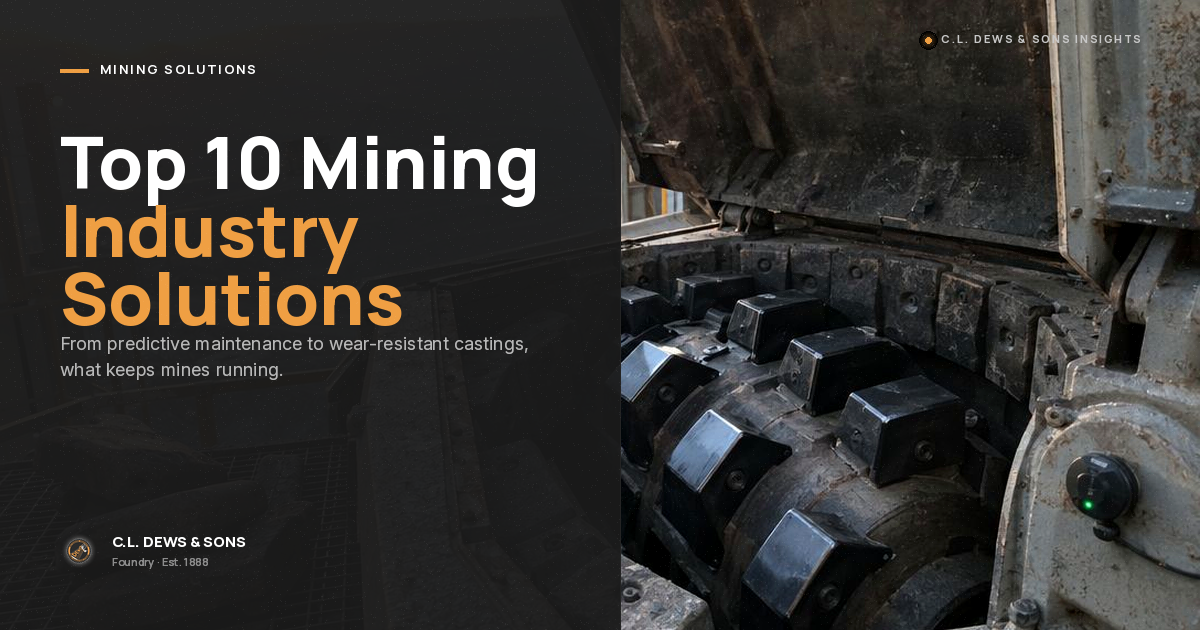
Top 10 Mining Industry Solutions Improving Modern Operations
From predictive maintenance and autonomous equipment to wear-resistant components and machining support, modern mining operations rely on a combination of technology, materials and maintenance strategies.
The mining sector is undergoing a major transformation as new technologies and strategies optimize efficiency, sustainability, and profitability. Today, mining industry solutions incorporate automation, artificial intelligence, advanced materials, equipment monitoring, and more sustainable operating practices to address changing operational demands.
To stay ahead, mining companies are embracing innovations such as AI-powered predictive maintenance, real-time data analytics, and advanced material processing. Machine shop services also play a crucial role in ensuring equipment longevity and operational efficiency. Let’s explore 10 solutions shaping modern mining operations.

1. AI and Machine Learning for Predictive Maintenance
Artificial intelligence (AI) is enhancing equipment longevity by predicting failures before they occur. AI-assisted condition monitoring and predictive maintenance can help mining operations identify developing equipment problems earlier and plan maintenance more effectively. The National Institute for Occupational Safety and Health (NIOSH) identifies AI, sensors, automation, and data analytics among the emerging technologies being applied and studied in mining.
Key Benefits:
- Helps reduce unscheduled breakdowns
- Can support longer machinery service life
- Can improve safety by identifying certain equipment problems earlier
2. Autonomous Mining Equipment
Automation has revolutionized mining operations, reducing the need for human intervention in hazardous conditions. Companies like Caterpillar and Komatsu are deploying autonomous trucks and drills that improve efficiency and reduce operational costs.
Advantages:
- Can reduce worker exposure to certain hazardous equipment interactions
- Can support more consistent equipment utilization
- May improve operating efficiency when properly implemented
Autonomous systems still require careful management of communications, human-machine interaction, operating conditions, and safety controls. NIOSH notes that automation can remove workers from some hazardous environments while also introducing new safety considerations.
3. Digital Twin Technology
Digital twins create virtual replicas of mines that simulate real-time scenarios, allowing engineers to test different operational strategies. This technology improves decision-making by analyzing geological data and optimizing production processes.
Applications:
- Predictive maintenance modeling
- Resource allocation optimization
- Environmental impact assessment
4. Sustainable Mining Solutions
With stricter environmental regulations, sustainable mining practices are critical for long-term success. Companies are investing in low-impact extraction methods and renewable energy to power mining sites.
Innovations in Sustainable Mining:
- Water recycling systems to reduce consumption
- Carbon capture technology to offset emissions
- Solar and wind energy to power mining operations
Mining companies are also evaluating renewable electricity, energy efficiency, water management, and other measures as part of broader efforts to manage environmental impacts.
5. Real-Time Data Analytics & IoT Integration
The Internet of Things (IoT) and real-time analytics allow companies to monitor operations continuously. Connected sensors and monitoring systems can provide operational data that supports equipment maintenance, hazard awareness, asset tracking, and production management.
IoT Applications in Mining:
- Remote equipment monitoring
- Automated hazard detection
- Supply chain optimization
6. Advanced Material Processing Technologies
Innovative material processing solutions are improving ore recovery rates and reducing waste. High-pressure grinding rolls (HPGRs) and sensor-based sorting are among the top technologies transforming material processing.
Benefits:
- Can reduce comminution energy requirements or downstream processing loads in suitable applications
- Can improve recovery or separation performance depending on ore characteristics and process design
- Can help reduce waste or unnecessary processing in suitable applications
7. Blockchain for Supply Chain Transparency
Blockchain technology can support supply chain transparency, traceability, and recordkeeping across mineral supply chains. Where appropriate systems and data controls are in place, companies may use distributed records to track materials from extraction through later supply-chain stages.
Key Advantages:
- Enhances security and traceability
- Reduces disputes over material origins
- Can support responsible-sourcing and compliance documentation
8. High-Performance Wear-Resistant Materials
The introduction of wear-resistant alloys and composite materials extends the lifespan of mining equipment. Material selection is particularly important in applications exposed to abrasion, impact, or combinations of both, and the appropriate alloy or wear material depends on the specific operating conditions.
For crushing and material-processing equipment, wear-resistant crusher components can help manage wear in components exposed to abrasive material flow. Dews Foundry produces high-chrome cast iron wear parts for mining and aggregate applications, including components for VSI and HSI crushers.

Applications:
- Crusher anvils, impellers, liners, and rotor shoes
- Wear components for abrasive material handling
- Replacement castings selected for specific operating conditions
9. Robotics for Ore Extraction and Processing
Mining robotics are improving efficiency by automating extraction and material handling processes. Robotic drills, loaders, and haul trucks are being used to support remote or automated operations, particularly where reducing worker exposure to hazardous equipment interactions is beneficial.
How Robotics Improve Mining:
- Enables remote-controlled operations in hazardous areas
- Can improve consistency and operational precision
- Can reduce worker exposure to certain equipment-related hazards
10. Machine Shop Services for Equipment Longevity
Reliable machine shop support can help mining operations repair, reproduce, or replace components when equipment wear or damage affects production. Machine shop services provide:
- Custom fabrication of replacement parts
- CNC machining for precision components
- Machining and repair capabilities for industrial components
Depending on the component, equipment condition, and repair requirements, these services can help limit downtime and support continued equipment operation.
Impact of Mining Industry Solutions on Operations
| Solution | Key Benefit | Primary Operational Role |
|---|---|---|
| AI Predictive Maintenance | Reduces downtime, extends lifespan | Identifies potential equipment problems and supports maintenance planning |
| Autonomous Equipment | 24/7 operation, enhanced safety | Supports remote or automated equipment operation |
| Digital Twin Technology | Optimized decision-making | Simulation, modeling, and operational planning |
| Sustainable Mining Solutions | Lowers environmental impact | Supports energy, water, and environmental management |
| IoT & Data Analytics | Real-time monitoring | Collects operational and equipment-condition data |
| Advanced Material Processing | Higher ore recovery, less waste | Supports mineral separation and processing efficiency |
| Blockchain for Transparency | Ensures ethical sourcing | Supports traceability and supply-chain recordkeeping |
| Wear-Resistant Materials | Extends equipment lifespan | Manages abrasion and component wear |
| Robotics for Mining | Reduces labor costs, improves safety | Supports remote and automated equipment functions |
| Machine Shop Services | Minimizes equipment downtime | Supports repair and replacement-component needs |
The Future of Control Systems in the Mining Industry
As the mining industry continues to evolve, the future of control systems is poised to be dramatically transformed by advancements in digital solutions and automation technologies. These innovations can enhance process efficiency and provide mining customers with greater oversight and control over their operations.
Future control systems will leverage artificial intelligence (AI), machine learning, and the Internet of Things (IoT) to create smarter, more responsive environments that can adapt to dynamic market conditions and operational challenges.
The integration of autonomous systems can support increasingly automated process control and remote monitoring and management of mining equipment and operations. Depending on the application, these systems may improve resource allocation and reduce worker exposure to certain manual or hazardous activities.
Enhanced data analytics will provide mining customers with real-time insights into equipment performance, enabling proactive maintenance and helping reduce unplanned downtime and support operational efficiency.
Moreover, the focus on sustainable practices will drive the development of control systems that prioritize environmental stewardship. Advanced process control technologies can support more precise resource extraction and waste management while helping operators monitor environmental performance and regulatory requirements.
As mining companies increasingly adopt these digital solutions, control systems are likely to remain an important part of improving operational visibility and managing increasingly connected mining environments.
Integrated Logistics Optimization
As mining operations become more data-driven, streamlining logistics and transportation management is crucial for reducing costs and increasing responsiveness. Transportation management, shipment visibility, and freight-management systems can help mining businesses coordinate material movement and monitor supply-chain activity across different transport modes.
Where systems are compatible, integration with operational and control technologies can provide better visibility across transportation and logistics activities.
The Future of Regulatory Compliance Solutions in the Mining Industry
As regulatory demands grow more complex, the future of compliance solutions in the mining industry will center around the integration of advanced digital technologies to streamline processes and support adherence to environmental and safety standards. Digital monitoring, data analytics, and reporting systems can improve data collection, recordkeeping, and visibility, but they do not replace an operator’s responsibility to meet applicable regulatory requirements.
With the increasing scrutiny from regulatory bodies, mining operations can use real-time monitoring and reporting systems to track relevant operational data and identify potential compliance issues.
By utilizing integrated digital solutions, mining companies can adapt quickly to changing regulations and market conditions, while maintaining clearer records and operational visibility.
Furthermore, as sustainability becomes a central focus for many stakeholders, regulatory compliance solutions will also need to address environmental, social, and governance (ESG) criteria. Digital tools can support data collection and transparency for sustainability reporting, subject to the reporting standards, data quality, and requirements applicable to each operation.
By embracing appropriate compliance solutions, the mining industry can enhance process control, mitigate risks, and build trust with regulators and the communities in which they operate.
The Future of Mining Industry Solutions
Modern mining industry solutions span digital technologies, equipment automation, mineral processing, wear management, maintenance, and environmental controls. The right mix depends on the operation, equipment, materials being processed, safety requirements, regulatory obligations, and maintenance challenges.
For operations dealing with abrasive crushing and material-processing environments, Dews Foundry provides foundry services, crusher wear parts, and machining capabilities for mining and aggregate applications. Selecting appropriate materials and maintenance support for the actual operating conditions can help operators manage component wear and equipment availability without relying on one solution for every application.
Need Wear Parts for Mining or Aggregate Equipment?
Explore Dews Foundry’s wear-resistant crusher components for demanding mining and aggregate applications.
Contact us today
